
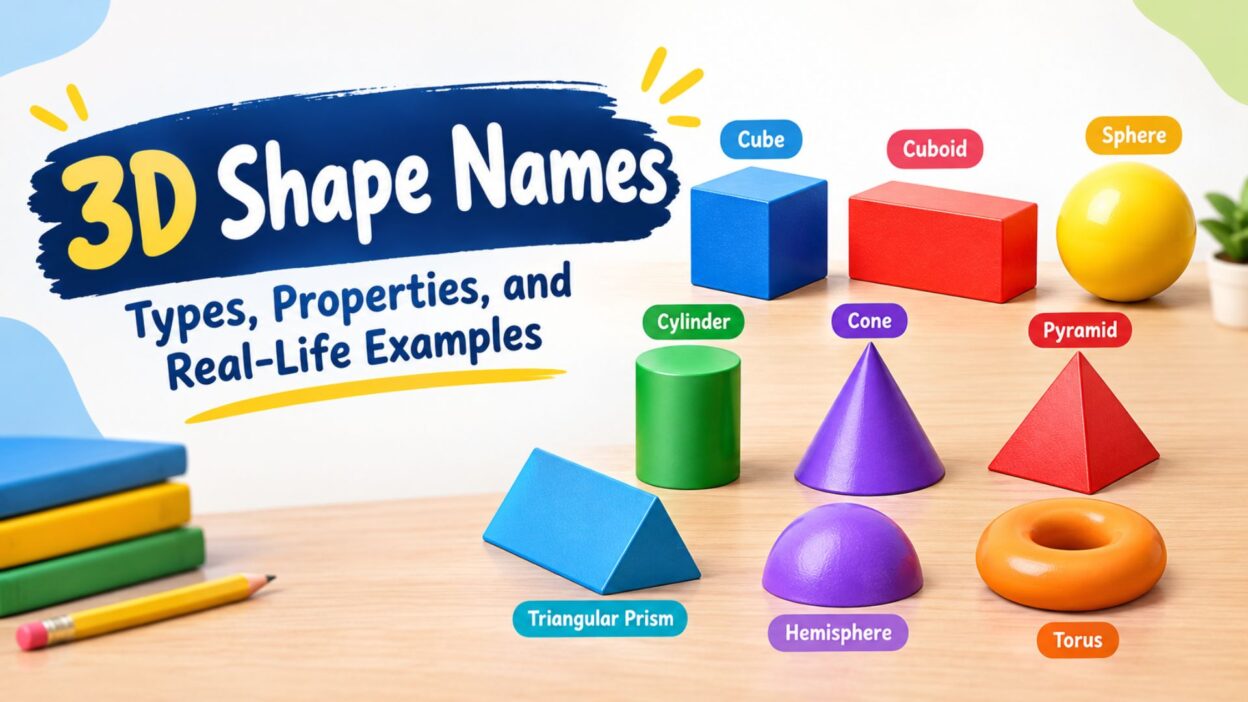
3D shape names help students recognize the solid objects they see at school, at home, and in everyday life. Unlike flat 2D shapes, three-dimensional shapes have length, width, and height. As a result, they take up space and have volume.
Some common examples are cubes, spheres, cones, cylinders, cuboids, and pyramids. You can find these shapes in dice, balls, cans, boxes, and many other everyday objects. In addition, geometry includes less familiar shapes, such as triangular prisms, tetrahedrons, octahedrons, and dodecahedrons.
Learning these names becomes easier when you connect each shape to a real object. Therefore, this guide explains common and advanced 3D shapes, their features, and their uses. You will also learn about faces, edges, and vertices. By the end, you will understand how to tell different solid shapes apart and remember their names more easily.
What Are 3D Shapes?
A 3D shape is a solid object with three dimensions: length, width, and height. Because it has these dimensions, it occupies space and has volume. For example, a ball is round, while a box has flat sides and sharp corners.
There are two main groups of 3D shapes:
- Polyhedra: These solids have flat faces made from polygons. Cubes, cuboids, and pyramids are common examples.
- Curved solids: These shapes have curved surfaces. Spheres, cones, and cylinders belong to this group.
Some solids have both flat and curved surfaces. For instance, a cylinder has two flat circular ends and one curved surface. Similarly, a cone has a flat circular base and a curved surface that meets at one point.
Understanding these groups makes it easier to learn 3D shape names and their features.
Common 3D Shape Names
The following shapes are among the most important ones to learn. Each has its own structure, properties, and real-life examples.
Cube
A cube has six equal square faces. It also has 12 edges and eight vertices. Since all its faces are the same size, a cube looks like a perfectly even box.
Real-life examples: Dice, some gift boxes, and cube-shaped building blocks.
Cuboid (Rectangular Prism)
A cuboid has six rectangular faces, 12 edges, and eight vertices. Unlike a cube, its length, width, and height do not need to be equal.
For example, a shoebox is usually shaped like a cuboid. Books, bricks, and many storage boxes have a similar shape as well.
Sphere
A sphere is completely round, with no flat faces, straight edges, or vertices. Every point on its surface is the same distance from its center.
Real-life examples: Balls, marbles, and many round decorative objects. However, real balls may not be perfect spheres.
Cylinder
A cylinder has two equal circular bases and one curved surface. It has no vertices. In basic school geometry, the two circular boundaries are often counted as edges.
Real-life examples: Tin cans, drinking glasses, pipes, and some candles.
Cone
A cone has one circular base and a curved surface. Its surface narrows toward a single point called the apex. In basic geometry, the circular boundary is counted as one edge.
Real-life examples: Party hats, traffic cones, and ice cream cones.
Pyramid
A pyramid has a polygon-shaped base and triangular side faces that meet at one point. The name of a pyramid depends on the shape of its base.
For example, a square pyramid has a square base and four triangular side faces. A triangular pyramid, also called a tetrahedron when all its faces are triangles, has a triangular base.
Real-life examples: Pyramid models, decorative ornaments, and some roof designs.
Triangular Prism
A triangular prism has two equal triangular bases joined by three rectangular side faces. It has five faces, nine edges, and six vertices.
Real-life examples: Some tent designs, triangular packaging, and Toblerone-style chocolate boxes.
Hemisphere
A hemisphere is half of a sphere. It has one flat circular face and one curved surface.
Real-life examples: Some dome-shaped structures, half-sphere bowls, and certain decorative objects.
Torus
A torus is a ring-shaped solid, similar to a doughnut. Its surface curves around a central hole.
Real-life examples: Doughnut-shaped objects, some rings, and inflatable swimming rings.
3D Shapes Names and Properties
Knowing the names is a good start. However, understanding each shape’s properties helps you identify it more accurately.
The table below shows the basic properties of common 3D shapes.
3D ShapeFlat FacesEdgesVerticesCube6128Cuboid6128Sphere000Cylinder22 curved boundaries0Cone11 curved boundary1Square pyramid585Triangular prism596Tetrahedron464Octahedron8126Dodecahedron123020Icosahedron203012
Important note: Schools may use different rules when counting edges on curved solids. In this table, the cylinder’s circular boundaries and the cone’s circular boundary are listed separately from straight edges. Always follow the definition used by your teacher or textbook.
As you study the table, notice that a cube and a cuboid share the same number of faces, edges, and vertices. Their main difference is the shape and size of their faces. In contrast, a sphere has no flat faces or corners.
More 3D Shapes and Their Names
Beyond the basic solids, geometry includes many other shapes. These are useful in advanced schoolwork, engineering, design, and mathematics.
Prism Names
A prism has two equal, parallel bases connected by side faces. The name of the prism comes from the shape of its base.
Common prism names include:
- Triangular prism: Has triangular bases.
- Square prism: Has square bases.
- Pentagonal prism: Has five-sided bases.
- Hexagonal prism: Has six-sided bases.
- Heptagonal prism: Has seven-sided bases.
- Octagonal prism: Has eight-sided bases.
- Nonagonal prism: Has nine-sided bases.
- Decagonal prism: Has ten-sided bases.
For example, a triangular prism has two triangular bases. Meanwhile, a hexagonal prism has two six-sided bases. The number of sides in the base helps you identify the correct name.
Pyramid Names
A pyramid has one base, while its triangular side faces meet at a shared point. As with prisms, its name depends on the base.
Here are some common types:
- Triangular pyramid: Has a triangular base.
- Square pyramid: Has a square base.
- Pentagonal pyramid: Has a five-sided base.
- Hexagonal pyramid: Has a six-sided base.
- Octagonal pyramid: Has an eight-sided base.
To identify a pyramid, first look at its base. Then count the sides of that base. This simple method helps you choose the correct name.
Polyhedra and Special Solids
A polyhedron is a solid made entirely of flat polygon faces. Cubes and pyramids are familiar examples. However, geometry also includes several special polyhedra.
- Tetrahedron: A solid with four triangular faces.
- Octahedron: A solid with eight triangular faces.
- Dodecahedron: A solid with 12 pentagonal faces in its regular form.
- Icosahedron: A solid with 20 triangular faces in its regular form.
- Truncated icosahedron: A solid with a mix of pentagonal and hexagonal faces, similar to the pattern on a traditional football.
The five regular convex polyhedra are the tetrahedron, cube, octahedron, dodecahedron, and icosahedron. They are known as the five Platonic solids. Each one has identical regular polygon faces, and the same arrangement of faces occurs at every vertex.
Other Curved and Rounded Solids
Some 3D shapes do not fit neatly into the basic groups. Nevertheless, learning their names can help you describe more complex objects.
- Ellipsoid: An oval-shaped solid that resembles a stretched or flattened sphere.
- Oblique cylinder: A cylinder whose side is tilted rather than perpendicular to its base.
- Oblique cone: A cone whose apex is not directly above the center of its base.
- Frustum: The part of a cone or pyramid left after its top is cut off by a plane parallel to the base.
- Elliptical cylinder: A cylinder with an oval-shaped base.
- Hemisphere: Half of a sphere.
These shapes appear in design, architecture, manufacturing, and technical drawings. For everyday learning, however, the cube, cuboid, sphere, cylinder, cone, and pyramid are the best ones to master first.
Difference Between 2D and 3D Shapes
The main difference between 2D and 3D shapes is the number of dimensions they have. A 2D shape is flat, while a 3D shape has depth and occupies space.
Feature2D Shapes3D ShapesDimensionsLength and widthLength, width, and heightStructureFlatSolidVolumeNo volumeHas volumeExamplesCircle, square, triangleSphere, cube, coneCommon measurementsArea and perimeterVolume and surface area
For example, a circle is a flat shape. A sphere, on the other hand, is a round solid. Although they may look similar in a drawing, they are different in geometry.
Likewise, a square has four equal sides, while a cube has six square faces. A square can be drawn on paper, but a cube takes up space.
Therefore, remember this simple rule: 2D shapes are flat, whereas 3D shapes are solid.
Faces, Edges, and Vertices Explained
Faces, edges, and vertices are important parts of many 3D shapes. Once you understand these terms, identifying solid shapes becomes much easier.
What Is a Face?
A face is a flat surface on a 3D shape. For instance, a cube has six square faces, and a cuboid has six rectangular faces.
However, some shapes also have curved surfaces. In basic geometry, these are usually described as curved surfaces rather than flat faces.
What Is an Edge?
An edge is where two faces meet. A cube has 12 straight edges, while a triangular prism has nine.
Curved solids need a little extra care. For example, the circular boundary between a cylinder’s flat base and curved surface may be called a curved edge in school materials.
What Is a Vertex?
A vertex is a corner where edges meet. The plural form is vertices.
A cube has eight vertices, and a square pyramid has five. In contrast, a sphere has no vertices because it has no corners.
Here is an easy way to remember these terms:
- Faces: The flat surfaces.
- Edges: The lines or boundaries where surfaces meet.
- Vertices: The corners.
Try counting these features on a box or a building block. Seeing them in a real object can make the definitions easier to remember.
Real-Life Examples of 3D Shapes
You can find 3D shapes almost everywhere. In fact, everyday objects are a simple way to practise geometry.
Everyday ObjectRelated 3D ShapeWhy It FitsDiceCubeIt has six equal square faces.ShoeboxCuboidIt has a rectangular box shape.BallSphereIts surface is round.Tin canCylinderIt has two circular ends and a curved side.Party hatConeIt narrows toward one point.Pyramid modelSquare pyramidIt has a square base and triangular sides.Triangular packageTriangular prismIt has two triangular ends.DoughnutTorusIt has a ring-like form.DomeHemisphere-like shapeIt resembles half of a sphere.Hexagonal pencilHexagonal prismIts cross-section has six sides.
Keep in mind that real objects are not always perfect geometric shapes. For example, a football may have seams and a slightly different surface, while a can may have a rim. Even so, these objects are useful examples because their overall forms resemble familiar solids.
How to Identify an Unknown 3D Shape
If you are unsure about a shape’s name, follow a few simple steps. This method works well for homework, classroom activities, and basic geometry tests.
- Look at the surfaces: Are they flat, curved, or a mixture of both?
- Check the base: Is it circular, triangular, square, or another polygon?
- Count the corners: A shape with pointed corners may be a cube, prism, or pyramid.
- Examine the side faces: Rectangular side faces may suggest a prism, while triangular faces meeting at one point suggest a pyramid.
- Compare its features: Count the faces, edges, and vertices when possible.
For example, a triangular prism has two triangular ends and rectangular side faces. A cone, however, has one circular base and a curved surface that narrows to an apex. Although both may look wider at one end, their structures are different.
With regular practice, you will recognize these features more quickly. You can also draw each shape and label its parts to improve your understanding.
Frequently Asked Questions About 3D Shape Names
What are the most common 3D shape names?
The most common 3D shape names are cube, cuboid, sphere, cylinder, cone, prism, and pyramid. Students usually learn these shapes first because they appear in everyday objects.
How many 3D shapes are there?
There is no single fixed number of 3D shapes. Geometry includes infinitely many possible solid shapes, from simple cubes and spheres to complex solids with many faces and curves.
What are the five Platonic solids?
The five Platonic solids are the tetrahedron, cube, octahedron, dodecahedron, and icosahedron. Each has regular polygon faces arranged in the same way at every vertex.
Is a cylinder a 3D shape?
Yes, a cylinder is a 3D shape because it has length, width, and height. It has two circular bases and one curved surface.
What is the difference between a cube and a cuboid?
A cube has six equal square faces. A cuboid also has six faces, but its faces are generally rectangles and its length, width, and height may differ.
What is the difference between a cone and a pyramid?
A cone has a circular base and a curved surface that meets at an apex. In comparison, a pyramid has a polygon-shaped base and flat triangular side faces that meet at an apex.
Which 3D shapes can roll?
A sphere can roll in different directions because its surface is curved. A cylinder can roll along its curved surface, while a cone can roll along a curved path. A cube usually slides or tumbles instead.
What are faces, edges, and vertices?
Faces are the flat surfaces of a solid, edges are where surfaces meet, and vertices are corners where edges meet. These features help you describe and compare many 3D shapes.
Conclusion
Learning 3D shape names helps you understand geometry and recognize the objects around you. Start with the cube, cuboid, sphere, cylinder, cone, prism, and pyramid. Then, learn their faces, edges, vertices, and other properties.
You can make learning easier by connecting each shape to a familiar object. For example, a dice resembles a cube, a can resembles a cylinder, and a ball resembles a sphere. In addition, practising with drawings and simple objects will help you remember the names.
Once you understand the basic shapes, move on to prisms, special polyhedra, and curved solids. With regular practice, you will be able to identify different 3D shapes and explain their features with confidence.