
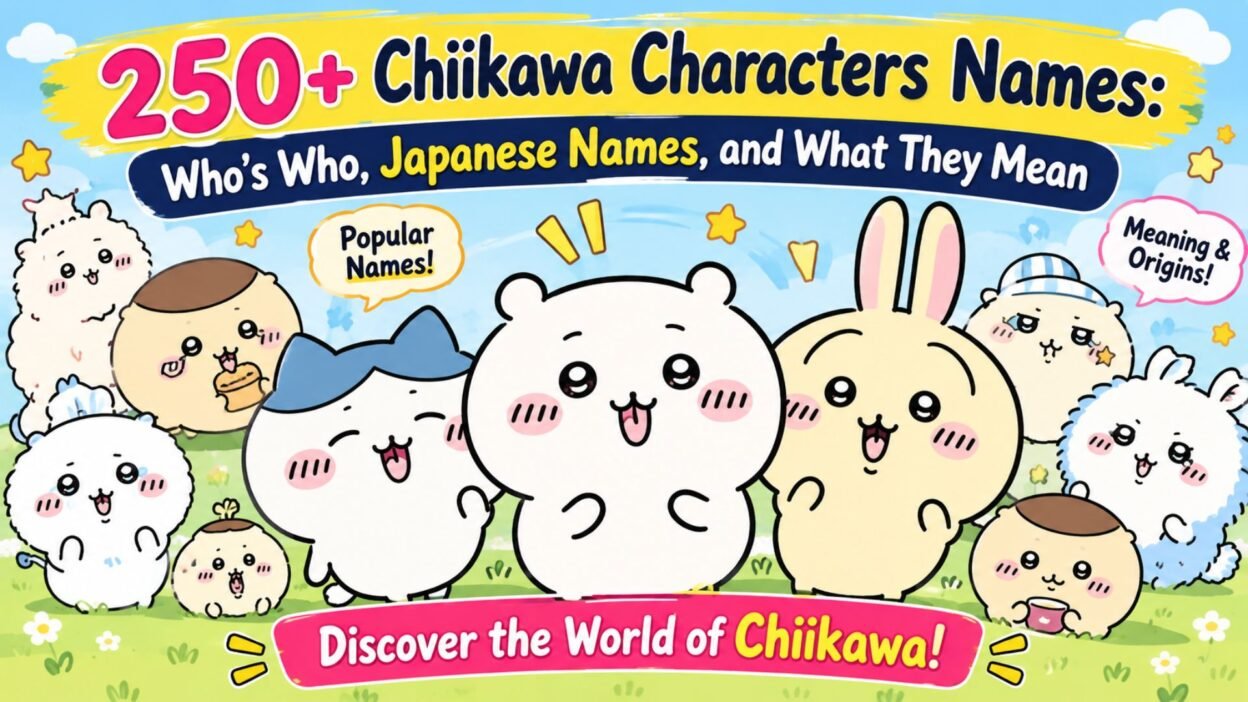
Chiikawa looks simple at first glance, but the cast grows quickly once you start watching or reading. Tiny creatures, armored workers, monsters, and faceless performing groups all share the same world. As a result, many newcomers struggle to remember who is who.
This guide to Chiikawa characters names sorts the cast into clear groups. You will meet the main trio first, then the supporting animals, the Yoroi-san, and the Pajama Parties. Along the way, you will find Japanese spellings, name meanings, common alternate spellings, and easy pronunciation tips.
The series is still running, so new faces can appear at any time. For the latest roster, the official Chiikawa website is the best place to check.
Where the Name “Chiikawa” Comes From
Before the individual characters, it helps to understand the series title. Chiikawa began as a webcomic by the illustrator Nagano, and the full Japanese title is ちいかわ なんか小さくてかわいいやつ.
The longer phrase, “Nanka Chiisakute Kawaii Yatsu,” translates roughly as “something small and cute.” In other words, the name describes the character instead of naming a person. That playful, casual style carries through the rest of the cast, because many names simply say what the character is or does.
The Main Trio
Three friends sit at the center of the story. Chiikawa, Hachiware, and Usagi appear most often, and they dominate the merchandise too.
Chiikawa (ちいかわ)
The title character is small, gentle, and sensitive. Chiikawa cries often and is kind to everyone. Surprisingly, nobody can say for sure which animal Chiikawa is supposed to be, so fans enjoy debating the answer.
Chiikawa rarely speaks in full sentences. Instead, the character relies on short sounds and expressive faces, and the other characters understand them anyway. Typical sounds are child-like ways of saying no in Japanese.
Hachiware (ハチワレ)
Hachiware is the communicator of the group. He is the only one of the three leads who speaks human language fluently, though he sometimes mispronounces words. Because of that, he often translates for Chiikawa and Usagi.
His name refers to a coat pattern. The two-tone split on his head resembles the number eight, and “hachi” is the Japanese word for eight. Most fans describe him as a cat.
In battle, Hachiware wields a blue wand and trains under Rakko to get stronger. He has also passed the fifth-grade weed-pulling test.
Usagi (うさぎ)
Usagi is the chaotic, energetic member of the trio. The name is simply the Japanese word for rabbit. Like Chiikawa, Usagi doesn’t speak in sentences, but the sounds are distinctive. Usagi communicates through noises such as “yaha” and “ura.”
Usagi is fearless and often leads the way. Still, a running joke persists: Chiikawa and Hachiware have no idea where Usagi actually lives. Meanwhile, Usagi holds a level-three weed-pulling certification.
Their Original Names
Early in development, the trio had different names. Chiikawa, Hachiware, and Usagi were first called Nitori, Ikeya, and Donki, respectively. These early names rarely come up today. Nevertheless, they offer a fun glimpse at how the characters evolved.
Supporting Characters
A handful of animal characters appear again and again beside the trio. Each has a clear personality, a job, or a quirk that makes the name easy to remember.
Momonga (モモンガ)
The name is the Japanese word for flying squirrel. Momonga often acts cute to get what it wants, and it copies other characters’ cute behavior, especially Chiikawa’s. Fans also describe Momonga as naughty, playful, and something of a diva.
Because of that, Momonga often causes trouble. Even so, the character has loyal friends, including Furuhonya.
Rakko (ラッコ)
Rakko means sea otter. This character is a hero in the eyes of the others. Rakko is the top-ranked monster hunter, yet loves sweet desserts and is very kind.
The serious exterior hides a soft side. As a result, fans often call Rakko their favorite “cool but cute” character.
Kurimanju (くりまんじゅう)
Kurimanju takes its name from kurimanju, a Japanese chestnut-bun sweet. The character is calm and a little mature in spirit.
Kurimanju holds a drinking license and often appears with snacks and drinks in hand. Even so, the character is kind and shares food with Chiikawa and friends.
Shisa (シーサー)
Shisa draws on Okinawan culture. The design is inspired by the lion-like guardian figures of the Ryukyu islands, and Shisa is a hard worker. The character assists at the ramen shop “Rou,” working under Ramen no Yoroi-san.
Some websites spell the name “Shisha,” but “Shisa” is the standard spelling.
Furuhonya (古本屋)
The name means used bookshop, which tells you the character’s job. Furuhonya is a kindhearted bookworm who buys and sells secondhand books and is friends with Momonga.
Interestingly, Furuhonya began as a faceless background figure. The design was revealed after Momonga placed a crab headband on the character. As a result, the author subtitles the name Kani, meaning crab, and fans often call this character Kani or Kani-chan.
The Yoroi-san (Armored Characters)
“Yoroi” means armor, and the Yoroi-san are the armor-wearing figures of the series. Some of the small creatures take jobs assigned by the Yoroi-san, such as weeding and monster hunting, and hunting can be dangerous. Names tend to follow each character’s job, so guessing what each one does is easy.
- Pochette no Yoroi-san (ポシェットの鎧さん) — A knight who loves cute things and sells handmade pouches and the pajamas worn by the Pajama Parties.
- Roudou no Yoroi-san (労働の鎧さん) — “Roudou” means labor. This was the first Yoroi-san to appear in the manga, and it mainly runs the work reception desk. The tone is blunt, but the character cares about others.
- Ramen no Yoroi-san (ラーメンの鎧さん) — The owner of the ramen shop “Rou.” The character seems rough and unapproachable but is very kind underneath.
The Pajama Parties (パジャマパーティー)
This group differs from the others, because it doesn’t act as individual named characters. The Pajama Parties are faceless characters who sing and dance in pajamas handmade by Pochette no Yoroi-san. They perform at concerts and events within the Chiikawa world.
Think of them as a small performing crew. Their matching outfits help you identify them quickly.
Quick Role Guide
Sometimes it helps to remember characters by what they do. This short list connects names to roles.
- Chiikawa — The sensitive lead and emotional center of the story.
- Hachiware — The talker who translates for the group.
- Usagi — The fast, fearless troublemaker.
- Momonga — The attention-seeking diva.
- Rakko — The top hunter and reliable role model.
- Kurimanju — The calm, snack-loving older friend.
- Shisa — The hard-working ramen shop assistant.
- Furuhonya — The kind bookseller and friend of Momonga.
Spelling Variations You Will See Online
Because the names are romanized from Japanese, spellings vary across websites, merchandise, and fan wikis. Knowing the common variants helps when you search.
- Kurimanju — Also written Kuri-Manju, Kuri-Manjuu, or Kuri-Manjū.
- Pochette no Yoroi-san — Also spelled Ponchette or Pouchette.
- Roudou no Yoroi-san — Also spelled Rodo or Rōdō no Yoroi-san.
- Ramen no Yoroi-san — Sometimes shortened to Ramen Yoroi-san.
- Furuhonya — Often shown as Kani or Kani-chan.
- Shisa — Occasionally spelled Shisha.
When in doubt, follow the spellings used in official English materials.
How to Pronounce the Main Names
You don’t need perfect Japanese to say these names well. Each syllable gets roughly equal weight, and vowels stay short and clear. The respellings below are approximate.
- Chiikawa — chee-ee-kah-wah
- Hachiware — hah-chee-wah-reh
- Usagi — oo-sah-gee
- Momonga — moh-mohn-gah
- Rakko — rahk-koh
- Kurimanju — koo-ree-mahn-joo
- Shisa — shee-sah
- Furuhonya — foo-roo-hohn-yah
For the long vowel in “Chiikawa,” hold the “ee” sound a little longer. Also, the double “k” in Rakko creates a brief pause before the next syllable.
Patterns Behind the Names
Once you see the logic, the cast gets much easier to remember. Most names fall into three groups.
First, many characters carry their animal’s name. Usagi means rabbit, Momonga means flying squirrel, and Rakko means sea otter. Second, a few names borrow from food or culture, such as Kurimanju and Shisa. Finally, the Yoroi-san take their names from their work, so the job appears right in the title.
This system also explains why new characters often feel instantly familiar. If a name sounds like an animal, a snack, or a job, it probably is one.
Chiikawa Characters in Games and Collaborations
Many of these characters now appear well beyond the original comic. A mobile game launched in 2025 lets players choose characters such as Chiikawa, Hachiware, Usagi, Momonga, Shisa, Kurimanju, and Rakko. In addition, Chiikawa characters dressed as Santa Claus in an animated music video for Ariana Grande’s “Santa Tell Me.”
These appearances show how recognizable the main characters have become. Therefore, learning the names pays off whether you read the manga, watch the anime, or collect merchandise.
Frequently Asked Questions
Who are the main Chiikawa characters?
The main characters are Chiikawa, Hachiware, and Usagi. Momonga, Rakko, Kurimanju, and Shisa form the next most visible group.
What does the name Chiikawa mean?
It is short for a phrase meaning “something small and cute.” As a result, the name describes the character instead of naming a person.
What animal is Chiikawa?
Nobody knows for sure. The series never clearly states it, so fans interpret Chiikawa in different ways.
Which Chiikawa character can talk?
Hachiware speaks fluently and often translates for the others. Meanwhile, Chiikawa and Usagi communicate mostly through sounds and expressions.
What are Yoroi-san?
Yoroi-san are armored figures who run shops and hand out work in the Chiikawa world. The word yoroi means armor.
Why do fans call Furuhonya “Kani”?
The author’s subtitle uses Kani, meaning crab, because of the crab-style headband Momonga gave this character. The official name remains Furuhonya.
Why are some Chiikawa names spelled differently?
Japanese names are romanized in several ways. Fan sites and merchandise often choose different spellings, but the characters stay the same.
Did the main characters have other names before?
Yes. Chiikawa, Hachiware, and Usagi were first called Nitori, Ikeya, and Donki. Those early names no longer appear in the main story.
Conclusion
Chiikawa characters names make far more sense once you group them. The main trio carries the story, the supporting animals add personality, and the Yoroi-san keep the world running. Most names also hint at an animal, a food, or a job, which makes them easier to remember. Because the series keeps growing, check the official website from time to time to meet newer faces.