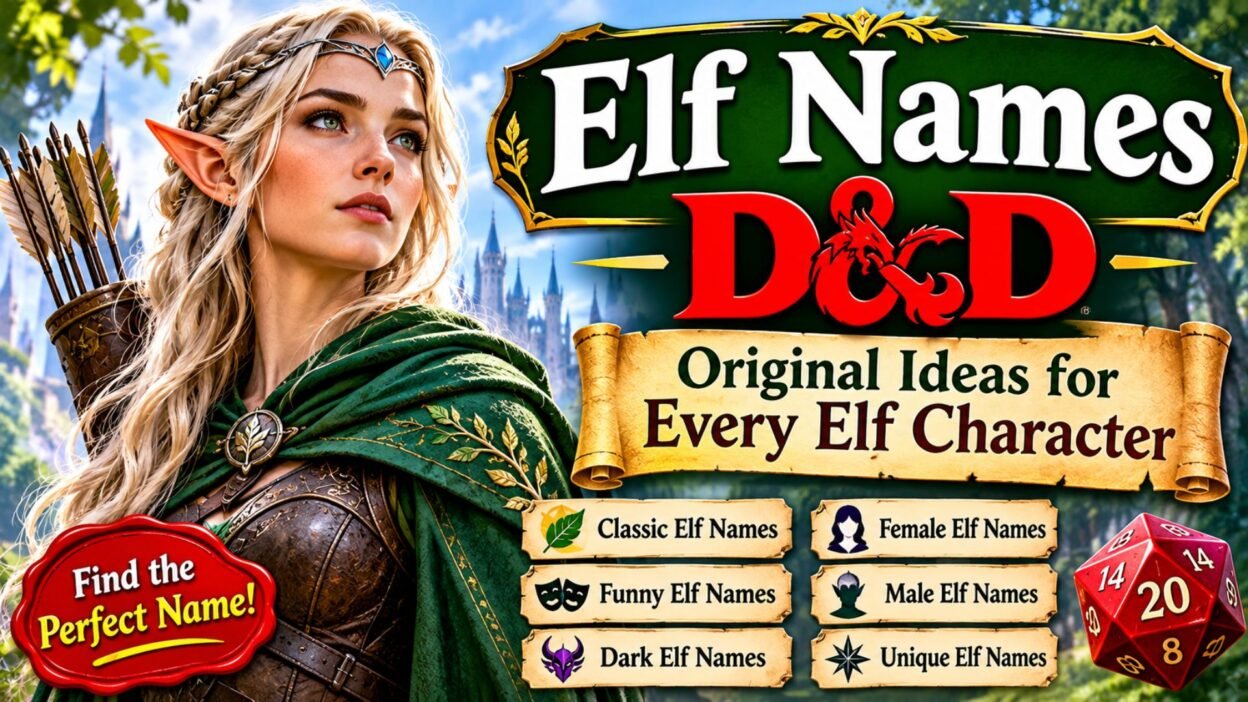
Elf names D&D players choose tend to share a musical, flowing sound, yet the best ones also say something about the character: where they grew up, what they study, and how many centuries of memories they carry. A name like that does real work at the table. It helps the Dungeon Master picture your character, and it gives you a voice to roleplay from the very first session.
This guide offers original names rather than recycled book lists. You will find top picks, a quick explanation of how elven naming works in the game, and lists for male, female and gender-neutral characters. Further down, you can browse names tailored to high elves, wood elves, drow, eladrin, shadar-kai and sea elves, plus family names and epithets. Finally, a simple syllable method shows you how to build your own.
Top Picks for Elf Characters
Short on time? These eight names cover a range of lineages and playstyles. Each one is easy to pronounce, which matters when you have to introduce your character out loud.
- Caelindor — Stately and confident, a natural fit for a high elf wizard or noble.
- Ilyssa — Soft and liquid, ideal for a bard or rogue who talks their way through trouble.
- Thalen — Short and table-friendly, so it works for a ranger or fighter you will name often.
- Mirenwyn — Gentle and woodland-flavored, perfect for a wood elf druid.
- Vaelith — Sleek with a sharper edge, suited to a drow rogue or cleric.
- Soryn — Compact and gender-neutral, easy to pair with almost any backstory.
- Aurelith — Warm and golden-sounding, a good match for an eladrin tied to a summer court.
- Nerithal — Flowing vowels that suggest tides, which fits a sea elf.
How Elf Names Work in D&D
Elves live a very long time. According to D&D Beyond’s elf species page, they reach about 750 years, and the 2024 rules offer three lineages: drow, high elf and wood elf. That long life shapes how players and writers approach elven naming.
The 2014 Player’s Handbook describes a three-part tradition. Parents give a child name, the elf chooses an adult name after reaching adulthood, and a family name follows, usually translated into Common. Nerds and Scoundrels summarizes this system well. Many tables simplify everything to one name, so treat the structure as flavor rather than a requirement.
Two practical points follow. First, settings differ, so your Dungeon Master’s world may use its own conventions. Second, the names below are original constructions rather than translated Elvish, which means they sound right without colliding with published characters.
Male Elf Names
These names lean on strong endings such as -ion, -dor and -ael, and they open with light vowels that keep the sound airy. They suit anyone from a scholarly wizard to a wandering ranger.
- Daelion — A soft opening with a bold ending, good for a charming bard.
- Haldoril — Slow and weighty, so it fits an elder statesman or a veteran warrior.
- Rhaedan — Crisp and modern-sounding, ideal for a fighter who dislikes ceremony.
- Aeleron
- Cyrandel
- Eldrith
- Fenarion
- Ithrendil
- Kaelian
- Maelor
- Orivar
- Pelarion
- Tavaril
- Vorelian
Female Elf Names
Feminine-leaning elf names often end in -a, -wyn or -elle, though nothing in the rules requires it. The choices below range from graceful to fierce, so you can match them to a cleric, a sorcerer or a swashbuckler.
- Aerindra — Airy and elegant, with enough length to feel ancient.
- Lunessa — Evokes moonlight, which suits a night-wandering ranger or a priestess.
- Zephira — Quick and bright, a good fit for a duelist who never stays still.
- Belaria
- Cyllara
- Elowyn
- Faelira
- Halira
- Isylra
- Nimarel
- Orisel
- Syrelle
- Taliera
- Ysolwen
Gender-Neutral Elf Names
Not every elf character needs a name that signals gender. These short options end in soft vowels or clean consonants, so they work for nonbinary characters, for players who want flexibility, and for anyone who prefers a name that feels timeless.
- Oriel — A graceful, almost architectural sound that suits a scholar or a diplomat.
- Vireth — Slightly sharp, ideal for a rogue or a spy.
- Alaren
- Caelis
- Eliar
- Ilvain
- Kiriel
- Merith
- Quenril
- Sevrin
- Taelis
- Yaelin
Elf Names by Lineage
Lineages, which older books call subraces, shape a character’s story, so they can shape the name too. D&D Beyond ties drow to the Underdark, high elves to crossings between the Feywild and the Material Plane, and wood elves to primeval forests. Use those homes as a guide for sound and mood.
High Elf Names
High elf names work best when they feel scholarly or noble. Longer, layered names with three or four syllables suggest courtly training and a long memory.
- Raelindor — Sounds like a title a court would announce.
- Quelathia — Elegant and a little mysterious, ideal for an arcane scholar.
- Aurendil
- Dorthilien
- Elaranthe
- Marenthil
- Sandorel
- Thaurelian
- Yvenna
- Corellith
Wood Elf Names
Wood elf names feel closer to the forest floor. Choose shorter names with natural sounds, or borrow gentle plant and bird imagery, so they suit trackers, druids and scouts.
- Larkwyn — Evokes birdsong and quick movement, perfect for a scout.
- Bramwen — Earthy and sturdy, with a hint of thorn.
- Tarwen
- Rowanel
- Fernith
- Alderen
- Thornel
- Ashiel
- Hazelwyn
- Pinara
Drow Names
Drow names often sound sharper than surface-elf names, with letters such as Z, X, Q and V. Many settings also give drow a house identity, so consider pairing one of these with a house name your Dungeon Master approves.
- Velthara — Smooth but dangerous, a fit for a scheming noble.
- Kyrazil — Quick and hard-edged, good for an assassin or a duelist.
- Zaelithra
- Xyrelith
- Qualenor
- Nyvara
- Zeryth
- Urzael
- Draevyn
- Ilmyra
Eladrin Names
Eladrin are tied to the Feywild and to changing seasons in several D&D books. Because of that, seasonal imagery gives their names a distinct identity. Ask your Dungeon Master whether this lineage is available at your table.
- Vernaeth — Suggests spring and renewal.
- Solmarien — Hints at summer sun and warmth.
- Autheril — Carries an autumn, harvest-and-fading feel.
- Hiyrelle — Cool and crystalline, for a winter-court character.
- Thaelora
- Fayrion
- Lumeril
- Elyndris
Shadar-Kai Names
Shadar-kai are linked to the Shadowfell, so their names can feel gaunt, quiet and slightly funereal. Consonants such as V, R and S give a hushed, ominous tone.
- Corvaine — A raven-like sound for a grim wanderer.
- Morvaeth — Heavy and somber, ideal for a fighter or warlock.
- Nythra
- Vessiel
- Ravaren
- Duskael
- Maelith
- Tessarin
Sea Elf Names
Sea elves call for flowing vowels and water imagery. Names built from -el, -an and -ae endings feel like tides rolling in, and they pair well with coral, pearl or storm-themed backstories.
- Thalassiel — Long and rolling, almost like a wave.
- Perlaen — Bright and delicate, a good match for a pearl diver.
- Marisael
- Coralyn
- Seravel
- Tidaren
- Azurael
- Ondaren
Elf Surnames and Epithets
Older core rules describe family names as translated phrases, so a surname can read like a small poem in Common. Instead of adding another Elvish word, you can compose a nature-based compound that tells a story about the family.
Family Names
- Lanternbough — Fits a family that guides travelers through dark woods.
- Songmantle — Suggests bards, choirs or a family that carries music from court to court.
- Embercrest — Warm and martial, suited to a line of battle-tested guards.
- Ashbloom
- Dawnthread
- Stormglass
- Wintermere
- Thornweaver
- Nightquill
- Riverlark
- Frostwillow
- Duskharrow
Earned Epithets
Because elves live so long, a character may collect a reputation worth naming. An epithet works as a nickname, a title or a quest hook that your Dungeon Master can build on.
- the Pale Lantern
- the Quiet Antler
- Last of the Silver Grove
- the Ember-Tongued
- Keeper of Hollow Bells
- the Third Moon
How to Choose an Elf Name for Your Character
A beautiful name still has to survive real play. These checks help you pick one that works for your table, not just on paper.
Say it aloud
Pronunciation matters, because everyone at the table will repeat your character’s name for dozens of sessions. If you stumble over it, shorten it or trade a tricky cluster for a simpler sound.
Match lineage and class
A long, layered name suits a court wizard, whereas a brisk two-syllable name fits a scout. Similarly, a drow rogue might favor sharper consonants than a gentle wood elf healer. The lineage lists above make that matching easier.
Plan a nickname
Elves often have long names, and friends are likely to shorten them. Pick a name with a natural short form, such as the first two syllables, so your party does not invent a nickname you dislike.
Think about age
An elf character may be centuries old, so consider whether the name was a childhood gift or an adult choice. In other words, a name can carry a backstory all by itself, and your Dungeon Master can use that hook.
Limit apostrophes
Apostrophes can make a name look fantasy-like, yet too many make it hard to read and type. Use them sparingly, and only when they mark a real pause or a family tie.
Skip famous names
Borrowing the name of a celebrated fictional elf can confuse your table and make your character feel like a copy. Original names tend to feel more personal and easier to build a story around.
How to Build Your Own Elf Name
If none of the lists fits, you can assemble a name from syllables. The method below keeps results consistent, which makes them sound like they belong to the same culture.
The Syllable Bank
- Bright openers: Ae-, El-, Il-, Lu-, Sy-
- Earthy openers: Fen-, Rowa-, Tar-, Bram-, Ash-
- Dark openers: Zae-, Vy-, Xy-, Ur-, Ny-
- Middles: -ra-, -lin-, -thar-, -vel-, -dor-
- Masculine-leaning endings: -ion, -dor, -ael, -ith
- Feminine-leaning endings: -ira, -wyn, -ia, -elle
- Neutral endings: -is, -in, -iel, -ar
Steps
- Decide the mood: bright and airy, wild and earthy, or sharp and dark.
- Choose an opener from the matching group.
- Add a middle syllable if you want extra length.
- Finish with an ending that fits your character.
- Say the result aloud, then trim anything awkward.
Examples
- Ilthariel
- Luvendra
- Syravel
- Zyvrael
- Aelith
- Vyrenel
Keep the same pattern in a family or party, because repeated sounds make characters feel connected. For example, two sibling elves could share a middle syllable while their endings differ.
Frequently Asked Questions
Do elves have last names in D&D?
Older core rules describe family names, usually translated into Common, but many tables skip surnames altogether. Ask your Dungeon Master, and use an epithet if you want a title without a full surname.
What is a good elf name for a D&D character?
Choose a name that fits your lineage and class, and that everyone at the table can pronounce. Short names suit fast-talking rogues, while longer ones suit nobles and scholars.
Do elf names have to match a character’s gender?
No. Rulebooks sometimes sort names by gender, yet nothing requires your character’s name to match. The gender-neutral list above shows how flexible elven names can be.
How do drow names differ from other elf names?
In many settings, drow names use harsher consonants and sometimes come with a house identity. There is no strict rule, so use sound and backstory to guide you.
How long do elves live in D&D?
According to D&D Beyond, elves live about 750 years. Because of that, an elf adventurer may have far more history than a human companion.
Can I use names from famous fantasy books?
Most tables prefer original names, because borrowed ones can feel derivative and confuse other players. If a book inspired you, take the mood and invent something new.
What should I name a half-elf?
A half-elf can draw on either heritage. Many players pair an elven first name with a human family name, or the reverse, to show a character caught between two cultures.
Conclusion
The best elf names D&D players can choose are easy to say, rooted in a lineage, and tied to a character’s story. Start with a mood, pick a name that fits it, and test the sound aloud before your first session.
If the lists do not quite fit, borrow a syllable pattern and build something personal. After all, a long-lived elf deserves a name with a history, and the right one will make your character memorable from the first introduction.