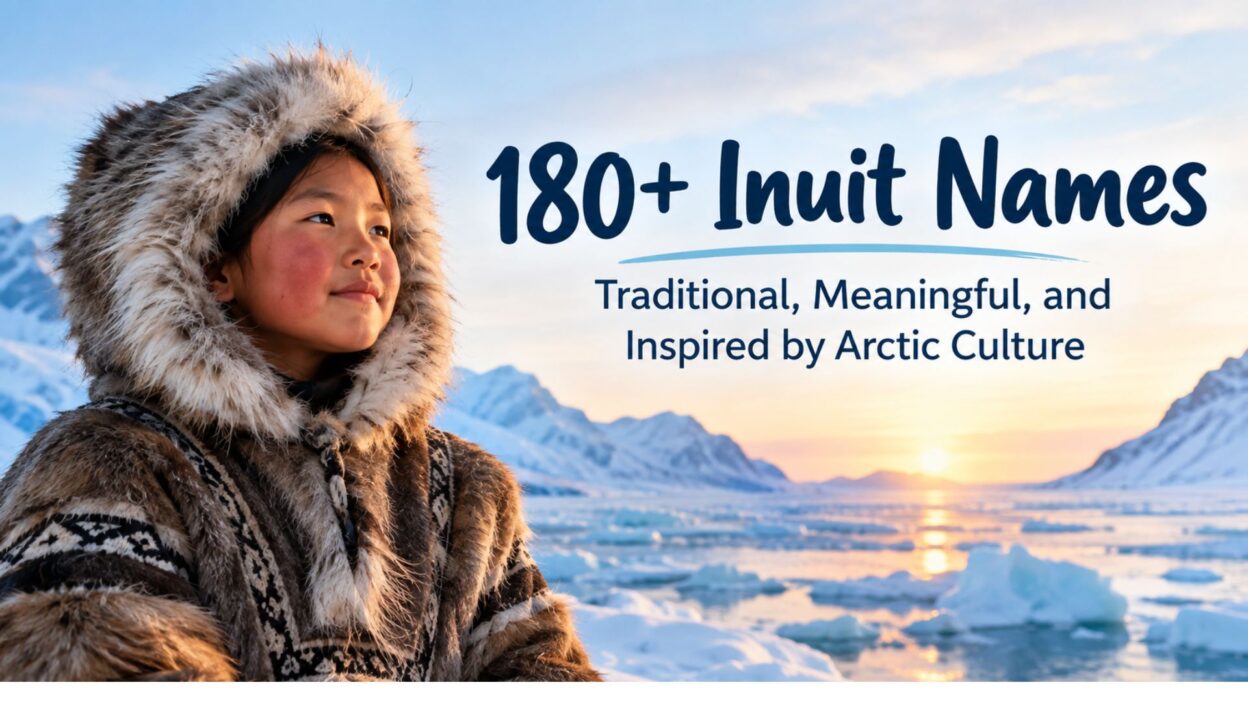
Inuit names carry much more than a distinctive sound. Across Inuit communities, naming can connect a person with family, ancestors, language, place, animals, and the wider world around them. In some traditions, a child may receive the name of an important relative or namesake, creating a continuing relationship between generations.
This collection brings together documented Inuit and Inuit-language names, along with names associated with Greenlandic and Inuktitut traditions. Because Inuit languages include multiple dialects, spellings and meanings can vary by region. For that reason, a name that appears in one community or language variety should not automatically be treated as universal across all Inuit peoples.
Whether you need a traditional name for a character, are researching name meanings, or simply want to explore beautiful Arctic names, the lists below provide a practical starting point.
Traditional Inuit Names
Traditional Inuit names often reflect relationships, the natural environment, animals, physical qualities, and everyday life. Some documented names are also connected with naming practices in Greenland and different varieties of the Inuit language.
- Amaruq — A documented Inuktitut name meaning “wolf.”
- Arnaq — A Greenlandic and Inuit name meaning “woman.”
- Iqaluk — An Inuktitut name meaning “fish.”
- Nanuq — A well-known Inuktitut name meaning “polar bear.”
- Nauja — A Greenlandic and Inuit name meaning “seagull.”
- Pittiulaaq — An Inuktitut name meaning “black guillemot,” a seabird.
- Qinnuajuaq — An Inuktitut name meaning “rough-legged hawk.”
- Siqiniq — An Inuktitut name meaning “sun.”
- Taqqiq — An Inuktitut name meaning “moon.”
- Tiriaq — An Inuktitut name meaning “ermine” or “weasel.”
- Tulugaq — A Greenlandic and Inuit name meaning “raven.”
- Ujaraq — An Inuktitut name meaning “stone.”
- Inuk — A Greenlandic Inuit name meaning “person” or “human being.”
- Inunnguaq — A Greenlandic name formed from inuk, referring to a “little person.”
- Ivalu — A Greenlandic name meaning “sinew” or “tendon.”
- Ivaaq — A Greenlandic name associated with a brooded or embraced egg.
- Aputsiaq — A Greenlandic name traditionally interpreted as “snowflake,” although Greenland’s official name authority recommends the more precise “snow crystal.”
- Niviaq — A Greenlandic name derived from the word for girl.
- Niviarsiaq — A Greenlandic name referring to a young woman or girl.
- Nuka — A Greenlandic name meaning “younger sister or brother.”
- Ujarak — A Greenlandic form associated with “stone.”
- Ulloriaq — A documented Greenlandic personal name.
- Panik — A Greenlandic name meaning “daughter.”
- Nukaaka — A Greenlandic name developed from Nuka, a kinship term.
The meanings and forms above come from documented name references rather than invented translations. Greenland’s official name database, for example, records thousands of personal names and provides detailed notes on pronunciation, spelling, variants, and meanings.
Inuit Names With Nature Meanings
The Arctic landscape provides a rich source of vocabulary connected with snow, ice, water, animals, weather, and the sky. Some names listed in popular naming resources come from these everyday environmental concepts, although their exact use and meaning can differ between languages and dialects.
- Aput — Snow.
- Siku — Ice.
- Sesi — Snow.
- Pukak — A term associated with crystalline snow.
- Imaq — Water or a body of water.
- Imiq — Drinking water.
- Ukiuk — Winter.
- Taqqiq — Moon.
- Siqiniq — Sun.
- Ujaraq — Stone.
- Iqaluk — Fish.
- Nauja — Seagull.
- Tulugaq — Raven.
- Tiriaq — Ermine or weasel.
- Amaruq — Wolf.
- Nanuq — Polar bear.
- Tuktu — Caribou in documented Arctic-language usage.
- Qimmiq — Dog in Inuktitut.
- Pittiulaaq — Black guillemot.
- Qinnuajuaq — Rough-legged hawk.
- Ulloriaq — A Greenlandic personal name associated with the star-themed vocabulary of Greenlandic naming.
- Nuvuk — A documented Inuit name associated with a headland.
- Malik — A Greenlandic name associated with “wave.”
- Aputsiaq — Snow crystal.
- Aqpik — Cloudberry in Inuktut.
- Tagiuk — Sea.
- Tuvaq — Sea ice in Inuktitut.
- Anuġi — Wind in Iñupiaq.
- Tuktuq — A documented Arctic-language form associated with caribou or mist/fog depending on language and source.
- Qannik — Snowflake in some Arctic-language sources.
Because “Inuit” covers several related language varieties, it is better to identify the specific language when accuracy matters. Nunavut, for example, uses Inuktut as an inclusive term for the Inuit language varieties spoken in the territory, including Inuktitut and Inuinnaqtun.
Inuit Names Inspired by Animals
Animals have an important place in Arctic life and vocabulary. Several documented Inuit names refer directly to animals, while others are associated with birds or marine life.
- Nanuq — Polar bear.
- Amaruq — Wolf.
- Iqaluk — Fish.
- Tulugaq — Raven.
- Nauja — Seagull.
- Tiriaq — Ermine or weasel.
- Pittiulaaq — Black guillemot.
- Qinnuajuaq — Rough-legged hawk.
- Qimmiq — Dog.
- Tuktu — Caribou.
- Natsiq — A documented Arctic name associated with seal.
- Qilalugaq — Beluga whale in Arctic-language naming resources.
- Ugruk — Bearded seal in Arctic-language sources.
- Ookpik — Snowy owl in Inuit-related Arctic naming references.
- Kanguq — Snow goose in documented Inuktut usage.
- Tiriaq — Ermine or weasel.
- Aklaq — Bear in some Arctic-language sources.
- Aqissiaq — Ptarmigan chick in Greenlandic naming tradition.
- Ugalik — Arctic hare in Inuit-related naming references.
- Aarluk — Orca or killer whale in Inuktut sources.
Animal-based names can be especially appealing for fictional characters and pets. However, a name should not be presented as universally “Inuit” when the available evidence actually identifies a particular language, region, or community.
Inuit Names for Girls
Many traditional names are not neatly divided into modern Western categories of “girls’ names” and “boys’ names.” Some Inuit and Greenlandic names are recorded for more than one gender, while others have region-specific usage. The examples below focus on documented names that are feminine or commonly associated with female naming traditions in the sources consulted.
- Arnaq — Woman.
- Niviaq — A name derived from the word for girl.
- Niviarsiaq — Young woman or girl.
- Niviatsiaq — A Greenlandic name from the nivi family of names.
- Niviarsina — A traditional Greenlandic form built from the nivi name family.
- Nivikka — A Greenlandic personal name related to the nivi stem.
- Ivalu — Sinew or tendon.
- Ivaana — A Greenlandic name derived from ivaaq, associated with a brooded or embraced egg.
- Ivaaraq — A diminutive form associated with ivaaq.
- Arnannguaq — A Greenlandic name built from arnaq, woman.
- Arnakkuluk — A Greenlandic feminine name from the arnaq family.
- Arnaliaq — A documented Greenlandic feminine name.
- Arnaaraq — A Greenlandic feminine name.
- Paneeraq — A documented Greenlandic feminine name.
- Paniaq — A Greenlandic feminine name.
- Paninnguaq — A Greenlandic feminine name derived from the pani family.
- Nukaaka — A Greenlandic name derived from Nuka.
- Kimmernaq — A Greenlandic name meaning “cowberry” or “lingonberry.”
- Nauja — Seagull.
- Siqiniq — Sun.
- Taqqiq — Moon.
- Iqaluk — Fish.
- Tulugaq — Raven.
- Qinnuajuaq — Rough-legged hawk.
- Pittiulaaq — Black guillemot.
Greenland’s official name authority documents many forms within related name families. For example, the nivi group includes Niviaq, Niviarsiaq, Niviarsiaraq, Niviatsiaq, Nivinnguaq, and other related forms.
Inuit Names for Boys
Traditional Inuit naming does not always follow a simple male/female division. Several documented names are unisex, while some Greenlandic records identify names primarily as masculine.
- Inuk — Person or human being.
- Amaruq — Wolf.
- Nanuq — Polar bear.
- Ujaraq — Stone.
- Iqaluk — Fish.
- Taqqiq — Moon.
- Tulugaq — Raven.
- Tiriaq — Ermine or weasel.
- Qinnuajuaq — Rough-legged hawk.
- Pittiulaaq — Black guillemot.
- Ulloriaq — A documented Greenlandic masculine name.
- Ivaaq — A name associated with the brooded or embraced egg.
- Inoqqut — A documented Greenlandic masculine name.
- Inuaq — A documented Greenlandic personal name.
- Inuaraq — A documented Greenlandic masculine name.
- Ujarak — Stone.
- Nuka — Younger sibling.
- Nukatsa — A documented Greenlandic masculine name related to the Nuka family.
- Panippak — A documented Greenlandic masculine name.
- Aajak — A documented Greenlandic masculine name.
- Aqi — A short form of Aqissiaq.
- Aqissiaq — Ptarmigan chick in Greenlandic tradition.
- Arivaraq — A Greenlandic name with an affectionate or diminutive sense.
- Ivaneq — “The one who has brooded” or “the one who has been brooded on.”
The Greenlandic name database shows that gender classification can vary, with several names marked for both female and male use. That makes it safer to describe these names according to documented usage rather than assuming every name fits a strict binary category.
Unisex Inuit Names
If you want a name that does not depend on a modern gender category, several documented Inuit or Greenlandic names offer flexible choices.
- Amaruq — Wolf.
- Iqaluk — Fish.
- Nanuq — Polar bear.
- Nauja — Seagull.
- Pittiulaaq — Black guillemot.
- Qinnuajuaq — Rough-legged hawk.
- Taqqiq — Moon.
- Tulugaq — Raven.
- Ujaraq — Stone.
- Inuk — Person or human being.
- Ivaaq — Brooded or embraced egg.
- Nuka — Younger sibling.
- Ujarak — Stone.
- Arivaraq — Affectionate or diminutive name form.
- Aaja — A documented Greenlandic name used for more than one gender.
- Aqissiaq — Ptarmigan chick.
- Iqaluk — Fish.
- Uerana — A documented Greenlandic name.
- Ujoru — A documented Greenlandic name.
- Ujarneq — A documented Greenlandic name.
These names are particularly useful for characters when you want a culturally grounded name without assigning a gender based solely on the spelling.
Strong Inuit Names
Some names stand out because their meanings evoke animals, the landscape, endurance, or a striking natural image.
- Amaruq — Wolf; direct and powerful.
- Nanuq — Polar bear; memorable and distinctly Arctic.
- Ujaraq — Stone; simple and solid.
- Tulugaq — Raven; striking and atmospheric.
- Qinnuajuaq — Rough-legged hawk; distinctive and unusual.
- Pittiulaaq — Black guillemot; an uncommon bird-inspired choice.
- Siqiniq — Sun; bright and commanding.
- Taqqiq — Moon; short and evocative.
- Iqaluk — Fish; closely connected with Arctic waters.
- Tiriaq — Ermine or weasel; compact and distinctive.
- Ulloriaq — A Greenlandic name with a celestial feel.
- Aputsiaq — Snow crystal; delicate in meaning but memorable in sound.
Short Inuit Names
Short names can be easier to pronounce and remember, especially when you are choosing a name for a character, pet, username, or creative project.
- Inuk
- Aput
- Siku
- Nuka
- Ivalu
- Nauja
- Ivaaq
- Iqaluk
- Nanuq
- Ulu
- Aqi
- Pani
- Nivi
- Malik
- Pukak
- Tuktu
- Sila
- Ujarak
- Aaja
- Ivaana
Keep in mind that a short spelling does not necessarily mean the original word has the same meaning in every Inuit language. Dialect and orthography matter, particularly when adapting a word for English-language use. Nunavut’s language resources emphasize the diversity of Inuit language varieties rather than treating them as one uniform language.
Beautiful Inuit Names
For a softer or more graceful feel, consider names connected with nature, affection, family, or delicate imagery.
- Aputsiaq — Snow crystal.
- Ivaaraq — A sweet, little form related to ivaaq.
- Niviatsiaq — A Greenlandic name from the nivi family.
- Nivinnguaq — A Greenlandic name associated with the nivi family.
- Nauja — Seagull.
- Siqiniq — Sun.
- Taqqiq — Moon.
- Ivalu — Sinew or tendon.
- Nuka — Younger sibling.
- Nukaaka — A name developed from Nuka.
- Kimmernaq — Cowberry or lingonberry.
- Arivaraq — An affectionate or diminutive form.
- Ivaana — A name connected with the idea of being brooded or embraced.
- Pittiulaaq — Black guillemot.
- Ulloriaq — A Greenlandic personal name with a celestial association.
The Greenlandic naming database is especially useful for names in this category because it explains how diminutive and affectionate endings can shape personal names rather than treating every name as an isolated vocabulary word.
Inuit Names Inspired by the Sky and Weather
The Arctic sky, snow, sun, moon, wind, and changing weather provide some of the most recognizable themes associated with Inuit-language vocabulary.
- Siqiniq — Sun.
- Taqqiq — Moon.
- Aput — Snow.
- Aputsiaq — Snow crystal.
- Siku — Ice.
- Pukak — Crystalline snow.
- Ukiuk — Winter.
- Anuġi — Wind in Iñupiaq.
- Ulloriaq — A Greenlandic personal name associated with star vocabulary.
- Qannik — Snowflake in some Arctic-language sources.
- Tuvaq — Sea ice in Inuktitut.
- Adlartok — Clear sky in Arctic naming references.
- Sirmiq — Glacier in Inuit-related naming resources.
- Iluq — A documented Arctic name associated with frost or ice in naming references.
- Kassuq — A documented Arctic name associated with drifting ice.
Some of these examples come from language varieties beyond Inuktitut, including Iñupiaq and Greenlandic. They are therefore better described as Arctic or Inuit-language names rather than assuming they all belong to one standardized Inuit vocabulary.
Inuit Names for Characters
For a fictional character, the best choice depends on the character’s setting. A character specifically from Nunavut, Greenland, Alaska, or another Arctic region should ideally have a name appropriate to that community and language rather than a generic “Inuit” label.
For a strong Arctic character:
- Amaruq — Wolf; suitable for a determined character.
- Nanuq — Polar bear; memorable and imposing.
- Tulugaq — Raven; works well for an observant or mysterious character.
- Ujaraq — Stone; simple and resilient in feel.
- Siqiniq — Sun; suitable for a bright personality.
- Taqqiq — Moon; works naturally for a quiet or reflective character.
- Qinnuajuaq — Rough-legged hawk; distinctive for an adventurous character.
- Iqaluk — Fish; especially fitting for a character connected with the sea.
- Pittiulaaq — Black guillemot; unusual without being an invented fantasy word.
- Aputsiaq — Snow crystal; fitting for a gentle or youthful character.
For historical or culturally specific fiction, however, researching the particular community is more respectful than selecting a name simply because it “sounds Arctic.”
Inuit Names for Pets
Animal-inspired names can work naturally for pets, especially when the meaning connects with the animal’s appearance or personality.
- Nanuq — Polar bear.
- Amaruq — Wolf.
- Qimmiq — Dog.
- Tulugaq — Raven.
- Nauja — Seagull.
- Tiriaq — Ermine or weasel.
- Iqaluk — Fish.
- Tuktu — Caribou.
- Siku — Ice.
- Aput — Snow.
- Pukak — Crystalline snow.
- Taqqiq — Moon.
- Siqiniq — Sun.
- Ujaraq — Stone.
- Sesi — Snow.
- Ukiuk — Winter.
- Qilalugaq — Beluga whale.
- Natsiq — Seal.
- Qinnuajuaq — Rough-legged hawk.
- Pittiulaaq — Black guillemot.
A name such as Nanuq can be especially memorable for a large white dog, while Siku may suit a pet with a pale or icy-looking coat. The connection is creative rather than a claim about traditional naming practice.
What Makes Inuit Names Different?
One important difference is that Inuit naming can function as a relationship system rather than simply a label chosen because a word sounds attractive. Inuit educational and cultural resources describe naming as a way of connecting children with family, ancestors, identity, and community.
The concept of the namesake is particularly important in many Inuit traditions. Sources discussing Inuit naming explain that a child may be named after an important person, including someone who has died, creating a continuing relationship between the child and that namesake. Different communities and dialects use different terms for this relationship, including sauniq and related forms.
That context matters when choosing an Inuit name for a fictional character or creative project. Understanding its language and cultural background makes the choice more meaningful
How to Choose an Inuit Name Respectfully
If you are choosing one of these names for a baby, character, pet, or creative project, a little research can make a major difference.
- Identify the language first. Check whether the name is Inuktitut, another Inuit language variety, or Greenlandic.
- Check the meaning. Do not rely on a generic naming website when an official or community-based source is available.
- Keep the spelling intact. Avoid changing letters simply because the original form looks unfamiliar.
- Learn the pronunciation. A written form may not tell an English speaker how the name should sound.
- Understand the cultural context. Some names carry family or namesake relationships that go far beyond their literal translation.
- Avoid treating Inuit culture as one uniform tradition. Inuit communities span a large Arctic region and have distinct languages and local traditions.
- For real-life naming, consult community resources. If the name will be used within an Inuit family or community, local Elders, speakers, and language authorities are more appropriate guides than a general internet list.
The Government of Nunavut describes Inuit names as an important expression of identity and emphasizes their connection with family, community, language, and history.
Why Inuit Naming Traditions Matter
Inuit naming traditions have also been affected by colonial policies. In Canada, government systems once replaced traditional identification practices with disc numbers and later formalized surname systems. Historical research describes these changes as having significant social and cultural effects on Inuit identity.
Modern efforts to document and restore Inuit names therefore have cultural significance beyond simply preserving interesting vocabulary. The Canadian Language Museum’s discussion of Atiqput describes Inuit names as connected with identity, spirit, land, water, family, and the recovery of meanings that had been lost or altered.
That history is one reason accuracy matters. A carefully researched Inuit name is not just an attractive word; it may carry linguistic and cultural knowledge.
Frequently Asked Questions
What does the word Inuit mean?
Inuit is the plural form of inuk, meaning “person” or “people” in the relevant Inuit language context. The term is used by Inuit peoples across much of the Arctic, although individual communities also use their own names and language terms.
What is a popular Inuit name?
Nanuq is one of the best-known Inuit names. It means “polar bear” in Inuktitut and is widely recognizable because the polar bear is strongly associated with the Arctic.
What Inuit name means wolf?
Amaruq is a documented Inuktitut name meaning “wolf.”
What Inuit name means moon?
Taqqiq is a documented Inuktitut name meaning “moon.” Tarqik is recorded as a variant.
What Inuit name means sun?
Siqiniq is a documented Inuktitut name meaning “sun.”
What Inuit name means raven?
Tulugaq is documented as a Greenlandic and Inuit name meaning “raven.”
Are Inuit names always gender-specific?
No. Some documented Inuit and Greenlandic names are used for more than one gender. For example, sources record Iqaluk, Nanuq, Tulugaq, Pittiulaaq, Qinnuajuaq, and Ujaraq with flexible or shared gender usage.
Why are Inuit names connected with namesakes?
In many Inuit naming traditions, receiving another person’s name creates a relationship between the child and the namesake. Inuit cultural sources describe this practice as an important way to maintain continuity between generations and preserve family and community connections.
Conclusion
The best Inuit names are meaningful because they connect language with people, place, family, animals, and the Arctic environment. Names such as Amaruq, Nanuq, Taqqiq, Siqiniq, Tulugaq, Iqaluk, and Ujaraq offer memorable choices, while Greenlandic names such as Niviaq, Ivalu, Nuka, and Aputsiaq show the diversity found across Inuit-language naming traditions.
Most importantly, Inuit names should be approached with cultural and linguistic care. Meanings, spellings, pronunciation, and naming customs can differ between communities and dialects. When you choose a name, look beyond how it sounds and learn the story, language, and context behind it. That approach creates a choice that is not only distinctive, but also informed and respectful.