
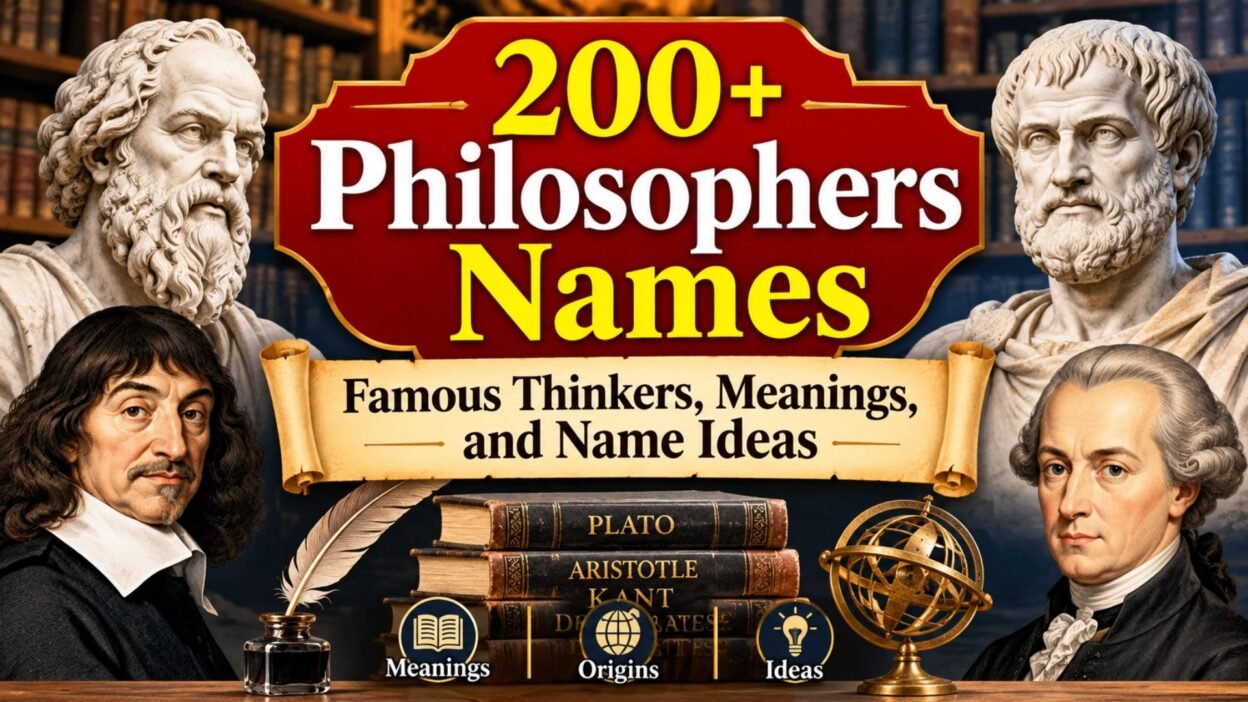
Philosophers names have outlived empires. Socrates, Confucius and Hypatia still turn up in classrooms, novels, baby name lists and even pet adoption forms. People search for them for different reasons. Some want a clear list of the great thinkers, while others hope to borrow a name with weight, wit or calm.
This guide covers both needs. You will find philosophers grouped by era and tradition, with short notes on what their names mean and who they were. After that, you will see how many of these names came about through nicknames, pen names and translation, plus practical tips for using them as given names or character names.
Where the meaning of a name is uncertain, the notes say so.
Ancient Greek Philosophers Names
Greek thinkers shaped the vocabulary of Western philosophy, so their names come first. Many are compounds of everyday Greek words, which is why they carry such clear meanings.
- Thales — Often called the first Western philosopher, he searched for a single natural substance behind everything.
- Heraclitus — His name means “glory of Hera,” and he is famous for the idea that everything flows.
- Pythagoras — Known for mathematics and for founding a community built around number and harmony.
- Democritus — Developed an early atomic theory of matter.
- Socrates — Left no writings, so students recorded his questioning method. The exact meaning of his name is debated, but it is often linked to “sound strength.”
- Plato — Traditionally said to be a nickname meaning “broad,” which hints at his build or his wide-ranging mind.
- Aristotle — Means “best purpose,” a fitting name for a philosopher of logic, ethics and science.
- Diogenes — Means “born of Zeus,” although he is remembered for living in a jar and mocking convention.
Hellenistic and Roman Philosophers Names
After Alexander’s conquests, philosophy became a guide to daily life. Stoics, Epicureans and Skeptics asked how people could stay calm and live well. Roman writers then carried these ideas into law, letters and politics.
- Epicurus — Means “ally” or “helper,” and he taught that simple pleasures and friendship bring contentment.
- Zeno of Citium — Founded Stoicism by teaching in a painted colonnade in Athens.
- Epictetus — His name means “acquired,” which suits a thinker who was born enslaved and later taught freedom of mind.
- Seneca — A Roman statesman and playwright whose name may connect to the Latin word for “old.”
- Marcus Aurelius — An emperor whose private notebook, now called the Meditations, remains a Stoic classic.
- Cicero — Brought Greek ideas into Latin prose. His family name is traditionally tied to the word for “chickpea.”
- Plotinus — Shaped Neoplatonism by blending Plato’s ideas with mystical thought.
- Hypatia — A teacher in Alexandria whose name means “highest,” and who led a Neoplatonist school and worked in mathematics and astronomy.
Medieval and Islamic Golden Age Philosophers Names
Medieval thinkers asked how reason and faith fit together. Meanwhile, scholars in the Islamic world preserved and extended Greek philosophy, and Latin Europe later knew many of them under altered names.
- Augustine of Hippo — His name comes from a Latin root meaning “venerable,” and his writings shaped Christian thought for centuries.
- Anselm — Offered a famous argument for God’s existence, and his name combines Germanic words for “god” and “helmet.”
- Thomas Aquinas — “Aquinas” means “of Aquino,” his family’s town, while Thomas comes from an Aramaic word for “twin.”
- Al-Farabi — His name points to Farab in Central Asia, and he wrote on logic and political thought.
- Avicenna — The Latin form of Ibn Sina, a physician and philosopher whose medical work shaped teaching for generations.
- Averroes — The Latinized Ibn Rushd, known for his commentaries on Aristotle.
- Maimonides — A Greek-style form of “son of Maimon,” used for Moses ben Maimon, who wrote on Jewish law and philosophy.
- Ibn Khaldun — Studied how societies rise and fall, and is often cited as an early thinker on history and economics.
Chinese and Indian Philosophers Names
Eastern traditions developed their own questions about virtue, nature and the self. Their names often include honorific titles that Western readers later turned into single words.
- Confucius — A Latinized form of Kong Fuzi, “Master Kong,” who taught moral cultivation and social duty.
- Laozi — Usually translated “Old Master,” and traditionally tied to the Daodejing.
- Mencius — The Latin form of Mengzi, “Master Meng,” who argued that people have good moral instincts.
- Zhuangzi — “Master Zhuang,” known for playful stories about freedom, dreams and perspective.
- Nagarjuna — A major Buddhist philosopher who developed the Madhyamaka idea of emptiness.
- Shankara — A teacher of Advaita Vedanta, whose name is commonly understood as “auspicious.”
Enlightenment and Early Modern Philosophers Names
Early modern thinkers questioned authority and tried to rebuild knowledge from the ground up. Their names are also among the easiest to recognize.
- Descartes — Gave us “I think, therefore I am,” and his surname gave us the word Cartesian.
- Spinoza — Born Baruch, a Hebrew name meaning “blessed,” and he argued for a single, unified reality.
- Leibniz — Combined philosophy, mathematics and law, and his first name Gottfried means “god’s peace.”
- Locke — Shaped ideas about knowledge, government and individual rights.
- Hume — A skeptic who questioned cause and effect and the limits of reason.
- Kant — His first name Immanuel means “God is with us,” and he wrote on knowledge, morality and duty.
- Rousseau — Wrote about freedom, education and the social contract.
- Voltaire — A pen name for François-Marie Arouet, and scholars still debate where it came from.
- Pascal — A mathematician and religious thinker who wrote about faith, doubt and human limits.
Nineteenth-Century Philosophers Names
The nineteenth century brought sharper questions about meaning, society and the self. Some of these names now describe whole schools of thought.
- Hegel — Built a vast system around history and the growth of freedom.
- Kierkegaard — His surname means “churchyard” in Danish, and he wrote about anxiety, choice and faith.
- Schopenhauer — Known for a pessimistic view of the will and for his influence on later writers.
- Nietzsche — Friedrich means “peaceful ruler,” which makes an ironic contrast with his bold challenges to tradition.
- Mill — Defended liberty and utilitarian ethics.
- Emerson — A leading voice of American transcendentalism.
- Thoreau — Tested self-reliance in a cabin at Walden Pond.
- Peirce — A founder of pragmatism and a pioneer in logic and signs.
Twentieth-Century and Contemporary Philosophers Names
Modern philosophy ranges from logic and language to ethics and politics. As a result, these names often carry a more technical or academic feel.
- Russell — A logician and public intellectual, and his first name Bertrand means “bright raven.”
- Wittgenstein — Ludwig means “famous warrior,” although he is remembered for quiet, searching questions about language.
- Heidegger — Explored what it means to exist and to dwell in the world.
- Sartre — Made existentialism famous with the claim that people define themselves through their choices.
- Camus — A novelist and essayist who wrote about the absurd and the search for meaning.
- Popper — Argued that scientific theories must be open to falsification.
- Rawls — Revived political philosophy with a theory of justice as fairness.
- Foucault — Studied how power, knowledge and institutions shape everyday life.
Women Philosophers Whose Names Deserve More Attention
Many general lists leave women out, even though women have shaped philosophy since antiquity. For readers who want broader coverage, or names that suit a character or a daughter, this group offers real depth.
- Mary Wollstonecraft — Argued for women’s education and equal rational standing in the late eighteenth century.
- Émilie du Châtelet — Translated and explained Newton, and wrote on physics and philosophy.
- Hannah Arendt — Wrote about totalitarianism, public life and what she called the banality of evil.
- Simone de Beauvoir — Shaped modern feminist thought with The Second Sex.
- Simone Weil — Combined philosophy, politics and spirituality in a short, intense life.
- Iris Murdoch — A novelist and moral philosopher who wrote about attention and goodness.
- Elizabeth Anscombe — Helped revive virtue ethics and wrote influential work on intention.
- Martha Nussbaum — A contemporary philosopher who writes on emotions, justice and human capabilities.
How Philosophers Got Their Names
A philosopher’s best-known name is often not the one on a birth certificate. Understanding these patterns helps you search, spell and choose names more confidently.
Nicknames stuck to some thinkers. Plato is the classic example, since the name that survives is a nickname rather than the one he was reportedly given at birth.
Latinization changed others. European scholars turned Ibn Sina into Avicenna and Ibn Rushd into Averroes. Similarly, Jesuit writers turned Kong Fuzi into Confucius.
Pen names also matter. Voltaire wrote under a name he chose himself, so the philosopher and the family name were never the same thing.
Finally, place names often became surnames. Thomas Aquinas carries the name of a town, and Al-Farabi does the same through Farab.
Philosopher Names That Work as First Names
Some philosophers’ names read well as given names, even if the philosophers themselves remain famous mainly for their ideas. The options below include first names that belonged to the thinkers above, along with a few ancient names that sound modern.
- Zeno — Short, crisp and easy to pronounce, and tied to Stoicism and the paradoxes of motion.
- Lucretius — A Roman poet and Epicurean who wrote about atoms and nature. A good option for a literary, bookish character.
- Immanuel — A gentle Hebrew name meaning “God is with us,” and the first name of a famous German thinker.
- Baruch — A traditional Hebrew name meaning “blessed.”
- Søren — A Scandinavian name linked to the Latin word for “stern,” and it has a crisp, modern sound.
- Ludwig — A strong Germanic name meaning “famous warrior.”
- Bertrand — A classic French and English choice meaning “bright raven.”
- Blaise — A short, stylish name drawn from the Latin Blasius.
- Hannah — A warm Hebrew name meaning “grace” or “favor.”
- Simone — A graceful name from Simon, with a long literary and philosophical history.
- Iris — The Greek name for the rainbow, and a flowery choice with serious intellectual associations.
Ancient single names such as Plato, Seneca and Hypatia can also work as given names. However, they carry strong associations, so choose one only if you like what it signals.
Tips for Choosing a Philosopher Name
Start with the meaning. A name like Epictetus or Heraclitus has a story, but the story should fit the person or character. Then say the name aloud with the full surname. Smooth rhythm matters more than historical weight.
Think about the audience, too. In a novel set in Ancient Rome, Seneca feels natural. In a modern high school drama, it may feel forced. Likewise, consider spelling and pronunciation, since names like Søren or Émilie need extra care.
Finally, respect the tradition behind the name. Avoid using a philosopher’s name as a joke if it comes from a living religious or cultural tradition.
Creating Your Own Philosopher-Inspired Names
If no real name fits, build one from philosophy’s own vocabulary. These formulas work for characters, pets and usernames:
- Virtue + Greek ending: a name inspired by courage, wisdom or justice, such as Sophron or Dikaios.
- School of thought + personality: a Stoic cat named Calm, or an Epicurean dog called Feast.
- Famous question + object: a gentle wink at a thinker, such as Paradox for a clever kitten.
Keep the result easy to say. Overly academic names rarely survive daily use.
Frequently Asked Questions
Who are the most famous philosophers?
Socrates, Plato and Aristotle usually top the list for Western philosophy. Confucius and Laozi hold a comparable place in Chinese thought. Kant, Nietzsche and Beauvoir also appear often in modern discussions.
Was Plato his real name?
Tradition says Plato was a nickname meaning “broad,” and some ancient accounts give a different birth name. Because the evidence comes from later writers, scholars treat the details cautiously.
Why do some philosophers have Latin names?
European scholars often translated or adapted foreign names into Latin. That is how Ibn Sina became Avicenna and Kong Fuzi became Confucius.
Which philosopher names work as baby names?
Zeno, Søren, Simone, Iris and Hannah are easy, modern options. More distinctive choices include Lucretius and Baruch. Pick one that matches your family’s language and style.
Who were the first philosophers?
Thales is often called the first Western philosopher, although earlier traditions in India and China also asked deep questions about nature and ethics.
Are there well-known women philosophers?
Yes. Hypatia, Mary Wollstonecraft, Hannah Arendt and Simone de Beauvoir are among the best known, and many contemporary women also shape the field.
Conclusion
Philosophers names offer more than a list of famous thinkers. They show how language travels, how nicknames stick, and how an idea can survive through a single word. Whether you want to learn about the great traditions or find a name for a baby, character or pet, start with the meaning and the sound. Then choose the name that feels right when you say it aloud.