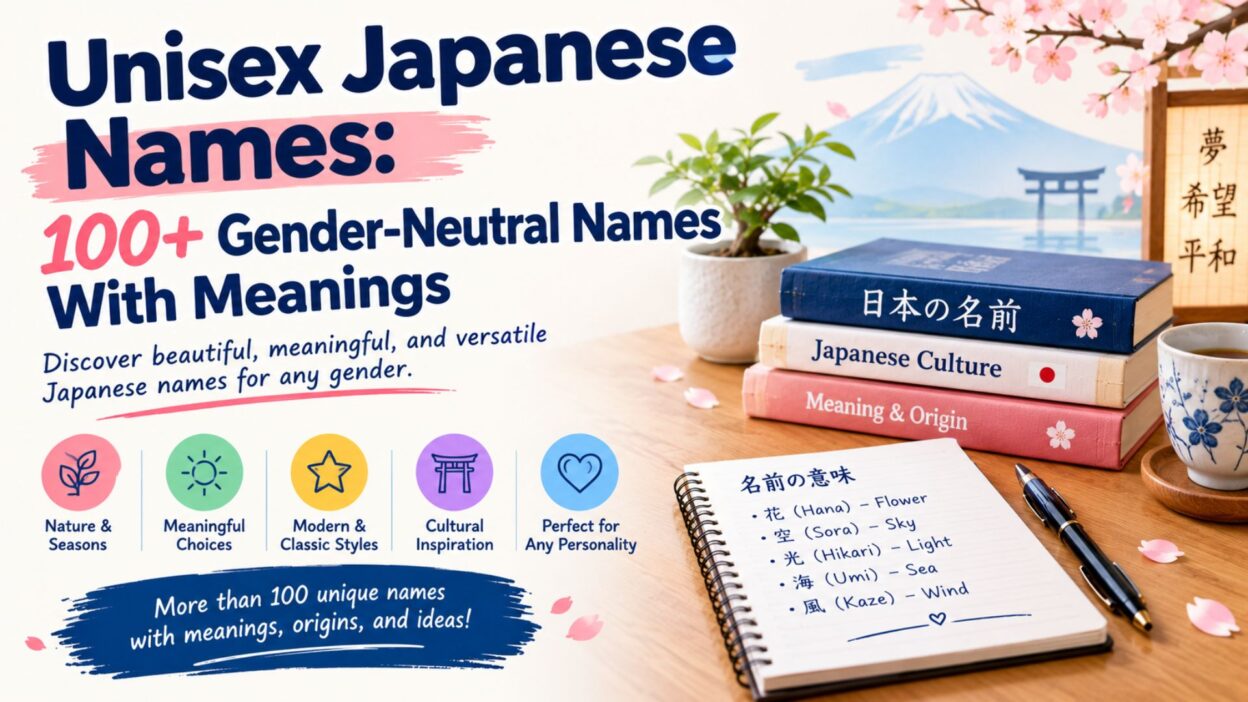
Unisex Japanese names offer a beautiful mix of simplicity, nature, elegance, and meaningful symbolism. Whether you are naming a baby, creating a character, choosing a username, or searching for inspiration, Japanese gender-neutral names provide plenty of distinctive options for different personalities and styles.
Some evoke natural beauty, such as the changing seasons or the morning sun. Others suggest brightness, wisdom, harmony, or strength.
In this guide, you will discover more than 100 unisex Japanese names, including short and cute choices, nature-inspired ideas, modern-sounding options, and names with meaningful kanji. You will also learn how Japanese name meanings work and how to choose a name that feels authentic rather than simply Japanese-inspired.
One important detail: a Japanese name’s meaning often depends on the kanji used to write it. Therefore, the meanings below describe common interpretations or associations, not necessarily the meaning of every possible spelling.
What Makes a Japanese Name Unisex?
A unisex Japanese name is a given name that can be used for people of different genders. In Japanese, gender-neutral names are often described as chūseiteki na namae (中性的な名前), meaning gender-neutral names.
Unlike some naming traditions, Japanese naming does not always divide names into strictly male and female categories. Nevertheless, many names have recognizable gender associations, so a name that sounds neutral to an English speaker may feel more masculine or feminine to a Japanese speaker.
Japanese names also have a distinctive feature: the same pronunciation can be written using different kanji. Each spelling may carry a different meaning or nuance.
For example, Akira can be written as 明, 昭, or 亮, among other forms. These characters can convey ideas such as brightness, clarity, or brilliance. Akira is used as both a masculine and a feminine given name.
Research on contemporary Japanese naming confirms that some names are gender-neutral in pronunciation, writing, or both. Consequently, choosing the spelling matters as much as choosing the sound. Oxford Academic’s research on gender-specific features in Japanese names provides further context.
Best Unisex Japanese Names
If you want a versatile name that works for a baby, fictional character, or online identity, start with these options. They combine recognizable Japanese sounds with appealing meanings or associations.
- Akira (あきら) — Often associated with brightness, clarity, or brilliance, depending on the kanji.
- Aoi (あおい) — Associated with blue-green colors and plants, depending on the written form.
- Asahi (あさひ) — Morning sun; a bright, optimistic choice.
- Haruka (はるか) — Can convey distance or remoteness through certain kanji combinations.
- Hinata (ひなた) — A sunny place or a spot in the sun, depending on the spelling.
- Hikaru (ひかる) — To shine or sparkle; a luminous and expressive name.
- Kaoru (かおる) — Fragrance or to be fragrant.
- Kaede (かえで) — Maple, associated with autumn leaves.
- Makoto (まこと) — Sincerity, truth, or genuineness.
- Minato (みなと) — Harbor or port.
- Nao (なお) — Can be associated with honesty, directness, or other meanings depending on the kanji.
- Rei (れい) — May convey ideas such as beauty, gratitude, spirit, or zero, depending on the character.
- Ren (れん) — Commonly associated with lotus when written 蓮.
- Sora (そら) — Sky.
- Yuki (ゆき) — Can mean snow when written 雪, though other spellings have different meanings.
- Yu (ゆう) — A short name with several possible meanings depending on the kanji.
- Yuu (ゆう) — A long-vowel spelling of the same Japanese sound represented by Yu; meanings depend on the chosen characters.
These names are useful starting points because they are relatively concise and offer different moods, from calm and gentle to bright and energetic. However, always check the intended kanji before assigning a specific meaning.
Cute Unisex Japanese Names
Cute Japanese gender-neutral names often feature soft sounds, short syllables, and associations with nature or everyday beauty. They are especially suitable for baby-name inspiration, fictional characters, pets, and friendly usernames.
- Ao (あお) — Blue or blue-green when written with suitable kanji.
- Chika (ちか) — Can suggest scattered flowers, wisdom, or other ideas, depending on the characters.
- Chiyo (ちよ) — Often associated with a thousand generations when written 千代.
- Fumi (ふみ) — May relate to writing, literature, or history, depending on the kanji.
- Haru (はる) — Spring when written 春; a fresh and cheerful choice.
- Hoshi (ほし) — Star.
- Iori (いおり) — A Japanese given name with multiple possible kanji spellings and interpretations.
- Itsuki (いつき) — May be written with characters associated with trees or other meanings.
- Jun (じゅん) — Can convey purity, obedience, or genuineness, depending on the spelling.
- Kanon (かのん) — Often chosen for its gentle sound; its meaning depends on the kanji.
- Koharu (こはる) — Commonly associated with a small or late-autumn spring-like warmth, depending on interpretation.
- Mio (みお) — Has several possible spellings and meanings, including combinations involving water or beauty.
- Nagi (なぎ) — Calm weather or a lull in the wind when written 凪.
- Rin (りん) — Can suggest dignity, clarity, or other qualities depending on the characters.
- Rio (りお) — A modern-sounding name with several possible kanji combinations.
- Shion (しおん) — Can be associated with the aster flower when written 紫苑.
- Suzu (すず) — Bell when written 鈴.
- Tomo (とも) — Can be associated with friendship or wisdom, depending on the kanji.
- Yori (より) — A short Japanese name with different possible written meanings.
- Yuzu (ゆず) — Japanese citrus fruit, known as yuzu.
Top cute picks: Haru, Nagi, Suzu, Ao, and Yuzu stand out for their short pronunciation and clear nature-related associations.
Cool and Modern Unisex Japanese Names
A modern Japanese name can feel stylish without being complicated. These options work particularly well for fictional heroes, anime-inspired original characters, gaming identities, and contemporary baby-name lists.
- Akito (あきと) — A masculine-leaning name in many contexts, with meanings that depend on the kanji.
- Amane (あまね) — Can convey ideas such as widespread or universal, depending on the written form.
- Arata (あらた) — New or fresh when written 新.
- Chihiro (ちひろ) — Can be written with characters suggesting a thousand or a vast expanse.
- Hinoki (ひのき) — Japanese cypress; a distinctive nature-inspired option, though less established as a conventional given name.
- Izumi (いずみ) — Spring or fountain when written 泉.
- Kanade (かなで) — To play or perform music when written 奏.
- Kiyoshi (きよし) — A traditionally masculine-leaning name associated with purity or clarity in certain spellings.
- Kyou (きょう) — A short name with several possible kanji and interpretations.
- Makio (まきお) — A name whose meaning depends on the chosen characters; it is generally masculine-leaning.
- Masumi (ますみ) — Can suggest purity or beauty, depending on the spelling.
- Michi (みち) — Can mean path or road when written 道.
- Mizuki (みずき) — A widely recognized Japanese name with several possible kanji combinations.
- Nozomi (のぞみ) — Hope or wish when written 望.
- Ritsu (りつ) — May convey ideas such as order, law, or rhythm, depending on the kanji.
- Shizuku (しずく) — Droplet when written 雫.
- Subaru (すばる) — Associated with the Pleiades star cluster when written 昴.
- Tsubasa (つばさ) — Wings when written 翼.
- Yuuhi (ゆうひ) — Evening sun when written 夕日.
- Yuuki (ゆうき) — Can convey courage or other meanings, depending on the characters.
Some names in this collection have stronger masculine or feminine associations in everyday Japanese usage. If gender neutrality is essential, verify the particular name and spelling instead of relying on the sound alone.
Unisex Japanese Names Inspired by Nature
Nature is an important source of imagery in Japanese naming. The seasons, sky, plants, water, and changing weather can express beauty, calmness, hope, and renewal.
These names are especially suitable for people who want a name with a natural image or a subtle connection to the Japanese landscape.
Names Inspired by Seasons and Weather
- Aki (あき) — Autumn when written 秋; can also be associated with brightness using other kanji.
- Fuyu (ふゆ) — Winter when written 冬.
- Natsu (なつ) — Summer when written 夏.
- Haruya (はるや) — A name that can incorporate the spring character 春, although its gender associations depend on the full spelling.
- Kazane (かざね) — Can evoke wind and sound through selected kanji, but the exact interpretation depends on the writing.
- Kiri (きり) — Mist or fog when written 霧.
- Kumo (くも) — Cloud when written 雲; more natural as a creative name than a conventional given name.
- Nagisa (なぎさ) — Shore or beach when written 渚.
- Shigure (しぐれ) — A passing shower, particularly associated with seasonal rain.
- Yoru (よる) — Night when written 夜; an atmospheric choice for fiction or usernames.
Names Inspired by Plants and Flowers
- Botan (ぼたん) — Peony when written 牡丹.
- Kaoru (かおる) — Fragrance; a natural choice for someone who likes subtle floral associations.
- Kaya (かや) — Can refer to certain grasses or plants depending on the characters.
- Kiriha (きりは) — A creative combination that may evoke leaves, depending on the chosen kanji; verify before presenting it as a traditional name.
- Kiku (きく) — Chrysanthemum when written 菊.
- Kirihae (きりはえ) — A constructed, Japanese-inspired option rather than a widely established conventional given name.
- Kohaku (こはく) — Amber when written 琥珀.
- Momiji (もみじ) — Maple leaves or autumn foliage.
- Ran (らん) — Orchid when written 蘭.
- Sumire (すみれ) — Violet when written 菫.
Some plant names are strongly associated with one gender in Japan even if their sound seems neutral elsewhere. For example, Sumire is typically feminine-leaning. Use such names as broader creative inspiration, or confirm their gender associations when choosing a real baby’s name.
Names Inspired by Sky, Water, and Light
- Amane (あまね) — Can suggest something widespread or far-reaching, depending on the characters.
- Hikari (ひかり) — Light when written 光.
- Kaito (かいと) — Often masculine-leaning, with possible meanings that depend on the kanji.
- Minami (みなみ) — South when written 南.
- Mizore (みぞれ) — Sleet when written 霙; an unusual option for a fictional character.
- Rai (らい) — Can be associated with thunder through certain kanji, but the meaning depends on the spelling.
- Ruka (るか) — A name with several possible kanji combinations and varying gender associations.
- Satsuki (さつき) — The traditional name for the fifth month in the Japanese calendar and also associated with azaleas.
- Sei (せい) — Can convey meanings such as clarity, life, or purity depending on the characters.
- Umi (うみ) — Sea when written 海.
For an especially nature-focused choice, Haru, Aki, Nagi, Hikari, and Umi provide clear imagery. Remember that nature-related meanings do not automatically make a name gender-neutral in Japanese.
Japanese Unisex Names With Beautiful Meanings
If meaning matters more than style, begin with the idea you want the name to express. Japanese kanji can communicate qualities such as sincerity, light, peace, hope, and strength. The following options have recognizable associations when written with the specified characters.
- Akira (明) — Bright or clear.
- Asahi (朝日) — Morning sun.
- Hikari (光) — Light.
- Hikaru (光る) — To shine; the spelling 光る is a verb form, while given names may use other written forms.
- Hinata (日向) — Sunny place or a place facing the sun.
- Izumi (泉) — Spring or fountain.
- Kaede (楓) — Maple.
- Makoto (誠) — Sincerity or truth.
- Minato (港) — Harbor.
- Nagi (凪) — Calm weather or a lull in the wind.
- Nozomi (望) — Hope or wish.
- Rei (礼) — Courtesy, gratitude, or respect.
- Ren (蓮) — Lotus.
- Ritsu (律) — Rule, law, or rhythm, depending on context.
- Sora (空) — Sky.
- Subaru (昴) — The Pleiades star cluster.
- Tsubasa (翼) — Wings.
- Yuki (雪) — Snow.
- Yuuki (勇気) — Courage; this is the ordinary word for courage and may not be the spelling used for every person named Yuuki.
- Yuu (優) — Can convey gentleness, kindness, or excellence, depending on the reading and context.
The written examples above illustrate common word or character meanings. They do not guarantee that every person with the same romanized name uses those characters. When selecting a real name, confirm that the intended kanji reading is appropriate and acceptable.
Short Unisex Japanese Names
Short names are easy to say, easy to remember, and practical for usernames or character names. Japanese names that use two or three morae can sound balanced in both Japanese and many other languages.
- Ai (あい) — Love when written 愛; often feminine-leaning in Japan.
- Ao (あお) — Blue or blue-green.
- Aki (あき) — Autumn when written 秋.
- Gen (げん) — A short name with several possible kanji and meanings; usually masculine-leaning.
- Haru (はる) — Spring when written 春.
- Jun (じゅん) — A name with several possible meanings and gender associations.
- Kai (かい) — A concise name with multiple possible kanji; gender associations vary by context.
- Kei (けい) — A Japanese given name with many possible spellings and meanings.
- Nao (なお) — A short name that can be used by different genders.
- Rei (れい) — A concise name with several possible kanji.
- Ren (れん) — Lotus when written 蓮.
- Rin (りん) — A compact name with multiple written forms.
- Rui (るい) — A short Japanese name with several possible kanji combinations.
- Sei (せい) — A short name with different meanings depending on the characters.
- Shin (しん) — Can convey meanings such as truth or newness through certain kanji.
- Tomo (とも) — Can be associated with friendship or wisdom.
- Yuu (ゆう) — A versatile pronunciation with many possible spellings.
Shortness makes these names practical, but it does not prove that they are gender-neutral. For example, Ai is often associated with women, while Gen and Shin tend to be masculine-leaning. Check actual usage if you need a name that is unambiguously suitable for more than one gender.
Traditional and Elegant Unisex Japanese Names
Some Japanese names have a classic, understated feel. They may appear in older naming traditions or remain familiar across generations, although their gender associations can differ.
- Akira (あきら) — A well-established name used for different genders.
- Chihiro (ちひろ) — A familiar Japanese given name with multiple kanji spellings.
- Haruka (はるか) — An elegant-sounding name with several possible written meanings.
- Kaoru (かおる) — Fragrance; used for different genders.
- Makoto (まこと) — Sincerity or truth.
- Masumi (ますみ) — A name whose interpretation depends on the characters.
- Michiru (みちる) — Can be written with characters associated with fullness or abundance.
- Naoki (なおき) — A conventional name that is generally masculine-leaning.
- Natsuki (なつき) — A familiar Japanese name with multiple possible kanji spellings and gender associations.
- Satsuki (さつき) — Associated with the fifth month and azaleas.
- Shizuka (しずか) — Quiet or calm when written 静か; generally feminine-leaning as a given name.
- Yoshiki (よしき) — A name with several possible kanji combinations, usually masculine-leaning.
- Yukari (ゆかり) — Can express connection or association through certain spellings; generally feminine-leaning.
- Yuki (ゆき) — Snow with the spelling 雪, and used for different genders.
- Yuri (ゆり) — Lily when written 百合; often feminine-leaning.
For a genuinely gender-neutral shortlist, prioritize names with documented use across genders rather than treating every traditional Japanese name as unisex. Akira, Kaoru, Makoto, Chihiro, and Yuki are useful names to investigate further.
Aesthetic Japanese Names for Characters and Usernames
If you are naming a fictional character, social media account, game avatar, or creative project, you may have more freedom than you would when choosing a legal given name. Aesthetic names can emphasize mood, imagery, sound, or symbolism.
The choices below range from established Japanese names to Japanese words that work better as creative handles than conventional personal names.
- Aoi (あおい) — A cool, blue-green aesthetic.
- Haru (はる) — A fresh, spring-inspired feel.
- Hoshi (ほし) — Star; simple and celestial.
- Itsuki (いつき) — A nature-friendly sound with several possible written meanings.
- Kaede (かえで) — Maple; ideal for an autumn-inspired character.
- Kohaku (こはく) — Amber; warm and luminous.
- Mizuki (みずき) — A familiar name with a gentle sound.
- Nagi (なぎ) — Calm or stillness, suggesting a peaceful personality.
- Rin (りん) — Short, crisp, and memorable.
- Sora (そら) — Sky; works well for an open, adventurous character.
- Subaru (すばる) — Associated with the Pleiades.
- Tsubasa (つばさ) — Wings; a fitting choice for a character who values freedom.
- Yoru (よる) — Night; better suited to creative naming than a typical conventional given name.
- Yume (ゆめ) — Dream when written 夢; generally feminine-leaning in personal-name usage.
- Yuzu (ゆず) — Yuzu citrus; bright and playful.
For a username, you can also pair a real name with a descriptive word, such as SoraNotes, NagiSketch, or HaruMoon. These are creative combinations, not traditional Japanese personal names. If authenticity matters, avoid adding Japanese words without checking their meaning and grammar.
How to Choose the Right Unisex Japanese Name
A name may look beautiful on a list but feel less suitable once you consider pronunciation, writing, and everyday use. Follow these practical guidelines to narrow your options.
Decide What the Name Is For
First, consider whether you are naming a baby, a fictional character, a pet, or an online identity. A baby name may need to work throughout adulthood, while a character name can be more imaginative or strongly themed.
For a real Japanese name, prioritize established usage and appropriate kanji. For a game or username, you can give more weight to originality, visual appeal, and personal style.
Check the Meaning of the Kanji
Never assume that a romanized name has only one meaning. For instance, Akira can be written with several characters, including 明 and 昭. Both have associations with brightness, but the precise meaning depends on the spelling.
Likewise, Yuki may be written 雪 for snow or with other characters for different meanings. Before finalizing a name, confirm the intended written form and reading.
Consider Gender Associations in Japan
A name can sound gender-neutral to an international audience while carrying a more specific association in Japan. The same name may also feel different depending on its kanji.
If you want a name that Japanese speakers are likely to recognize as usable across genders, consult a reliable Japanese naming reference and look for examples of actual usage. Research into Japanese names shows that both sound and written characters can influence perceived gender.
Say It Aloud
Pronounce your shortlist several times. Check whether the name is easy to say in Japanese and in the language spoken by your intended audience.
Also, decide how you want to write it in Roman letters. For example, Yuu and Yu can represent different ways of indicating a long vowel, depending on the romanization system. Consistency makes the name easier to recognize.
Avoid Inventing Meanings
Combining two kanji may create an appealing name, but the result does not automatically have the meaning you expect. Japanese characters can have multiple readings, and a combination that looks poetic may not be a natural or familiar personal name.
For a real baby name, check the spelling, pronunciation, reading, and cultural associations with a knowledgeable Japanese speaker or a reliable naming reference.
Common Mistakes to Avoid When Choosing Japanese Unisex Names
A few simple checks can help you choose a more accurate and respectful name.
- Assuming every Japanese name is unisex: Many names have strong gender associations, even when their pronunciation seems neutral.
- Assigning one meaning to every spelling: Different kanji can change the meaning of the same spoken name.
- Treating Japanese words as conventional given names: A word such as Yoru, meaning night, may work as a creative character name but is not automatically a common personal name.
- Confusing Japanese and other East Asian naming traditions: Similar-looking characters may be pronounced and used differently in Japanese, Chinese, and Korean.
- Choosing kanji based only on appearance: A visually attractive character may have an unsuitable meaning or an unexpected reading.
- Relying on anime alone: Fiction can inspire a name, but a character’s name does not establish that it is common or gender-neutral in everyday Japanese.
- Ignoring pronunciation: A name should sound comfortable when spoken by the people who will use it regularly.
The most reliable approach combines a name’s sound, written form, meaning, and actual usage. This is particularly important if you are choosing a name for a child rather than for a fictional character.
Frequently Asked Questions
What are the best unisex Japanese names?
Akira, Aoi, Asahi, Chihiro, Haruka, Hikaru, Kaoru, Makoto, Nao, Rei, Ren, Sora, and Yuki are useful options to explore. Their gender associations and meanings vary, so check the intended kanji before making a final choice.
What Japanese name means light and works for any gender?
Hikari (光) means light, while Hikaru can mean to shine. Both are used as Japanese given names, but their perceived gender associations may vary. The written form is important when selecting a specific meaning.
Is Akira a unisex Japanese name?
Yes. It can be written with several kanji, including 明, 昭, and 亮, which convey meanings related to brightness or clarity.
Is Yuki a gender-neutral Japanese name?
Yuki is used for different genders. When written 雪, it means snow. Other kanji combinations can produce different meanings, and the name’s gender associations depend partly on the written form and naming context.
What Japanese unisex names mean nature or sky?
Sora means sky when written 空, Kaede means maple when written 楓, Nagi refers to calm weather when written 凪, and Umi means sea when written 海. These offer clear nature-related imagery, although their gender associations should still be checked.
Are Japanese unisex names suitable for anime characters?
Yes. Names such as Akira, Sora, Nagi, Ren, and Hikaru can suit fictional characters with different personalities. However, consider the character’s background, the intended kanji, and whether you want an established personal name or a more imaginative creative choice.
Can I create my own Japanese name using kanji?
You can explore possible combinations, but creating a natural and accurate Japanese name requires care. Kanji have multiple readings, and combining characters does not guarantee that Japanese speakers will recognize the intended pronunciation or meaning. Consult a knowledgeable speaker or reliable naming reference before using a new combination for a real person.
How can I tell whether a Japanese name is genuinely unisex?
Look for reliable references that document the name’s use across genders, rather than relying on its sound or a website’s label alone. Check the pronunciation, kanji, examples of actual usage, and cultural associations. A name can be gender-neutral in sound but gendered in its written form.
Conclusion
Unisex Japanese names offer a wide range of choices, from nature-inspired names such as Haru, Kaede, and Sora to meaningful options such as Akira, Makoto, and Hikaru. The best choice depends on the sound you like, the meaning you want, and whether the name needs to feel authentic in everyday Japanese.
Before settling on a name, check its kanji, pronunciation, and gender associations. That extra research helps you move beyond a name that simply looks attractive toward one that feels meaningful, appropriate, and memorable.
Do you like this personality?