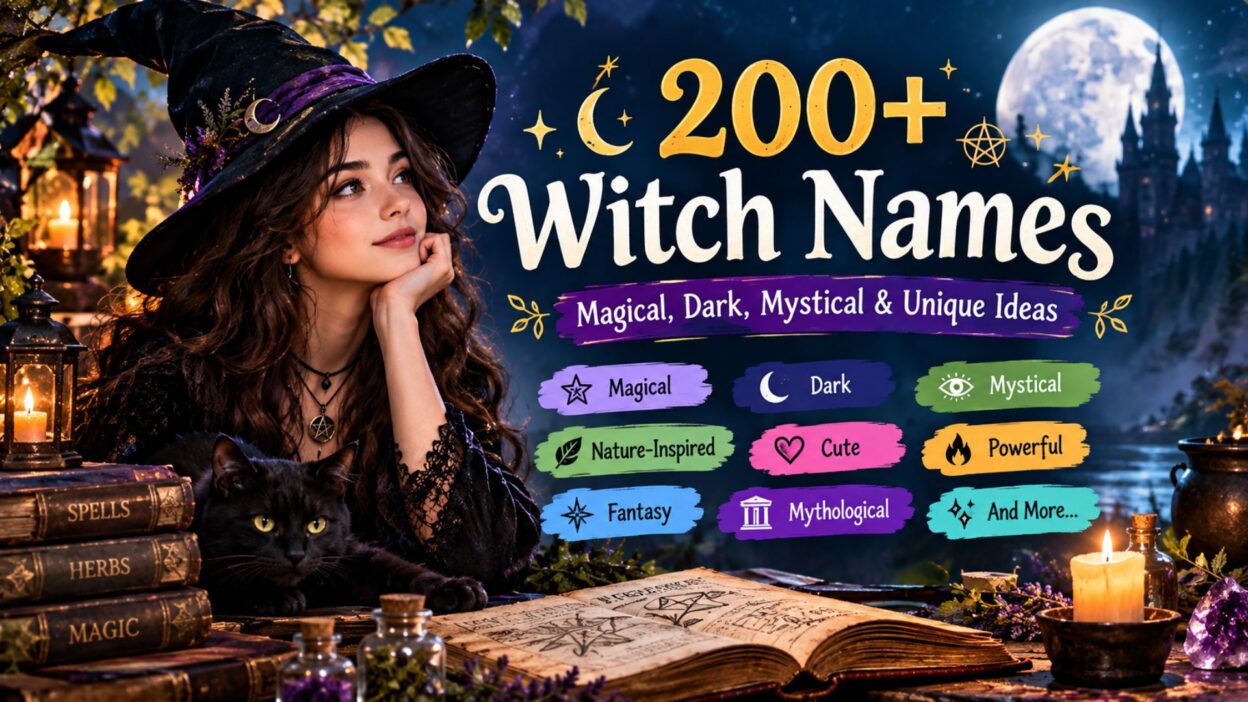
Witch names can instantly give a character, fantasy persona, pet, story, or game avatar a distinctive magical identity. Some sound dark and mysterious, while others feel elegant, earthy, celestial, playful, or powerful. The best choice depends on the personality and world behind the name.
Current naming resources commonly draw inspiration from folklore, mythology, nature, herbs, celestial imagery, historical records, and fantasy naming patterns. They also show that readers often want more than random names: they look for names grouped by mood, gender, style, meaning, and character role.
This collection brings together 210 witch names across distinct styles. You will find dark and mysterious choices, nature-inspired names, moonlit names, traditional options, powerful mythological names, cute ideas, male and gender-neutral choices, fantasy creations, and even playful names for Halloween or fictional characters.
Best Witch Names
These names offer a balanced magical feel without locking a character into one particular personality. They can work for fantasy stories, games, usernames, role-playing characters, or a witch-themed project.
- Vespera — An elegant choice with a dusky, evening atmosphere.
- Morwen — Old-fashioned and mysterious, ideal for a quiet spellcaster.
- Elowen — A soft, woodland-inspired name with a graceful fantasy feel.
- Morgana — A classic magical choice associated with Arthurian legend.
- Selene — A celestial name with a strong moonlit atmosphere.
- Rowan — A natural choice with a folkloric, protective feel.
- Cerridwen — A Welsh mythological name strongly associated with enchantment and transformation.
- Tabitha — A familiar traditional name that works nicely for a character with an old-world personality.
- Sable — Short, dark, and stylish without sounding overly complicated.
- Hecate — A powerful mythological choice connected with magic and witchcraft in Greek tradition.
- Willow — Gentle and botanical, making it suitable for a nature-focused witch.
- Prudence — A vintage choice that can give a character a serious or mysterious personality.
- Circe — A famous Greek sorceress from mythology, making the name especially recognizable.
- Lunara — A fantasy-style name with an unmistakable lunar sound.
- Ravenna — Dramatic and gothic without being difficult to pronounce.
Dark and Mysterious Witch Names
For a shadowy character, darker sounds can create the right atmosphere. These names suit gothic fiction, mysterious villains, supernatural stories, or characters who prefer secrets to attention.
- Nyxara
- Ravella
- Belladrix
- Noctelle
- Sablewyn
- Mirelda
- Velmora
- Grimella
- Umbrielle
- Duskara
- Nerissa
- Obsidia
- Tenebra
- Vesperine
- Drusilla
The darker style does not have to mean every name contains words such as “dark,” “shadow,” or “night.” A softer name with an unusual rhythm can create mystery more effectively. Modern witch-character guides similarly distinguish between frightening, cozy, historical, and morally complex witch archetypes rather than treating every witch as the same type of character.
Nature-Inspired Witch Names
Plants, trees, herbs, flowers, and landscapes provide some of the most natural inspiration for witch names. This style works particularly well for forest witches, herbalists, healers, cottage-fantasy characters, and nature-loving personalities.
- Briar
- Hazel
- Rowan
- Willow
- Juniper
- Myrtle
- Sage
- Yarrow
- Aster
- Clover
- Fern
- Lavender
- Marigold
- Thistle
- Bramble
Nature-based naming has a genuine connection with the modern fantasy image of witches. Contemporary naming resources frequently use herbs, trees, and botanical vocabulary to create an earthy magical register.
For a more grounded character, a real botanical name can feel more believable than an invented magical word. Hazel, Rowan, and Willow, for example, can work in both ordinary and fantasy settings.
Moon and Celestial Witch Names
Celestial names are a natural fit for witches associated with the night sky, dreams, astrology, stars, or moonlit settings. They can also suit characters who are elegant rather than frightening.
- Selene
- Lunara
- Elara
- Aurelia
- Cressida
- Celestine
- Elaris
- Moonelle
- Twyla
- Astrea
- Seren
- Luneth
- Calista
- Solara
- Opaline
Celestial witch naming is a common modern fantasy direction, with naming guides often grouping moon, stars, dawn, sky, and cosmic imagery into separate styles.
Traditional Witch Names
Traditional names can make a fictional witch feel as though she belongs to an older village, historical setting, or folklore-inspired world. These choices avoid obvious fantasy constructions and instead rely on established names with an old-fashioned character.
- Agnes
- Tamsin
- Cecily
- Edith
- Beatrix
- Prudence
- Verity
- Dorothea
- Sibyl
- Hester
- Mabel
- Fenella
- Ottilie
- Morwenna
- Rowena
Several modern witch-name resources use historical or folklore-flavored given names such as Agnes, Tamsin, Cecily, Prudence, and Morwen as a foundation for believable witch characters.
This approach works especially well when the story takes place in a historical village or a fantasy world that uses familiar European-style naming traditions.
Good Witch Names
A magical character does not need to be sinister. For a kind healer, protective spellcaster, wise mentor, or friendly cottage witch, softer names can create a warmer first impression.
- Elowen — Gentle and woodland-like, making it a natural fit for a healer or herbalist.
- Althea — Elegant and calm, with an old-fashioned fantasy quality.
- Isolde — Romantic and legendary in tone without sounding childish.
- Seraphine — Graceful and luminous for a benevolent magical character.
- Amara — Smooth and memorable for a compassionate heroine.
- Eveline — Soft enough for a gentle character while still feeling classic.
- Clara — Simple and bright, useful for a witch who hides her magical identity.
- Rosalie — Floral and warm, especially suitable for a garden witch.
- Adeline — Refined and approachable for a magical protagonist.
- Liora — Bright-sounding and suitable for a hopeful character.
- Meliora — An elegant choice for someone focused on growth and improvement.
- Celia — Short, graceful, and easy to remember.
- Elaraine — A fantasy variation with a gentle, lyrical sound.
- Maribel — Friendly and charming for a cozy fantasy setting.
- Faye — Short and magical in feel, especially for a fairy-tale-inspired character.
A good witch name can signal personality before the character speaks. Modern character-naming guidance often recommends matching the name’s sound with the character’s role, setting, and relationship to magic.
Powerful Witch Names
These choices have a commanding sound and work well for coven leaders, ancient sorceresses, powerful antagonists, or legendary magical figures.
- Bellatrix
- Morgana
- Circe
- Hecate
- Medea
- Cerridwen
- Rhiannon
- Morrigan
- Alecto
- Andromeda
- Calypso
- Thessaly
- Ariadne
- Electra
- Zenobia
Some of these names have genuine mythological backgrounds rather than being invented fantasy names. Circe, for example, appears as a famous sorceress in Greek legend, while Hecate has a long association with magic, crossroads, and the supernatural in ancient Greek sources.
When using a mythological name, consider whether you want the historical or mythological association to remain part of the character. If not, an original fantasy name may give you more freedom.
Cute Witch Names
Cute witch names are useful for cheerful characters, familiars, Halloween personas, cozy fantasy stories, and playful usernames. They can sound magical without becoming intimidating.
- Poppy
- Pixie
- Dottie
- Winnie
- Mimi
- Bumble
- Tansy
- Fifi
- Coco
- Nellie
- Peaches
- Mochi
- Pippa
- Lulu
- Bibi
For this style, short sounds and friendly endings usually work better than heavy gothic vocabulary. A name like Poppy can suggest a cheerful garden witch, while Bumble might suit a whimsical character with a mischievous personality.
Male Witch and Warlock Names
Although many popular lists focus on female witches, fantasy settings can include male practitioners as well. These names lean toward an old-world, scholarly, mysterious, or warlock-like style.
- Aldric
- Oswin
- Eadric
- Selwyn
- Leofric
- Godwin
- Mordecai
- Barnaby
- Ambrose
- Alaric
- Wystan
- Bramwell
- Edmund
- Osric
- Thaddeus
Some current naming resources explicitly separate feminine witch names from masculine warlock-style names while also offering gender-neutral choices.
For a historical-feeling character, an established old-fashioned name can be more convincing than a name assembled from random magical syllables.
Gender-Neutral Witch Names
A gender-neutral name can give you more flexibility, especially when you are still developing a character or want the name to work independently of gender.
- Wren
- Marlow
- Merrin
- Sagewood
- Rune
- Arden
- River
- Ash
- Storm
- Vale
- Rook
- Ember
- Onyx
- Haven
- Winter
Nature and atmospheric vocabulary works particularly well here because the names communicate mood without strongly signaling a gender.
Fantasy Witch Names
If you are building a completely fictional world, an invented name gives you room to create your own magical culture. These names are intentionally fantasy-inspired rather than presented as historical names or established meanings.
- Avelith
- Eirawyn
- Vaelora
- Nimvella
- Orinthia
- Zorielle
- Maevryn
- Sylvara
- Elarune
- Thalindra
- Virelia
- Caelwyn
- Ophirra
- Isavelle
- Ravynne
Use invented names carefully. A memorable fantasy name should still be pronounceable and visually clear. Current witch-name generators commonly combine recognizable folk-style sounds with nature, shadow, or magical elements rather than creating completely random strings of letters.
Funny Witch Names
Funny witch names are ideal for Halloween parties, lighthearted characters, usernames, pets, or stories that deliberately play with classic witch clichés.
- Hexcellent — A simple pun for a witch who thinks she is exceptional.
- Witch Please — Short, cheeky, and easy to remember.
- Broom Service — A playful twist on a familiar phrase.
- Resting Witch Face — Works especially well for a character with a serious expression.
- Spellbound & Confused — A good fit for an inexperienced magical character.
- Double Double — A playful nod to the classic witchy atmosphere.
- Cackle Club — Cheerful and intentionally silly.
- Broommates — Great for two or more witches sharing a home.
- Hex and the City — A modern pun with a magical twist.
- Potion Commotion — Fits a character whose experiments rarely go as planned.
- Witch Better Have Snacks — Best for a food-loving magical character.
- Covenly Yours — A playful sign-off turned into a name.
- Hocus Pocus — A familiar magical phrase that works for a fun theme.
- Witch Way — Short and suitable for a wandering character.
- No Probllama — A deliberately silly option for a whimsical fantasy setting.
Short Witch Names
Short names are useful when you want something memorable for a username, game character, pet, or fictional persona. They are also easier to say aloud and less likely to be misspelled.
- Hex
- Rue
- Fae
- Nox
- Bex
- Lux
- Moss
- Moon
- Vex
- Zara
- Mira
- Nia
- Eve
- Ivy
- Rook
A short name does not have to sound simple. Nox, Lux, and Vex, for example, create a sharper magical atmosphere with only a few letters.
Elegant Witch Names
Elegant names are useful when your character is sophisticated, mysterious, aristocratic, or magically powerful without appearing frightening. They also work well in historical fantasy and gothic settings.
- Aurelia — Bright and refined in sound.
- Cordelia — A classic choice with literary and dramatic associations.
- Lucinda — Graceful and traditional.
- Lavinia — An old-world name suited to historical fantasy.
- Evangeline — Long and lyrical for an elegant magical heroine.
- Theodora — Formal and commanding without sounding harsh.
- Gwendolyn — A strong choice for a legendary fantasy setting.
- Arabella — Ornate enough for a noble magical character.
- Marcelline — Distinctive and sophisticated.
- Isabeau — A graceful alternative to more familiar medieval-style names.
- Persephone — Mythological and dramatic.
- Isolde — A strong literary and legendary feel.
- Ondine — Light and watery in atmosphere.
- Sabrina — Familiar, memorable, and strongly connected with modern witch fiction.
- Felicity — A surprising choice for a cheerful or deceptively ordinary witch.
Famous and Mythological Witch Names
Mythology and folklore offer some of the richest inspiration for magical characters. However, it helps to distinguish a genuine mythological figure from a modern fictional character.
Circe is one of the most recognizable examples. In Greek legend, she is a powerful sorceress associated with potions, transformation, and Odysseus’s journey in Homer’s Odyssey.
Hecate has an older and more complex history. Ancient sources connect her with magic and crossroads, although her wider divine role was broader than the modern idea of a “witch goddess.”
Here are additional mythology-inspired choices:
- Circe — Greek mythological sorceress.
- Hecate — Greek goddess strongly associated with magic.
- Medea — A famous magical figure from Greek mythology.
- Cerridwen — A Welsh mythological figure associated with a magical cauldron.
- Morrigan — A powerful figure from Irish mythology.
- Rhiannon — A major figure in Welsh medieval tradition.
- Calypso — A mythological figure associated with Odysseus.
- Ariadne — A famous Greek mythological name with strong labyrinth imagery.
- Persephone — Greek goddess associated with the underworld and seasonal mythology.
- Andromeda — A prominent name from Greek mythology.
- Alecto — One of the Erinyes in Greek mythology.
- Electra — A well-known figure from Greek mythology.
- Zenobia — A historical queen whose name can suit a commanding fantasy character.
- Sabrina — A name with a long literary and folklore association in Britain.
- Morgana — A name associated with Arthurian magical tradition.
These names can add depth because they carry associations beyond the sound itself. Still, check the original mythology before assigning a specific personality or power to a character.
Witch Names Inspired by Real History and Folklore
The history of witchcraft is more complicated than the fantasy image suggests. In Europe and colonial America, real people were accused and prosecuted for witchcraft, often under religious, social, legal, and political circumstances. Modern witch fiction frequently draws from that history, but historical victims should not be treated simply as fictional character templates.
For a historically inspired character, established names can create a more grounded atmosphere:
- Agnes
- Bridget
- Sarah
- Mary
- Anne
- Elizabeth
- Alice
- Joan
- Margaret
- Jane
- Dorothy
- Hester
- Rebecca
- Susanna
- Martha
These are ordinary historical given names rather than magical words. That can actually make a character feel more believable, particularly in historical fiction. Modern resources also highlight historical witch-trial names as a separate source of inspiration rather than mixing them indiscriminately with invented fantasy names.
How to Choose the Right Witch Name
Start with the character rather than the spellbook. Ask what kind of person the witch is, where she lives, how she uses magic, and how other people see her.
A few practical considerations can make the final choice much stronger:
- Match the personality. A gentle healer may suit a botanical or luminous name, while a mysterious antagonist may need something sharper.
- Think about the setting. A historical village character should not necessarily have the same naming style as an urban fantasy heroine.
- Consider pronunciation. If readers cannot work out how to say the name, they may struggle to remember it.
- Keep the spelling manageable. Unusual does not have to mean complicated.
- Check the associations. Mythological names can carry established stories that may affect how readers interpret your character.
- Say it aloud. A name that looks impressive on a page may sound awkward in dialogue.
- Think about longevity. Choose a name that still fits the character after the story develops.
Reedsy likewise recommends considering the witch’s archetype, world, phonetic feel, and relationship to magic rather than choosing a name from sound alone.
How to Create Your Own Witch Name
Creating an original witch name is easier when you combine familiar ideas instead of stacking random magical words.
Try these simple formulas:
- Botanical element + atmospheric ending: Rowan + a fantasy ending can create a woodland feel.
- Moon or sky element + elegant name: Luna + a refined ending can produce a celestial character name.
- Old-fashioned given name + nature surname: Agnes + a plant or landscape surname can create a folklore-inspired identity.
- Short magical word + ordinary surname: Hex + a believable surname creates contrast.
- Character trait + natural object: a wise, quiet witch might receive a name inspired by sage, ash, raven, or willow.
- Place + title: a witch from a fictional marsh, forest, or mountain can carry a title connected to that location.
For example, Briar Ashmere, Elowen Thornvale, and Vespera Moonwick follow recognizable fantasy patterns while remaining easy to pronounce.
The strongest original names usually have a clear sound and a reason behind them. Current generators often use nature, folklore, herbs, old-fashioned given names, and atmospheric surnames as building blocks for this reason.
Frequently Asked Questions
What are good witch names?
Good witch names depend on the character’s personality. Elowen, Willow, Selene, Morgana, Circe, Vespera, and Rowan offer different styles ranging from gentle and natural to powerful and mysterious.
What is a powerful witch name?
Names such as Hecate, Circe, Medea, Cerridwen, Morgana, and Morrigan have strong mythological or legendary associations. Hecate and Circe, in particular, have documented connections with magic or sorcery in ancient sources.
What are some cute witch names?
Cute options include Poppy, Pixie, Winnie, Dottie, Pippa, Lulu, Tansy, and Bumble. These work well for cheerful characters, pets, cozy fantasy stories, and playful Halloween themes.
What are good dark witch names?
For a darker atmosphere, consider Noctelle, Umbrielle, Obsidia, Tenebra, Sablewyn, Duskara, or Vesperine. Their sounds create a mysterious mood without relying on the same repeated “shadow” and “dark” combinations.
Can witch names be gender-neutral?
Yes. Names such as Wren, Marlow, Rune, Arden, Ash, River, Vale, Rook, and Winter can work for characters of different genders.
What makes a witch name sound magical?
A strong witch name often combines memorable sounds with imagery connected to nature, folklore, the night, herbs, mythology, or mystery. However, it does not need to contain an obviously magical word to feel enchanting.
Are Circe and Hecate real witch names?
They are names from ancient Greek mythology rather than ordinary modern “witch names.” Circe is a famous sorceress in Greek legend, while Hecate was a goddess with important associations with magic and the supernatural.
How do I make a witch name unique?
Start with a real name, plant, celestial object, landscape feature, or folklore reference, then add a subtle original element. Keep the result pronounceable and make sure it fits the character’s personality and setting.
Conclusion
The right witch name can establish a character’s mood before the story even begins. Whether you want something dark and mysterious, soft and natural, celestial, powerful, funny, historical, or completely fantastical, the strongest choice is one that matches the character behind it.
Use the 210 ideas above as a starting point, then consider the character’s personality, setting, magical style, and the associations attached to the name. A familiar mythological name can add depth, while an original fantasy name gives you greater creative freedom. Most importantly, choose a name that sounds memorable when spoken aloud and feels like it belongs in the world you are creating.