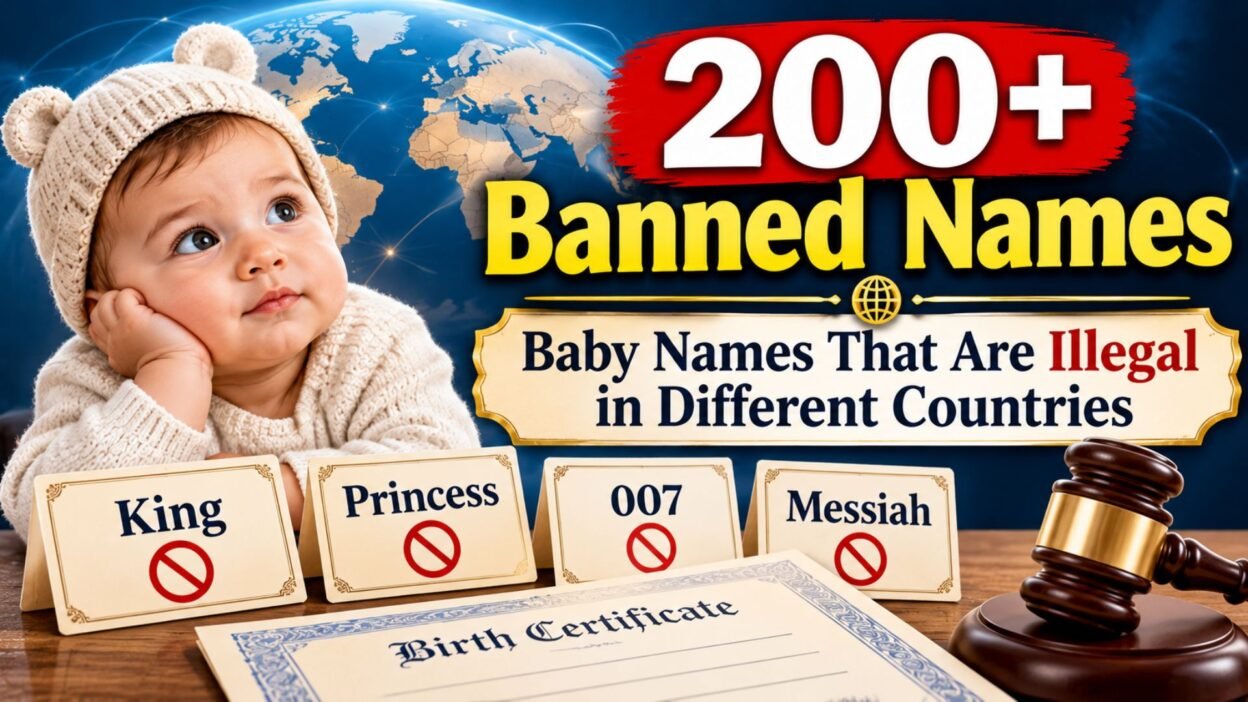
Choosing a baby name is a personal decision, but parents cannot always choose any name they want. Some countries have naming laws that restrict certain words, spellings, titles, symbols, and unusual combinations. These rules may prevent parents from using names that could confuse a child, cause embarrassment, or conflict with cultural and legal standards.
Banned names offer an interesting look at how different societies approach identity, language, and family traditions. Some restrictions involve offensive expressions, while others concern royal titles, religious references, or names that do not fit a country’s registration rules. However, a name that faces restrictions in one country may be perfectly acceptable somewhere else.
In this guide, you will discover examples of restricted baby names, the reasons authorities may reject them, and how naming regulations vary around the world.
Why Are Some Baby Names Banned?
Naming restrictions exist for several reasons. Governments generally balance parental freedom with a child’s interests, cultural traditions, language rules, and the practical needs of official records.
A name may face rejection for one or more of the following reasons.
Names That Could Embarrass a Child
Some authorities reject names that could expose children to ridicule, bullying, or unnecessary embarrassment. Offensive words, insults, and deliberately humiliating expressions may fall into this category.
For example, a name that sounds amusing to parents might become uncomfortable for a child during school, employment, or everyday social interactions.
Names That Resemble Royal or Official Titles
Words such as King, Queen, Prince, Princess, and Judge can create confusion when used as personal names. Some countries restrict them because they suggest an official position or social rank.
New Zealand, for example, has rejected several names involving royal titles and official designations.
New Zealand Legislation+1
Names Containing Numbers or Symbols
Birth registration systems need names that can be recorded consistently. Therefore, some countries restrict numbers, punctuation marks, unusual symbols, and excessively complicated combinations.
A name containing a number might look creative on social media, but it may not meet the requirements of a country’s civil registration system.
Religious or Culturally Sensitive Names
Some naming authorities consider religious beliefs, cultural traditions, and local naming customs when reviewing applications.
A proposed name may face restrictions if officials consider it offensive, inappropriate, or inconsistent with local conventions. However, rules differ considerably, and religious names are not automatically prohibited everywhere.
Names That Break Language Rules
Certain countries protect their linguistic traditions through naming regulations. They may require names to follow accepted spelling patterns, grammatical structures, or established naming conventions.
Iceland is a well-known example. Its naming rules consider whether a name fits Icelandic language structures and spelling conventions.
Banned Baby Names Around the World
There is no single international list of illegal baby names. Instead, individual countries apply their own registration laws and approval systems.
The following examples include names that authorities have rejected or restricted in particular circumstances. A rejection does not necessarily mean that the name is permanently illegal in every situation.
Banned Names in New Zealand
Examples from official registration records
New Zealand allows considerable freedom when choosing a baby’s name. However, the Registrar-General can refuse names that may offend a reasonable person, are unreasonably long, or resemble official titles and ranks without adequate justification.
The country’s Department of Internal Affairs has published several lists of declined names. Some notable examples include:
New Zealand Legislation+2
- King — Repeatedly declined because it represents a royal title.
- Prince — An official royal designation.
- Princess — A title associated with royalty.
- Queen — A royal title rather than an ordinary personal name.
- Bishop — A religious position.
- Major — A military rank.
- Judge — An official judicial designation.
- Captain — A recognized title or rank.
- Chief — A leadership designation.
- Royal — A word associated with royalty.
- Royalty — A term suggesting royal status.
- Empress — A royal title.
- Pope — A religious title.
- III — A Roman numeral used as a name.
- Messiah — A religiously significant title that has appeared among declined registrations.
An important detail is that New Zealand reviews proposed names individually. A name’s appearance on a declined list does not automatically establish a universal prohibition.
Banned Names in Iceland
Iceland has a formal personal naming system designed partly to preserve the structure of its language. Parents generally choose an approved name or submit an application for a new name to the Personal Names Committee.
The rules consider spelling, grammatical structure, and whether a name could cause its bearer embarrassment. Icelandic naming law also limits the number of given names.
The important restrictions concern:
- Names that do not fit Icelandic language structures.
- Spellings that conflict with Icelandic conventions.
- Names that could cause embarrassment.
- Proposed names requiring approval before registration.
- Excessive numbers of given names.
Unlike a simple list of forbidden words, Iceland’s system evaluates whether a proposed name meets established naming requirements. A name accepted elsewhere may therefore require special approval in Iceland.
Banned Names in Denmark
Denmark maintains official lists of approved first names. Parents can select a name from the relevant list or apply to have a new name approved.
Authorities consider whether a proposed name is suitable as a first name and whether it could be inappropriate or offensive. The rules also distinguish between traditionally recognized male and female names.
The Danish system is particularly interesting because an unfamiliar name is not necessarily permanently forbidden. Parents can request approval for a name that does not already appear on the official list.
Key naming restrictions include:
- Names considered unsuitable as first names.
- Names that may cause offence.
- Names that do not meet the country’s naming requirements.
- Names that conflict with applicable gender-based naming rules.
Banned Names in Sweden
Sweden uses a suitability-based approach to personal names. The Swedish Tax Agency reviews proposed first names under the country’s naming legislation.
A name may be rejected if it is unsuitable, has an extremely unusual spelling, is difficult to pronounce, or does not fit established naming conventions. However, a completely new name is not automatically unacceptable.
The Swedish approach demonstrates that naming restrictions are not always based on a fixed prohibited list. Authorities can examine the actual name and its circumstances before making a decision.
Banned Names in Portugal
Portugal uses official first-name registration rules and publishes lists of names that can be consulted by parents.
The country’s registration system considers whether a proposed name meets Portuguese naming conventions. Parents who want to use a name outside the accepted rules may need to seek guidance or approval from the relevant authority.
This approach can affect names that are familiar in other languages but do not follow Portuguese naming conventions.
Banned Names in Japan
Japan regulates the characters used in personal names through its family registration system. Parents cannot simply choose any combination of characters without considering the applicable legal requirements.
A further change took effect on May 26, 2025, requiring the reading of a person’s name to be recorded in the family register. The reading must follow the applicable standards for the characters used.
HushName
These rules focus on the written form and reading of a name rather than maintaining one universal list of forbidden baby names.
Famous Names That Have Faced Rejection
Some proposed baby names have attracted international attention because of unusual meanings, spelling, or cultural associations. These examples are useful reminders that naming authorities may consider more than personal preference.
- 4Real — New Zealand authorities declined this proposed name because it contained a number.
- Talula Does the Hula from Hawaii — A widely reported New Zealand case involving a lengthy phrase used as a child’s name.
- Chief Maximus — A proposed name reported as rejected in New Zealand because of its title-like wording.
- Nutella — A proposed French baby name that attracted legal attention because it was also a well-known commercial brand.
- Akuma — A Japanese name meaning devil, associated with a reported registration dispute.
These cases do not all represent the same legal situation. Some involved registration refusals, while others received attention through court proceedings or media reports.
Te Ara Encyclopedia of New Zealand+2
Types of Names That May Be Restricted
Beyond individual examples, certain naming styles are more likely to attract attention from registration authorities.
Offensive and Insulting Names
Names containing profanity, discriminatory expressions, or humiliating language may face rejection.
Examples of potentially problematic choices include:
- Idiot
- Ignorant
- Fool
- Loser
- Filthy
- Criminal
- Scumbag
These are illustrative examples, not a verified international list of legally prohibited names.
Royal and Noble Titles
Some countries restrict names that imply a person holds a royal or official position.
Examples include:
- King
- Queen
- Prince
- Princess
- Emperor
- Empress
- Duke
- Duchess
- Lord
- Baron
Military and Government Ranks
Names resembling professional ranks or public offices may also face registration difficulties.
Examples include:
- General
- Major
- Colonel
- Admiral
- Captain
- Sergeant
- President
- Governor
- Judge
- Sheriff
Numbers and Unusual Symbols
Some countries restrict names that contain characters unsuitable for official records.
Examples include:
- 007
- 4Real
- III
- 123
- @Home
- Baby#
- X-9
These examples illustrate unusual naming formats rather than a universal legal ban.
Countries With Different Baby Naming Rules
The following comparison highlights how different governments approach personal names.
Country
Main naming restriction
New Zealand
Offensive names, excessive length, and unjustified titles or ranks
Iceland
Language structure, spelling, and suitability
Denmark
Approved first names and suitability requirements
Sweden
Suitability, spelling, and naming conventions
Portugal
Official naming rules and accepted name forms
Japan
Permitted characters and recognized name readings
Sources: Official government information from New Zealand, Iceland, Denmark, Sweden, and Portugal.
New Zealand Legislation+4
Are Banned Names Illegal Everywhere?
No. A name rejected in one country may be completely acceptable in another.
For example, a country may reject a name because it resembles a royal title, while another country may have no specific restriction against using that word as a first name.
The same applies to foreign-language names. A name that does not follow one country’s spelling conventions may be perfectly valid under another country’s registration system.
It is also important to distinguish between three situations:
- Legally prohibited names: Names that cannot be registered under applicable laws.
- Rejected applications: Names that a registration authority has refused in a particular case.
- Restricted naming formats: Names that require changes or special approval before registration.
Understanding these differences helps prevent misleading claims about international naming laws.
How to Check Whether a Baby Name Is Allowed
If you are expecting a baby and have selected an unusual name, checking the local registration requirements can save time and frustration.
Consider these practical steps:
- Check official government guidance: Visit your country’s birth registration or civil registry website.
- Review approved name lists: Some countries publish searchable lists of accepted first names.
- Check spelling requirements: Unusual characters, numbers, and foreign spellings may require additional approval.
- Understand local traditions: Cultural and linguistic rules can influence whether a name is accepted.
- Contact the registration authority: Ask officials about unfamiliar names before submitting the birth registration.
Remember that online articles may contain outdated information. Official government guidance is a more reliable source when making an actual naming decision.
Frequently Asked Questions
What are banned names?
Banned names are personal names that a government or registration authority does not allow parents to register under particular naming laws. Restrictions may concern offensive meanings, official titles, unusual spelling, or cultural and linguistic requirements.
What are some examples of banned baby names?
Examples of names that have faced registration rejection include King, Prince, Princess, Royal, Bishop, and Messiah in New Zealand. Other reported cases include 4Real and Talula Does the Hula from Hawaii.
Which country has the strictest baby naming laws?
There is no universally accepted ranking of countries by naming restrictions. Iceland, Denmark, and Portugal have formal naming systems, while Sweden uses suitability requirements. Each country applies different standards.
Can parents choose any name for their baby in the United States?
The United States generally allows considerable freedom in choosing baby names. However, individual states have restrictions involving certain characters, numbers, symbols, and other registration requirements. There is no single federal list of prohibited baby names.
Why do countries ban certain baby names?
Governments may restrict names to protect children from embarrassment, prevent offensive language, preserve cultural traditions, maintain linguistic standards, and ensure that official records work properly.
Is the name King illegal?
Not everywhere. New Zealand has repeatedly declined registrations involving King because it resembles a royal title. However, the word is not universally prohibited as a personal name around the world.
Can a rejected baby name ever be approved?
Yes. Some countries allow parents to submit an application for a name that does not appear on an approved list. Authorities may review its spelling, meaning, cultural background, and suitability before making a decision.
Are unusual or unique baby names automatically banned?
No. An unusual name is not necessarily illegal. Many countries allow creative names as long as they meet basic registration requirements. The rules depend on the country and the circumstances.
Conclusion
Banned names reveal how differently countries approach personal identity, cultural traditions, and parental freedom. While some governments restrict royal titles, offensive expressions, and unusual spelling, others focus on protecting their language and established naming conventions.
A name rejected in one country may be perfectly acceptable in another. Therefore, parents should always check their local registration rules before choosing an unusual baby name. Ultimately, a good name should reflect personal meaning while giving a child an identity they can comfortably carry throughout life.
Is this conversation helpful so far?