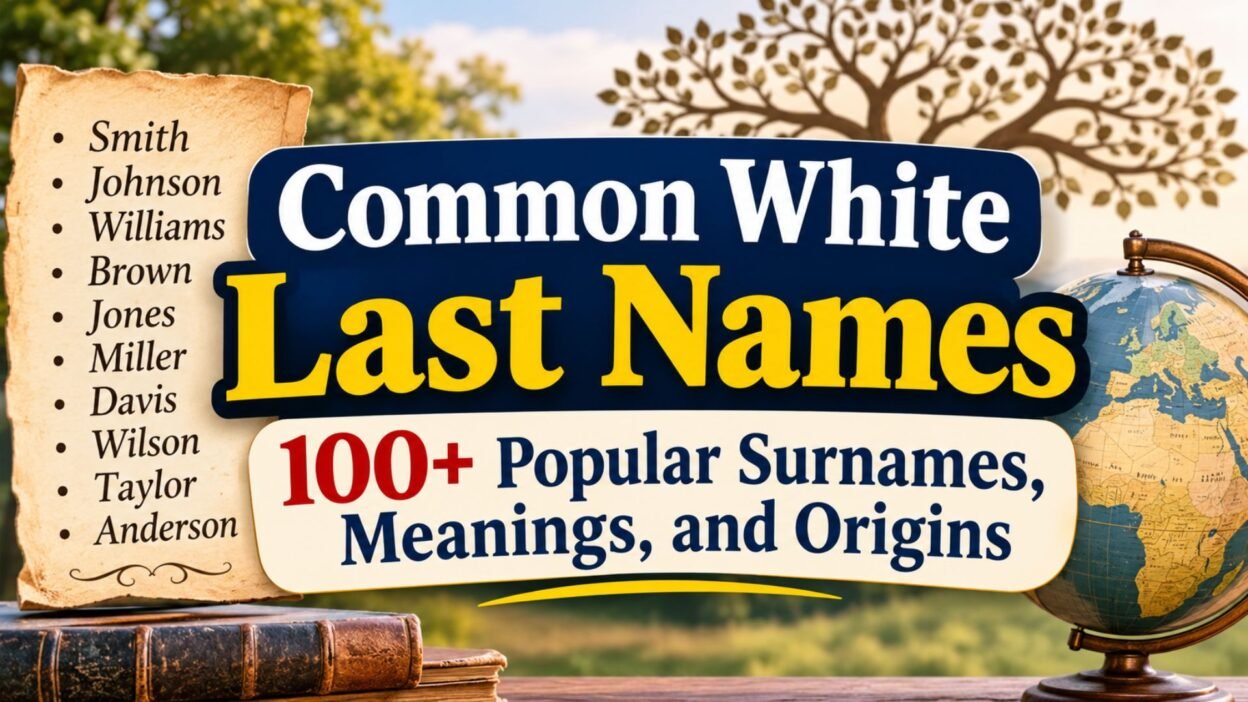
Common white last names often have roots in European countries, including England, Ireland, Scotland, Germany, France, Italy, and Scandinavia. Many surnames traveled to North America through immigration and became familiar across generations. Names such as Smith, Miller, Anderson, Wilson, Taylor, and Campbell are recognizable examples of surnames with European linguistic or historical backgrounds.
However, a surname does not prove someone’s race, ethnicity, or family identity. Many names are shared across different communities, and people with European-origin surnames can have diverse backgrounds. In this article, you will discover more than 100 familiar surnames, organized by cultural and linguistic origin, along with useful explanations of their meanings and naming traditions. Whether you are researching family history, developing a fictional character, or simply exploring traditional American and European family names, these collections offer a helpful starting point.
What Are Common White Last Names?
The phrase white last names generally refers to surnames commonly associated with people of European ancestry, particularly in countries such as the United States, Canada, the United Kingdom, and Australia.
Most of these surnames developed from occupations, personal characteristics, geographical locations, family relationships, or the names of ancestors. For example, Smith originally referred to a metalworker, while Johnson developed from a phrase meaning John’s son.
It is important to understand that no surname belongs exclusively to one racial group. The same family name can appear in communities with different ethnic and cultural backgrounds.
In the United States, the Census Bureau publishes surname frequency data and demographic information. Its 2020 Census surname release includes information about how people with different last names identified themselves. This provides a more useful picture than assuming that a name automatically identifies someone’s race.
Most Common White Last Names in America
Many familiar American surnames have English, Scottish, Irish, German, or other European origins. Some developed centuries ago, while others became widespread through migration and family settlement.
Here are popular examples that have long-standing associations with European naming traditions.
- Smith — An English occupational surname traditionally used for someone who worked with metal.
- Johnson — An English patronymic surname meaning son of John.
- Miller — An occupational surname for someone who operated a grain mill.
- Anderson — A Scandinavian and Scottish surname meaning son of Anders or Andrew.
- Wilson — An English and Scottish patronymic surname meaning son of Will.
- Taylor — An English and French occupational surname associated with tailoring.
- Thomas — A surname derived from the biblical given name Thomas.
- Moore — An English and Irish surname with several possible geographical and descriptive origins.
- Martin — A surname derived from the Latin name Martinus.
- Thompson — An English and Scottish surname meaning son of Thomas.
- White — An English surname that may have developed from a descriptive nickname or other historical sources.
- Clark — An occupational surname historically associated with a clerk or educated person.
- Lewis — A surname with Welsh, English, and other European naming traditions.
- Walker — An English occupational surname historically associated with someone who processed cloth.
- Hall — An English surname connected with a large residence or manor house.
- Allen — A surname with several possible British and Celtic roots.
- Young — An English and Scottish descriptive surname often associated with youth.
- King — An English surname that may have originated as a nickname or title-related name.
- Wright — An English occupational surname meaning a maker or craftsman.
- Scott — A surname historically associated with someone from Scotland.
These names work well for genealogy research, historical characters, and stories set in English-speaking communities. However, their meanings and family histories can vary depending on the particular family line.
Common English Last Names
English surnames developed through several naming traditions. Many came from occupations, villages, geographical features, personal characteristics, and relationships with parents.
Occupational names became especially familiar because communities often identified people by their work. As a result, names such as Baker, Cooper, Carter, and Fletcher remain recognizable today.
Here are traditional English surnames worth exploring:
- Baker — Originally referred to someone who made or sold bread.
- Cooper — An occupational name for a person who made wooden barrels.
- Carter — Traditionally associated with someone who transported goods using a cart.
- Bennett — Derived from Benedict, a name associated with the meaning blessed.
- Parker — Originally referred to someone who managed or maintained a park.
- Fletcher — An occupational surname for someone who made arrows.
- Turner — Associated with a craftsperson who shaped wood or other materials on a lathe.
- Harrison — A patronymic surname meaning son of Harry.
- Harris — Traditionally derived from the given name Harry.
- Collins — A surname with several possible British and Irish origins.
- Bailey — Connected with historical administrative or occupational roles.
- Bennett — A form derived from the medieval given name Benedict.
- Palmer — Historically associated with a pilgrim who had visited the Holy Land.
- Webb — An occupational surname for a weaver.
- Porter — Originally associated with a gatekeeper or someone who carried goods.
- Chapman — An old occupational name for a merchant or trader.
- Dixon — A patronymic surname meaning son of Dick.
- Harvey — A surname derived from an old personal name with Breton and Norman connections.
- Gibson — A patronymic surname meaning son of Gib.
- Atkinson — An English surname meaning son of Atkin.
English surnames are particularly useful when creating characters for historical fiction, traditional family stories, or settings inspired by British culture.
Common Irish Last Names
Irish surnames often contain recognizable prefixes such as O’ and Mc. These elements can indicate family relationships and connections to earlier generations.
The prefix O’ traditionally means descendant of, while Mc or Mac generally means son of. Nevertheless, not every Irish surname follows these patterns.
Some Irish surnames also have connections to Gaelic personal names, historical family groups, and geographical locations.
Popular Irish family names include:
- Murphy — An anglicized form of an Irish surname associated with the Gaelic name Murchadh.
- Kelly — Derived from several Irish family names, including Ó Ceallaigh.
- Sullivan — An anglicized form of Ó Súilleabháin.
- Ryan — Derived from the Irish surname Ó Riain.
- O’Brien — Associated with the historic Irish family name Ó Briain.
- O’Connor — Derived from Ó Conchobhair, a traditional Irish family name.
- McCarthy — An anglicized form of Mac Cárthaigh.
- Walsh — Historically associated with people of Welsh origin in Ireland.
- Byrne — Derived from the Irish surname Ó Broin.
- Doyle — An anglicized form of Ó Dubhghaill.
- Gallagher — Derived from Ó Gallchobhair.
- Kennedy — An anglicized form of Ó Cinnéide.
- Fitzgerald — A Norman-Irish surname with the meaning son of Gerald.
- Dunne — Derived from the Irish surname Ó Duinn.
- Flanagan — An anglicized form of Ó Flannagáin.
Irish surnames are especially recognizable because of their distinctive spelling patterns and connections to Gaelic history. They can also help readers explore family ancestry and traditional Irish naming practices.
Common Scottish Last Names
Scottish surnames often reflect clan relationships, geographical origins, and family connections. Some names developed from Gaelic words, while others came from older Scottish and northern British naming traditions.
Names beginning with Mac or Mc are particularly familiar in Scotland. However, these prefixes also appear in Irish surnames.
Popular Scottish family names include:
- Campbell — A Scottish surname traditionally associated with the Gaelic nickname meaning crooked mouth.
- Stewart — Originally connected with the historical occupation of steward or household administrator.
- MacDonald — A patronymic surname meaning son of Donald.
- MacGregor — A traditional Scottish clan surname associated with the Gaelic name Mac Griogair.
- Fraser — A well-known Scottish surname with historical connections to Norman and Scottish families.
- Graham — A surname associated with a historic Scottish family and geographical origins.
- Douglas — Derived from a Scottish place name connected with dark water.
- Murray — A Scottish surname associated with the historic region of Moray.
- Cameron — A Scottish surname traditionally connected with the Gaelic meaning crooked nose.
- Wallace — A surname historically associated with people from Wales or Britain.
- Mackenzie — A Scottish patronymic surname derived from Gaelic Mac Coinnich.
- Sinclair — A surname of Norman and Scottish historical background.
- Ross — A Scottish surname associated with geographical features and places.
- Gordon — A surname connected with a historic place and family in Scotland.
- Armstrong — A Scottish and northern English surname traditionally associated with a descriptive nickname.
Scottish surnames are useful for stories involving clans, medieval settings, traditional family histories, and characters with Scottish-inspired backgrounds.
Common German Last Names
German surnames often originated from occupations, geographical locations, personal characteristics, and family relationships. Many became familiar in the United States through German immigration.
Some names have straightforward occupational meanings, while others have developed different forms over centuries.
Here are common German surnames:
- Schmidt — A German occupational surname meaning smith or metalworker.
- Schneider — Traditionally referred to a tailor.
- Fischer — A German surname meaning fisherman.
- Weber — An occupational surname meaning weaver.
- Meyer — Historically associated with a farm administrator or estate manager.
- Wagner — An occupational name for a wagon maker.
- Becker — A German surname associated with baking.
- Hoffmann — Traditionally connected with a farm or estate manager.
- Schulz — Historically associated with an administrative or local official.
- Bauer — A German word meaning farmer.
- Richter — An occupational surname meaning judge.
- Koch — A German surname meaning cook.
- Klein — A descriptive surname meaning small.
- Wolf — A surname derived from the German word for wolf or related personal names.
- Zimmermann — An occupational surname meaning carpenter.
German surnames can be particularly useful for understanding family records because many preserve clues about the occupations and communities of earlier generations.
Common French Last Names
French surnames developed from several sources, including occupations, geographical locations, personal names, and descriptive characteristics.
Some have recognizable French spellings, while others have changed as families moved to English-speaking countries.
Consider these traditional French family names:
- Martin — A French surname derived from the Latin personal name Martinus.
- Bernard — Derived from an old Germanic personal name associated with strength and bravery.
- Dubois — A French surname meaning from the woods.
- Moreau — A surname with historical connections to a descriptive nickname.
- Laurent — Derived from the Latin name Laurentius.
- Simon — A surname based on the personal name Simon.
- Michel — Derived from the given name Michael.
- Leroy — Literally meaning the king in French.
- Garcia — A surname with Spanish and Basque historical roots, not originally French.
- Rousseau — A French surname traditionally associated with reddish hair or complexion.
- Fontaine — A geographical surname meaning fountain or spring.
- Lambert — Derived from a Germanic personal name.
- Chevalier — A French surname meaning knight.
- Blanc — A French surname meaning white.
- Marchand — An occupational surname meaning merchant.
French surnames can suit historical characters, family-history projects, and fictional families inspired by French culture. Remember that French-speaking communities also have surnames from many other linguistic backgrounds.
Common Scandinavian Last Names
Scandinavian surnames come from countries such as Sweden, Norway, Denmark, and Iceland. Their naming traditions include patronymic surnames, geographical names, and family names inspired by nature.
Some Scandinavian surnames end in -son or -sen, reflecting historical naming patterns connected with family relationships.
Examples include:
- Andersson — A Swedish patronymic surname meaning son of Anders.
- Johansson — A Swedish surname meaning son of Johan.
- Karlsson — Meaning son of Karl.
- Eriksson — Meaning son of Erik.
- Larsson — Meaning son of Lars.
- Svensson — Meaning son of Sven.
- Hansen — A Scandinavian and Danish-Norwegian surname meaning son of Hans.
- Nielsen — A Danish and Norwegian patronymic surname meaning son of Niels.
- Larsen — Meaning son of Lars.
- Olsen — Meaning son of Ole.
- Lindberg — A Swedish surname combining elements associated with a linden tree and mountain.
- Lindgren — A Swedish nature-inspired surname associated with a linden tree and branch.
- Bergström — A Swedish surname combining words associated with mountain and stream.
- Nyström — A Swedish surname combining elements meaning new and stream.
- Dahl — A Scandinavian surname meaning valley.
These surnames are useful when exploring Scandinavian heritage or creating characters inspired by Nordic settings.
Common Italian Last Names
Italian surnames frequently developed from personal names, occupations, geographical features, and family nicknames. Some have recognizable regional variations, making them especially interesting for family-history research.
Popular Italian family names include:
- Rossi — An Italian surname traditionally associated with red coloring or red hair.
- Russo — A surname related to the word for red or reddish.
- Ferrari — An occupational surname connected with ironworkers or blacksmiths.
- Esposito — Historically associated with children who were exposed or abandoned, particularly in certain Italian naming records.
- Romano — A surname meaning Roman or someone connected with Rome.
- Colombo — Derived from the Italian word for dove.
- Ricci — Traditionally associated with curly hair.
- Marino — Derived from the Latin word marinus, meaning of the sea.
- Greco — An Italian surname meaning Greek.
- Bruno — Derived from a personal name associated with brown coloring.
- Gallo — An Italian surname meaning rooster.
- Costa — A geographical surname associated with a coast or hillside.
- Conti — Connected with the historical title count.
- De Luca — A patronymic surname meaning of Luca or from Luca’s family.
- Lombardi — A surname historically associated with Lombardy or the Lombard people.
Italian surnames can add a distinctive cultural background to fictional characters. However, a surname alone cannot establish someone’s precise region or family history.
Traditional and Old-Fashioned European Last Names
Some surnames have a traditional sound because they have appeared in family records, historical documents, literature, and older communities for generations.
If you are creating a character from another era or researching an established family name, these options may be suitable.
- Montgomery — A surname with Norman and French geographical connections.
- Chamberlain — An occupational surname associated with an official responsible for household or financial duties.
- Whitaker — An English geographical surname associated with a white field or acre.
- Kensington — A surname connected with an English place name.
- Fairchild — An English surname with historical descriptive and family-name associations.
- Harrington — A surname derived from several English place names.
- Ashford — An English geographical surname associated with a place near an ash tree or river crossing.
- Winchester — A surname derived from an English place name.
- Sinclair — A traditional surname with Norman and Scottish connections.
- Beaumont — A French-derived surname meaning beautiful mountain.
- Kingsley — An English surname connected with a place name.
- Wellington — A surname associated with an English place name.
- Livingston — A Scottish surname connected with a historical place.
- Bellingham — An English geographical surname.
- Westbrook — An English surname associated with a western stream or settlement.
These names can work well for period fiction, historical settings, and characters from established fictional families. Nevertheless, a traditional-sounding surname does not automatically indicate wealth, noble ancestry, or aristocratic status.
Short and Simple European Last Names
Short surnames are easy to pronounce, remember, and combine with different first names. They can also work particularly well for fictional characters, online profiles, and creative writing.
Here are some recognizable options:
- Ford — An English geographical surname associated with a shallow river crossing.
- Reed — An English surname that may refer to reed plants or reddish coloring.
- Lane — An English geographical surname associated with a narrow road or pathway.
- Wood — A surname connected with a wooded area.
- Stone — An English surname derived from a geographical feature or descriptive nickname.
- Hill — A geographical surname associated with a raised landscape.
- Dean — A surname connected with a valley or an official title, depending on its origin.
- Reid — A Scottish surname traditionally associated with red hair or complexion.
- Bell — A surname with several possible occupational and descriptive origins.
- Shaw — An English and Scottish surname associated with a small wood or thicket.
- West — A geographical surname indicating a western location.
- Frost — An English surname that may have originated as a nickname.
- Day — A surname with several possible historical origins.
- Long — A descriptive surname historically associated with height or length.
- Cole — A surname derived from an old personal name or descriptive nickname.
Short surnames are especially convenient when you want a clean, memorable full name without a complicated spelling.
How to Choose a European Last Name
Selecting a surname involves more than finding something that sounds attractive. Its cultural background, pronunciation, meaning, and compatibility with a first name can all affect the final choice.
Consider these practical tips:
- Match the cultural background: If your character has an Irish family history, an Irish surname such as Murphy or Gallagher may feel more appropriate.
- Check the meaning: Research the surname before using it, particularly if its historical meaning is important to your project.
- Consider pronunciation: Names such as Schmidt and Mackenzie have different pronunciation patterns. Choose something suitable for your intended audience.
- Think about the time period: A surname used in medieval Scotland may create a different impression from a modern American family name.
- Consider regional differences: European countries often have several regional naming traditions. A German surname may not have the same background as a Scandinavian one.
- Avoid assumptions: Never assume that someone has a particular ethnicity, nationality, or family history simply because of their last name.
For fictional characters, combining a suitable first name with a culturally consistent surname can make the character feel more believable.
Frequently Asked Questions
What Are the Most Common White Last Names?
Some familiar surnames associated with European ancestry in the United States include Smith, Johnson, Miller, Anderson, Wilson, Taylor, Thomas, Moore, Clark, and Walker. However, these surnames are not exclusive to white people.
What Are Some Traditional White American Last Names?
Traditional examples include Smith, Miller, Thompson, Harrison, Baker, Carter, Wilson, Davis, Cooper, and Wright. Many have English, Scottish, German, or other European linguistic origins.
What Are Common White Last Names of English Origin?
Popular English surnames include Smith, Taylor, Baker, Parker, Walker, Clark, Harrison, Carter, Cooper, and Fletcher. Many originally described a person’s occupation or family relationship.
What Are Some Common Irish Last Names?
Well-known Irish surnames include Murphy, Kelly, Sullivan, Ryan, O’Brien, O’Connor, Byrne, Doyle, Gallagher, and Kennedy. Several have roots in traditional Gaelic family names.
What Are Some Common German Last Names?
Common German surnames include Schmidt, Schneider, Fischer, Weber, Wagner, Becker, Meyer, Bauer, Richter, and Hoffmann. Many developed from traditional occupations.
Do White Last Names Have Specific Meanings?
Many European-origin surnames have historical meanings. For example, Smith refers to a metalworker, Miller refers to someone associated with a mill, and Baker describes someone who made bread. However, some surnames have several possible origins.
Can a Last Name Tell You Someone’s Ethnicity?
No. A surname may provide clues about linguistic or family history, but it cannot reliably establish someone’s ethnicity or racial identity. Migration, marriage, adoption, and cultural changes have influenced surnames across generations.
What Is the Difference Between European and American Last Names?
European surnames often reflect the language and naming traditions of their original regions. American surnames, meanwhile, come from many cultural backgrounds because of immigration and historical population changes. Many American families still carry surnames that originated in Europe.
Conclusion
Common white last names often reflect the diverse languages, occupations, geographical locations, and family traditions of Europe. From English surnames such as Smith and Taylor to Irish names such as Murphy and Sullivan, each group offers a glimpse into different naming histories. German, Scottish, French, Italian, and Scandinavian surnames provide even more variety. Whether you are exploring ancestry, researching traditional family names, or choosing a surname for a fictional character, understanding its origin and meaning can help you make a more informed choice. Remember that surnames connect people to family histories, but they do not define someone’s race or identity.


