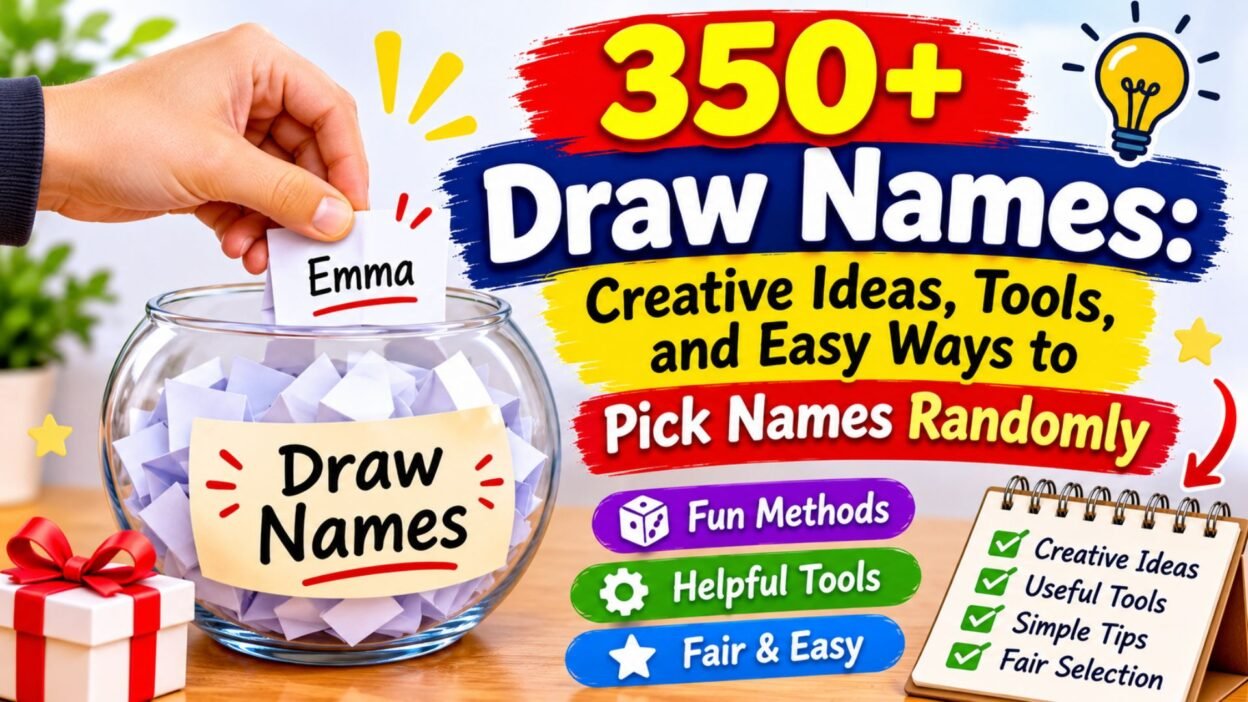
Choosing names for a group activity, classroom game, gift exchange, or friendly competition can be much easier with a simple name-drawing method. Draw names usually refers to selecting one or more people randomly from a group, often to make a fair and unbiased choice. It can also describe online name-picker tools that help organize the process without using paper slips.
Whether you are planning a Secret Santa exchange, assigning classroom tasks, choosing team members, or deciding who goes first in a game, the right approach can save time and avoid confusion. This guide explains different ways to draw names, explores useful online options, and shares practical tips for making random selections fairly. You will also find ideas for different group activities and guidance on choosing a method that fits your needs.
What Does It Mean to Draw Names?
To draw names means to select people from a list, container, or digital name picker. The selection can be completely random, or it can follow specific rules depending on the activity.
For example, a teacher might draw a student’s name to answer a question. Meanwhile, a family might draw names to decide who buys a holiday gift for whom.
The process usually follows one of two approaches:
- Random selection: Each eligible person has a chance of being selected.
- Assigned name drawing: Participants receive another person’s name according to rules, such as a Secret Santa exchange where nobody draws themselves.
The difference matters because selecting one winner is not the same as assigning everyone a recipient. A simple random picker works well for choosing a volunteer, whereas a gift exchange needs a method that gives each participant a valid assignment.
Best Ways to Draw Names Randomly
The best method depends on your group size, available equipment, and whether the results need to remain secret. For a small gathering, paper slips may be enough. However, an online name picker can make larger draws easier to organize.
Draw Names Using Paper Slips
Hands drawing folded paper slips from basket
Paper slips offer a straightforward way to draw names without using a phone or computer. They work especially well for classrooms, family gatherings, parties, and small office activities.
To organize a paper draw:
- Write each participant’s name on an identical slip of paper.
- Fold the slips in the same way so nobody can identify a name by its appearance.
- Place all the slips in a bowl, hat, or box.
- Mix the slips thoroughly.
- Let each participant draw one when appropriate.
- Check the results against your activity’s rules.
This method is inexpensive and creates a fun, suspenseful moment. However, the organizer must prevent accidental peeking, duplicate entries, and situations where someone draws their own name.
Use an Online Random Name Picker
Wheel of Names: A Fun Way to Transform Your Teaching & Create an
An online random name picker lets you enter a list of names and select one or more entries digitally. Depending on the tool, you might see a spinning wheel, shuffled list, or randomly selected result.
This option is particularly useful when you need to select a classroom participant, choose a game winner, assign a presentation order, or decide which team goes first.
Before using a tool, check whether it supports the features you need:
- Adding multiple names quickly.
- Selecting one or several entries.
- Removing a selected name before the next draw.
- Preventing duplicate selections when necessary.
- Keeping results hidden when privacy matters.
A basic name picker may not support every feature. For example, selecting several winners without repeating a person requires a tool that handles unique selections.
Draw Names With a Secret Santa Generator
Comment organiser un Secret Santa parfait | Tilune
A Secret Santa generator does more than pick a single name. It assigns each participant another person to buy a gift for, usually while preventing anyone from drawing themselves.
Some tools also support exclusions, gift budgets, exchange dates, wish lists, and private result links. The exact features depend on the service.
drawnames UK+1
This method works well for:
- Family Christmas exchanges.
- Office gift swaps.
- Friend groups.
- Classroom celebrations.
- Holiday parties.
- Other occasions when participants exchange gifts.
For a successful draw, finalize the participant list before generating assignments. Also, decide whether couples, household members, or previous gift partners should be excluded from drawing one another.
Draw Names From a Spreadsheet
A spreadsheet is another useful option when organizing a large group or recurring activity. You can list participant names in one column, assign identification numbers, and use spreadsheet functions to randomize their order.
For a simple selection, place names in a column and use a random-number formula to help shuffle the entries. Then sort the names by the generated random values.
However, a shuffled list is not automatically a complete Secret Santa assignment system. If each person must receive a different recipient and nobody can draw themselves, you need additional checks to validate the assignments.
Spreadsheets are especially helpful for teachers, event organizers, and team leaders who need to keep a record of participants and results.
Best Draw Names Ideas for Different Activities
Name drawing becomes more enjoyable when the selection method matches the activity. Here are practical ways to use it across different settings.
Draw Names for Classroom Activities
Teachers can use name drawing to make participation more balanced and introduce variety into lessons. Rather than repeatedly calling on the same volunteers, a teacher can select students from a prepared list.
Useful classroom ideas include:
- Choosing a student to answer a question.
- Selecting a presenter for a group activity.
- Assigning classroom responsibilities.
- Picking a team leader.
- Choosing a reading partner.
- Deciding the order of student presentations.
- Selecting a participant for a classroom game.
For younger students, paper slips or a visible name wheel can make the activity engaging. Digital tools may be more convenient for larger classes.
Still, random selection should support learning rather than embarrass students. Give learners a reasonable opportunity to participate, and provide an alternative when someone needs one.
Draw Names for Secret Santa and Gift Exchanges
Secret Santa is one of the most useful situations for drawing names because each participant needs a specific recipient.
A successful exchange starts with clear rules. Decide on the budget, exchange date, participant list, and any restrictions before the draw.
For example, a group of friends might agree to spend no more than $20 per gift. Each person then receives one recipient and prepares a gift for that individual.
To keep the exchange fair:
- Include only confirmed participants.
- Prevent self-assignments.
- Decide whether mutual gift pairings are acceptable.
- Keep individual assignments private when secrecy matters.
- Establish a plan for participants who cancel after the draw.
Online generators can simplify these arrangements, particularly when people live in different locations. Some services also let organizers exclude particular pairings and share individual results privately.
InviteBird+1
Draw Names for Office Activities
Workplaces can use random name drawing to organize team activities, informal recognition, and social events.
Consider these ideas:
- Select a colleague to lead a meeting icebreaker.
- Assign employees to discussion groups.
- Organize a workplace gift exchange.
- Choose presentation order.
- Pick a team for a friendly challenge.
- Select a volunteer for a nonessential task.
For workplace activities, explain the rules before drawing names. Participation in social activities should remain voluntary, and organizers should avoid using random selection to assign sensitive responsibilities or make consequential employment decisions.
Draw Names for Parties and Games
A random draw can settle small decisions without lengthy discussions. It can also add excitement to a party by allowing everyone to see the selection happen.
Try drawing names to:
- Choose the first player.
- Select a participant for charades.
- Decide who answers a trivia question.
- Assign people to game teams.
- Choose a prize winner from eligible entries.
- Select someone to choose the next activity.
If the game involves several rounds, decide whether a selected person returns to the pool. Removing each selected name creates a different result from allowing repeat selections.
Draw Names for Online Groups
Online groups can use digital name drawing even when members cannot meet in person. A shared list and an online tool may be enough for a simple activity.
For example, friends can use a name picker to select a game leader, while a remote team can use a gift-exchange generator to assign recipients.
When using online services, consider privacy before entering participant information. First names or recognizable nicknames are usually sufficient for many casual activities. Avoid sharing phone numbers, addresses, or other personal information unless the service genuinely needs it.
How to Draw Names Fairly
A fair name draw begins with a complete list, a suitable selection method, and clear rules. Randomness alone does not guarantee fairness if the participant list contains errors or the organizer changes the process halfway through.
Follow these guidelines to reduce mistakes.
Prepare the Participant List
Start by confirming who is eligible to participate. Remove duplicate entries and check spelling so each person appears correctly.
If two people share a name, add a surname initial or another simple identifier. This prevents confusion when you reveal the results.
For group activities, confirm participation before drawing. Otherwise, someone may be selected who cannot take part.
Decide Whether Names Can Repeat
The rules should specify whether a person can be selected more than once.
For example, when selecting one winner from a list, you may need only a single result. If you are choosing five different winners, you generally want five distinct participants.
For a Secret Santa exchange, each participant normally gives to one person and receives a gift from one person. The assignment must therefore satisfy additional restrictions.
Use the Same Rules for Everyone
Do not give some participants extra entries unless the activity explicitly allows it. If every person should have an equal chance, use one entry per participant and apply the same selection process throughout.
For a contest with multiple entries per person, explain the eligibility rules beforehand. The draw can only be fair relative to the rules the group has agreed to follow.
Make the Process Transparent
For a casual group activity, drawing names in front of participants can help everyone understand how the selection happens.
For online draws, explain how the tool handles repeat selections, exclusions, and results. If the draw determines a significant prize or official outcome, use a method appropriate to the stakes and keep a record of the procedure.
Keep Private Results Confidential
Not every name draw needs public results. Secret Santa assignments, for example, work best when each participant sees only their own recipient.
Choose a tool that supports private results if confidentiality matters. Also, review how the service handles stored names and shared links before using it.
How to Draw Names Online Step by Step
The exact process depends on the tool, but most simple random name pickers follow a similar workflow.
- Prepare the names: Create a clean list of eligible participants.
- Open a name picker: Choose a tool that supports the type of draw you need.
- Enter the list: Add each participant once, unless the rules allow multiple entries.
- Set the options: Choose the number of selections and decide whether names should be removed after selection.
- Run the draw: Use the tool’s selection feature to generate the result.
- Check the outcome: Confirm that the selection follows your rules.
- Share the result: Announce the winner or privately send assignments to the appropriate participants.
For a Secret Santa exchange, choose a dedicated generator instead of a basic single-name picker. That way, the tool can account for self-assignment restrictions and other matching rules.
Frequently Asked Questions
What is the easiest way to draw names?
For a small group, write names on paper slips and draw them from a bowl. For a larger group, an online random name picker is usually more convenient. Choose a dedicated assignment tool when participants must receive different names.
Is there a free way to draw names online?
Yes. Several online services offer free name drawing or Secret Santa features. For example, the drawnames app advertises free participation without registration, while other generators offer browser-based draws with different privacy options. Check each tool’s current features before using it.
drawnames UK+1
Can I draw names without repeating anyone?
Yes. Choose a random picker that supports removing selected names or selecting unique entries. For a group assignment, use a tool designed to create valid assignments rather than simply shuffling a list.
How do I draw names for Secret Santa?
Confirm the participants, agree on a budget and exchange date, and use paper slips or a Secret Santa generator. Ensure that nobody draws themselves. If necessary, add exclusions for couples or other participants who should not be matched.
Can I draw names from a list on my phone?
Yes. Many browser-based name pickers and gift-exchange tools work on phones. Enter the names, configure the selection rules, and run the draw. Check the tool’s mobile compatibility and privacy practices before entering personal information.
How many people do I need for a name draw?
It depends on the activity. You can draw one winner from a list of two or more eligible people. Secret Santa exchanges generally require at least three participants to give everyone a different recipient without self-assignments.
Is an online name draw truly random?
It depends on how the tool generates its results. A well-designed random picker should use an appropriate randomization method and follow the stated rules. For important contests, review the tool’s methodology and use a process that participants can trust.
What should I do if someone drops out after names are drawn?
Review the rules and determine whether the activity needs a redraw or a smaller adjustment. In a gift exchange, changing one participant’s assignment may affect several others, so check the entire arrangement before announcing revised results.
Conclusion
Drawing names is a simple way to make group decisions, organize activities, and create excitement for games or gift exchanges. Paper slips work well for small gatherings, while online name pickers offer a convenient option for larger groups. For Secret Santa, choose a dedicated generator that handles self-assignment restrictions and keeps results private when needed.
Before starting, confirm the participant list, establish clear rules, and choose a method that fits your activity. With a little preparation, you can draw names fairly, avoid unnecessary confusion, and make the experience enjoyable for everyone.
Is this conversation helpful so far?