
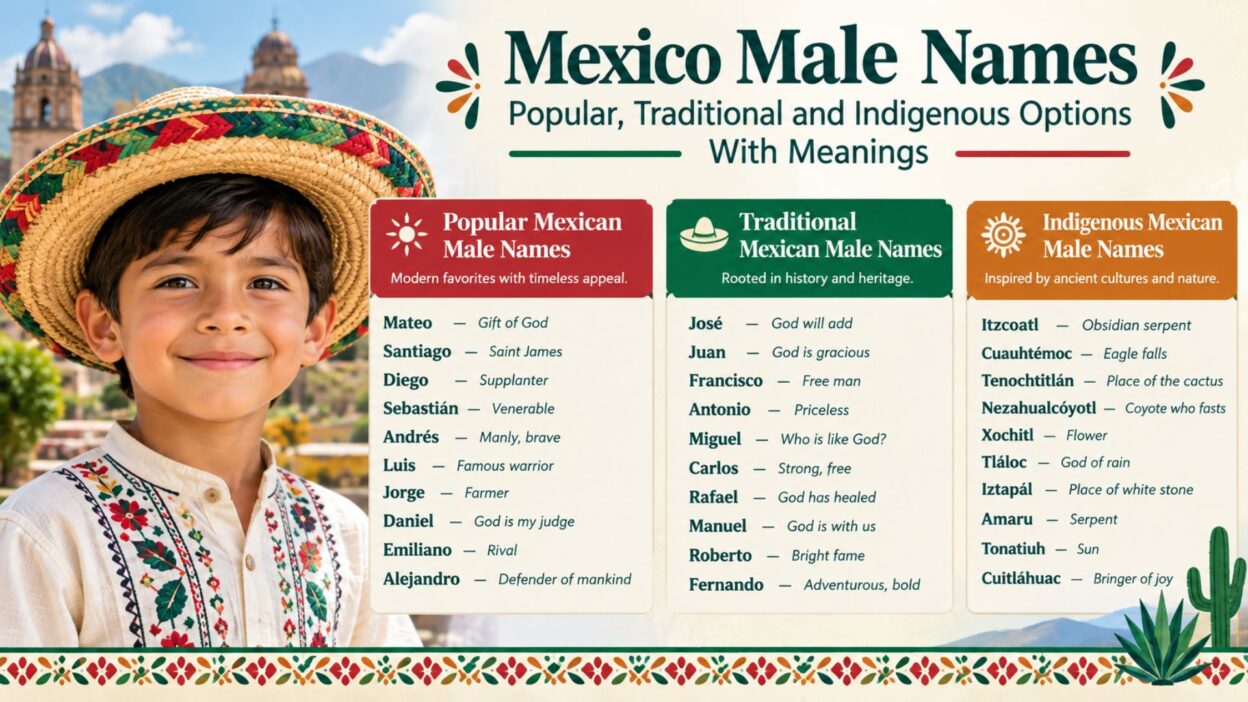
Mexico male names draw on three big sources: Catholic tradition, Spanish heritage and the indigenous languages of Mesoamerica. As a result, you will find everything from saint-inspired classics to names that come straight from Nahuatl and Maya. Mexican naming has also changed quickly. Parents once chose names from the saints’ calendar, but that habit has faded. forbes
This guide sorts names by how people actually search for them. You will find today’s most popular choices, enduring classics, indigenous names, names that honor Mexican history, compound names, short names and everyday nicknames. A short section on how Mexican names are structured follows, then practical tips for choosing one. Whether you are naming a baby, a character or a family tree entry, start with the names below.
Most Popular Mexican Male Names Today
Mexico’s national statistics agency, INEGI, publishes birth-registration data. In 2022, Mexico registered about 1.89 million births, and Santiago was the top boy’s name. Meanwhile, the rest of the top ten included Mateo, Sebastián, Leonardo, Matías, Daniel, Emiliano, Miguel Ángel, Diego and Alejandro. The list below follows that ranking order. nancynancy
- Santiago — The Spanish form of “Saint James,” and a favorite for years.
- Mateo — The Spanish form of Matthew, usually read as “gift of God.”
- Sebastián — A Greek-rooted name with a classic, easy-to-pronounce sound.
- Leonardo — A Germanic name often interpreted as “brave lion.”
- Matías — A close cousin of Mateo with the same “gift of God” meaning.
- Daniel — A Hebrew name meaning “God is my judge.”
- Emiliano — Rooted in the Roman family name Aemilius, and linked in Mexico to revolutionary hero Emiliano Zapata.
- Miguel Ángel — A compound of Michael and “angel” that works as a single given name.
- Diego — A Spanish name of debated origin, often connected to Santiago or to a Latin word for “teaching.”
Notably, international spellings also make the charts. For instance, Alexander appeared in the top ten for both 2019 and 2020. forbesnancy
Classic Mexican Male Names
Classic names fill family trees across the country. Many come from the Bible or from saints, so you will hear them in every generation. They suit parents who want a name that feels timeless and works easily in both Spanish and English.
- José — The Spanish form of Joseph, meaning “he will add.”
- Juan — From Hebrew, usually translated as “God is gracious.”
- Luis — A Germanic name often explained as “famous warrior.”
- Carlos — The Spanish form of Charles, meaning “free man.”
- Francisco — Traditionally read as “Frenchman,” and the source of several well-loved nicknames.
- Antonio — A Roman family name with a warm, familiar sound.
- Manuel — A Hebrew name meaning “God is with us.”
- Jesús — A widely used name meaning “savior,” with Hebrew roots.
- Fernando — A Germanic name with a regal, old-world feel.
- Javier — Often traced to a Basque phrase meaning “new house.”
- Rafael — A Hebrew name meaning “God has healed.”
- Salvador — A Latin-rooted name meaning “savior.”
- Guillermo — The Spanish form of William, often read as “resolute protector.”
- Héctor — A Greek name associated with steadfastness.
- Ernesto — A strong, serious name meaning “earnest.”
- Joaquín — A Hebrew name meaning “God will establish.”
- Gabriel — A Hebrew name meaning “God is my strength.”
- Eduardo — A name meaning “wealthy guardian.”
Indigenous Male Names From Mexico
Nahuatl, the language of the Aztecs, and the Maya languages offer some of the most distinctive options. These names often point to nature, the sky or warrior qualities. However, a few belong to deities or historical rulers, so think about the weight each one carries before you choose.
Pronunciation helps, too. For example, Cuauhtémoc sounds roughly like “kwow-TEH-mok.”
- Cuauhtémoc — Often translated as “descending eagle,” and the name of the last Aztec emperor.
- Tonatiuh — Nahuatl for “sun,” and the name of the Aztec sun god.
- Ehécatl — Means “wind” in Nahuatl, and also names a wind deity.
- Nezahualcóyotl — The name of the poet-king of Texcoco, usually read as “fasting coyote.”
- Itzcóatl — Often translated as “obsidian serpent,” and borne by an Aztec ruler.
- Mixcóatl — Commonly read as “cloud serpent.”
- Ollin — A short Nahuatl word for “movement.”
- Yaotl — Often linked to “warrior” or “enemy.”
- Ocelotl — Means “jaguar,” a symbol of strength in Mesoamerican culture.
- Cuauhtli — A simple Nahuatl word for “eagle.”
- Atl — A brief, modern-feeling name meaning “water.”
- Balam — A Maya word for “jaguar.”
- Kinich — A Maya name connected to the sun.
- Canek — A Yucatec Maya name often read as “black serpent.”
Mexican Male Names That Honor National History
Mexican parents often name sons after independence leaders, presidents, artists and writers. These names carry pride without sounding overly formal. Furthermore, each one comes with a ready-made story to tell your child.
- Benito — Recalls Benito Juárez, the reformist president.
- Vicente — Honors independence fighter Vicente Guerrero and singer Vicente Fernández.
- Ignacio — Recalls Ignacio Allende, a leader of the independence movement.
- Venustiano — A distinctive nod to Venustiano Carranza of the Mexican Revolution.
- Lázaro — Honors President Lázaro Cárdenas, who nationalized the oil industry in 1938.
- Octavio — Links to Octavio Paz, the Nobel Prize–winning poet.
- Pedro — Evokes Pedro Infante, a star of Mexican cinema’s Golden Age.
Compound Mexican Male Names
Two-part given names are common in Mexico. Typically, the first part acts as the everyday name, although families sometimes use both. Parents often honor a grandfather, a saint or two relatives at once.
Spanish naming also has no middle-name tradition. Instead, the second name belongs to the full given name.
- José Luis — A familiar pairing that works across generations.
- Juan Carlos — Combines two classics into one steady, friendly name.
- José Antonio — Pairs a biblical name with a Roman one.
- Luis Ángel — A gentle, modern-sounding compound.
- Juan Pablo — Adds the apostle Paul to a timeless first name.
- José Manuel — A traditional choice that often honors two family members.
- Luis Fernando — Balances a short opening name with a longer one.
- José María — A traditional male compound, so don’t confuse it with the female María José.
- Juan Manuel — A smooth pairing that flows easily when spoken aloud.
- Luis Miguel — A pairing made famous by the singer of the same name.
- Juan Diego — Recalls Saint Juan Diego, connected to the Virgin of Guadalupe.
- Carlos Alberto — A formal compound that suits long surnames well.
Short Mexican Male Names
Short names are easy to say and hard to misspell. They also pair well with Mexico’s two-surname format, because a long given name plus two surnames can run long on forms.
- Hugo — A crisp, Germanic name meaning “mind” or “spirit.”
- Raúl — A Spanish form of Ralph, with a confident sound.
- Iker — A Basque name that has become a modern favorite.
- Axel — A Scandinavian import with a sharp, energetic feel.
- Gael — A short name with Celtic roots, popular with newer parents.
- Noé — The Spanish form of Noah, meaning “rest” or “comfort.”
- Omar — An Arabic-origin name with a long history in Spanish-speaking countries.
- Saúl — A Hebrew name meaning “asked for.”
- Abel — A biblical name that is simple and gentle.
- Aldo — A short Germanic name meaning “old” or “wise.”
- Iván — The Slavic form of John, used widely across Latin America.
- Ian — A compact name that is easy to say in English too.
- Óscar — A name with Irish and Old English roots, long established in Mexico.
Modern and International-Style Names
Many younger parents now choose names with global appeal. These names feel contemporary and travel easily between countries. In addition, they often have easy spellings, which helps in school and on international documents.
- Thiago — A Portuguese form of Santiago with a sporty, modern edge.
- Dante — An Italian name with literary prestige.
- Bruno — A Germanic name meaning “brown” or “armor.”
- Liam — A short Irish form of William.
- Dylan — A Welsh name that appeals to parents who like a casual sound.
- Christopher — An English name, often shortened to “Chris.”
- Kevin — An Irish name that is also common in Mexico.
- Maximiliano — A long, formal name meaning “greatest.”
Vintage and Less Common Mexican Male Names
Some older names have faded from the charts. For that reason, they feel fresh again, especially for parents who want something familiar to Spanish speakers but uncommon in a classroom.
- Macario — A Greek-origin name meaning “blessed.”
- Ubaldo — A Germanic name often read as “bold spirit.”
- Abelardo — Often explained as “noble and strong.”
- Silverio — A Latin-rooted name linked to silver.
- Braulio — A Germanic name with a distinctive, old-fashioned sound.
- Rosalio — A rare name with a soft, floral feel.
- Constantino — A Latin name meaning “steadfast.”
- Bernabé — The Spanish form of Barnabas.
- Melchor — One of the Three Kings, alongside Gaspar and Baltazar.
- Gaspar — The third of the Three Kings, tied to the Día de Reyes on January 6.
- Baltazar — The Spanish spelling of Balthazar, also a Three Kings name.
Common Nicknames for Mexican Men
Nicknames, or apodos, shape everyday life in Mexico. Some sound nothing like the original name, so they confuse newcomers. Even so, they appear in families, workplaces and friendships all the time.
- Pancho — A classic nickname for Francisco.
- Paco — Another shortening of Francisco.
- Chuy — A friendly short form of Jesús.
- Pepe — The traditional nickname for José.
- Toño — A casual short form of Antonio.
- Memo — A common nickname for Guillermo.
- Lalo — A relaxed short form of Eduardo.
- Beto — Used for Alberto and Roberto.
- Nacho — A familiar nickname for Ignacio.
- Chava — A short, affectionate form of Salvador.
- Quique — A playful nickname for Enrique.
- Rafa — A quick, easy shortening of Rafael.
How Mexican Names Work
Understanding the format helps you write names correctly. The usual formula is first name, then the father’s first surname, then the mother’s first surname. For example, Juan García López carries García from his father and López from his mother. In daily life, people usually go by the first surname, so he would be Señor García. mexiconewsdaily
The system has deep roots. The Spanish Civil Code of 1889 helped fix the habit of passing down both surnames. Also, women keep their birth names after marriage. mexiconewsdailymexiconewsdaily
Meanwhile, a compound given name like Juan Carlos counts as one given name, not a first and middle name. Therefore, forms in other countries sometimes split these names incorrectly. If you live abroad, hyphenating or listing both surnames can prevent confusion.
How to Choose a Mexican Male Name
Picking a name works best when you test it in real situations. Try these ideas before you decide:
- Say it with both surnames. A long given name plus two surnames can sound heavy, so read the full name aloud.
- Check the nickname. Many Mexican names come with built-in nicknames, and you may prefer one over another.
- Consider two languages. Names like Mateo, Daniel and Gabriel work easily in Spanish and English.
- Respect meaning. Indigenous names often belong to deities or rulers, so learn the background first.
- Think about spelling. Accent marks matter in Spanish, for example Matías versus Matias, so decide how you will write it.
- Look beyond the charts. In 2020, Mexico registered over 400,000 different baby names, about 160,000 of them male. Popular names are just the top layer. nancy
How to Build a Mexican Male Name for a Character
Writers can use a simple formula to create believable names. Match the era first, then add a realistic surname pairing.
- Classic first name + two common surnames — For example, Ricardo Hernández Soto.
- Compound first name + family surname — For example, José Luis Ramírez Cruz.
- Indigenous name + Spanish surname — For example, Tonatiuh Morales Vega.
Common Mexican surnames include García, Hernández, López, Martínez, González and Rodríguez. Plus, older characters usually fit classic and vintage names, while younger ones fit the modern lists.
Frequently Asked Questions
What are the most popular male names in Mexico?
INEGI’s 2022 data puts Santiago first, followed by Mateo, Sebastián, Leonardo and Matías. Rankings shift slightly each year, so check INEGI’s latest release for current figures.
Do Mexican men have two first names?
Often, yes. Compound given names are common, such as Juan Carlos or José Luis. However, the second name is part of the given name rather than a middle name.
Why do Mexicans have two last names?
Each surname represents one parent’s family. The father’s first surname comes first, and the mother’s first surname follows.
Are indigenous names common in Mexico today?
They are less common than Spanish and international names. For instance, every name in INEGI’s 2022 top ten has European roots. Nevertheless, indigenous names are growing in popularity as a way to honor heritage.
What does Santiago mean?
Santiago is the Spanish form of “Saint James.” It is one of the most common names in Mexico today.
Can I use a Mexican male name for a fictional character?
Yes. Match the name to your character’s age, family background and region. In addition, pair it with realistic surnames so the full name feels authentic.
Conclusion
Mexico male names offer far more variety than a single top-ten list suggests. Santiago, Mateo and Sebastián lead the modern charts, while classics like José and Juan still anchor many families. Meanwhile, Nahuatl and Maya names offer a direct link to the country’s pre-Hispanic past, and compound names reflect Mexico’s family-centered traditions.
Say your favorites aloud with both surnames, check the nickname, and learn the meaning behind each option. Finally, choose the name that fits the person or character you have in mind.