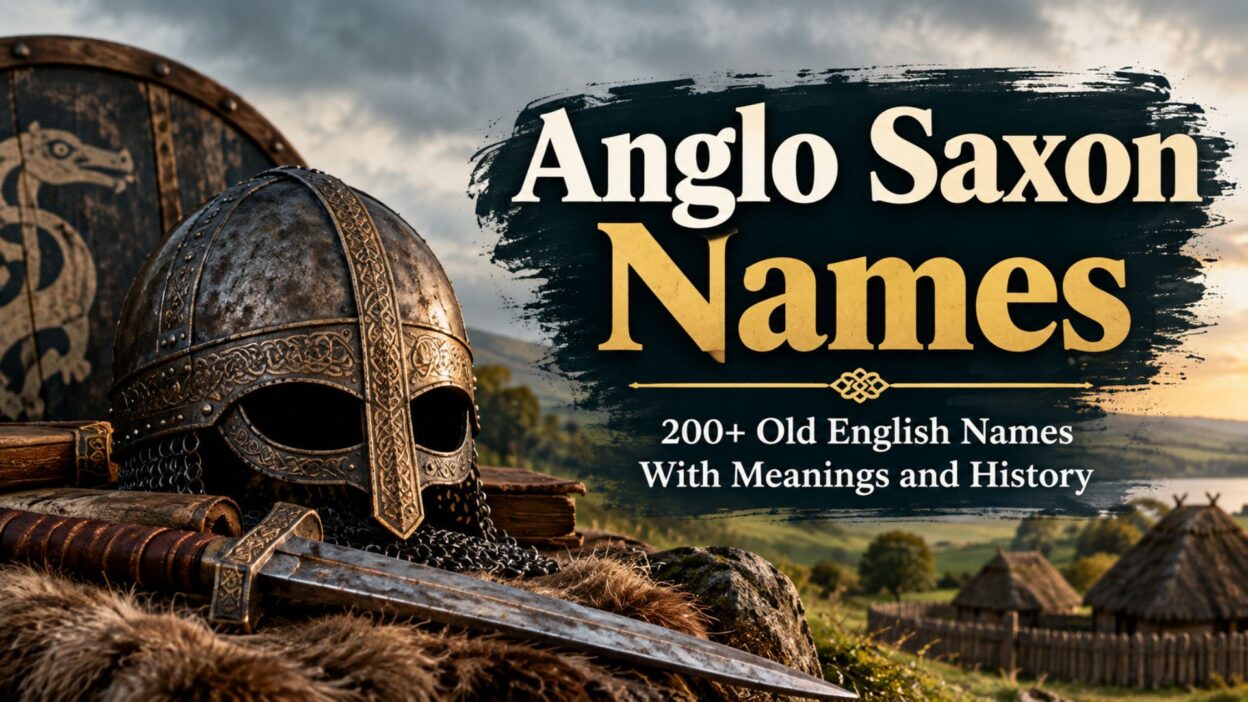
Anglo Saxon names offer a rich link to early medieval England and the Old English language. Many of these names were built from two meaningful parts. Those parts often relate to ideas such as wealth, friendship, strength, battle, protection, nature, and nobility. As a result, an old English name can carry both history and personality.
Some Anglo Saxon names are still familiar today. For example, Ælfræd developed into Alfred, Eadweard became Edward, and Eadwine became Edwin. Other names, including Æthelflæd, Wulfstan, Æthelweard, and Æthelwulf, have a much stronger medieval feel.
In this guide, you will find traditional Anglo Saxon names, Old English names with meanings, short choices, historical names, and ideas for fictional characters. You will also learn how these names were formed and how to choose one that fits your purpose.
What Are Anglo Saxon Names?
Anglo Saxon names are personal names connected with the Anglo-Saxons and the Old English language. They were used in early medieval England, although naming practices changed over time.
Many names followed a two-part pattern. For instance, Eadweard contains ead, which is linked with wealth or prosperity, and weard, meaning guardian. Likewise, Wulfstan combines wulf, meaning wolf, with stan, meaning stone.
Because of this structure, Old English names can feel meaningful without needing a long explanation. They can also help writers create characters who fit an early medieval setting.
However, name meanings should not always be treated as exact descriptions of a person. Old English names were part of a wider Germanic naming tradition. Therefore, the combined meaning can sometimes be symbolic rather than literal.
Best Anglo Saxon Names
If you want a name with a clear Old English feel, the following choices are a good place to begin. Some later developed into familiar English names, while others still sound strongly medieval.
- Æthelstan — A noble-sounding name associated with stone and royal history.
- Ælfric — Combines an elf-related element with one linked to power or rule.
- Eadwine — An early form of Edwin, combining prosperity with friendship.
- Eadweard — The Old English form of Edward, linked with prosperity and guardianship.
- Eadgar — The Old English form of Edgar, combining prosperity with spear.
- Wulfric — Combines wolf imagery with an element linked to rule.
- Godric — A traditional name with elements connected to God and rule.
- Leofric — Combines the idea of being beloved with rule or power.
- Eadmund — The Old English form of Edmund.
- Dunstan — A historic English name strongly linked with the medieval period.
- Æthelweard — Combines nobility with guardianship.
- Æthelwulf — Combines nobility with wolf imagery.
- Wulfstan — Combines wolf with stone.
- Sigeberht — Combines victory with brightness.
- Cynewulf — A traditional name containing royal and wolf-related elements.
These names work especially well for historical fiction, fantasy stories, role-playing characters, and readers who enjoy traditional English naming.
Traditional Anglo Saxon Male Names
Old English male names often use elements related to leadership, friendship, battle, protection, wealth, and animals. In addition, several of them later influenced familiar English names.
Names Connected With Nobility
- Æðelbeald — Noble and bold.
- Æðelbeorht — Noble and bright.
- Æðelfrið — Noble and peaceful.
- Æðelmær — Noble and famous.
- Æðelric — Noble ruler.
- Æthelstan — Noble stone.
- Æthelweald — Noble power.
- Æthelweard — Noble guardian.
- Æðelwine — Noble friend.
- Æðelwulf — Noble wolf.
These choices suit characters with a royal, noble, or respected background. For example, Æthelweard can fit a guardian or adviser, while Æthelstan works well for a ruler.
Names Connected With Prosperity
- Eadberht — Prosperity and brightness.
- Eadmund — Prosperity and protection.
- Eadræd — Prosperity and counsel.
- Eadric — Prosperity and rule.
- Eadwald — Prosperity and power.
- Eadweard — Prosperity and guardianship.
- Eadwig — Prosperity and war.
- Eadwine — Prosperity and friendship.
- Eadwulf — Prosperity and wolf.
- Ealdwine — Old and friend.
These names can suit characters who are meant to appear wealthy, respected, wise, or well connected.
Warrior and Strength-Based Names
- Beorhtric — Bright ruler.
- Beornræd — Warrior and counsel.
- Burgheard — Fortress and strength.
- Cenric — Bold ruler.
- Eoforheard — Boar and strength.
- Sigeberht — Victory and brightness.
- Sigeweard — Victory and guardian.
- Wigmund — Battle and protection.
- Wigstan — A traditional name containing a battle element.
- Wilheard — Will and strength.
- Wulfric — Wolf and rule.
- Wulfnoð — Wolf and boldness.
- Wulfsige — Wolf and victory.
- Wulfstan — Wolf and stone.
- Wynnstan — Joy and stone.
For a warrior character, names with wulf, wig, or sige can create a strong historical tone. Still, the meaning should match the character rather than replace good storytelling.
Traditional Anglo Saxon Female Names
Female Old English names also used meaningful elements. Many contain ideas related to gifts, strength, battle, joy, nobility, and divine themes.
Names With Noble Elements
- Æðelflæd — Noble and beautiful or fair.
- Æðelþryð — Noble and strong.
- Ælfgyð — Elf and battle.
- Ælfhild — Elf and battle.
- Ælfswiþ — Elf and strength.
- Ælfþryð — Elf and strength.
- Ælfwynn — Elf and joy.
- Cyneburg — Royal fortress.
- Ealhswiþ — Temple and strength.
- Ealdgyð — Old and battle.
These names have a distinctly early English sound. Moreover, their unusual spellings can help a historical or fantasy character stand out.
Names With Gift Elements
- Ælfgifu — Elf and gift.
- Eadgifu — Prosperity and gift.
- Godgifu — God and gift.
- Leofgifu — Beloved and gift.
- Modgifu — Courage or spirit and gift.
- Osgifu — A divine element and gift.
- Wulfgifu — Wolf and gift.
The element gifu means “gift,” so these names share a clear naming theme. Therefore, they can work particularly well for characters whose stories involve family, inheritance, or treasured relationships.
Other Traditional Female Names
- Æbbe — An early English female name.
- Ælfflæd — A traditional Old English compound.
- Bealdhild — A traditional name linked with boldness and battle.
- Eadgyð — Prosperity and battle.
- Eoforhild — Boar and battle.
- Friðuswiþ — A traditional Old English form associated with Frideswide.
- Leofcwen — Beloved woman or queen.
- Leofgyth — Beloved and battle.
- Leofrun — Beloved and a lore-related element.
- Mildburg — A traditional Old English female name.
- Mildgyth — Mild and battle.
- Mildrith — A traditional Old English name.
- Osgyth — A divine element and battle.
- Osthryth — A divine element and strength.
- Osburh — A traditional Old English female name.
- Oswynn — A divine element and joy.
- Sæhild — A traditional Old English compound.
- Sæwynn — Sea and joy.
- Seaxburg — Saxon or seax element and fortress.
- Sigryth — A traditional Old English female compound.
- Sunngifu — A traditional Old English female name.
- Waerburh — A traditional Old English female compound.
- Wigflæd — A traditional Old English female compound.
- Wilburh — Will or desire and fortress.
- Wulfþryð — Wolf and strength.
- Wulfwynn — Wolf and joy.
- Wynnflæd — Joy and a traditional female name element.
Short Anglo Saxon Names
Short names can be easier to remember and pronounce. They are also useful when a writer wants a historical feel without giving a character a long or complex name.
- Æsc — Ash tree.
- Bada — An early name probably connected with battle.
- Cola — An Old English personal name or byname.
- Hild — A short name connected with battle.
- Icel — An early English personal name.
- Offa — A well-known Anglo-Saxon royal name.
- Penda — A famous Mercian royal name.
- Tata — An early English personal name.
- Tibba — An early English personal name.
- Wine — Friend.
- Ymar — A name found in early English records.
For modern readers, these shorter forms can be easier to use. However, their historical context may differ, so check the period if you are writing historical fiction.
Anglo Saxon Names With Meanings
One useful feature of Old English names is their building-block system. Once you understand a few common elements, many names become easier to read.
Common Name Elements
- Ælf — Elf.
- Æthel — Noble.
- Ead — Wealth, fortune, or prosperity.
- Eald — Old.
- God — God.
- Leof — Dear or beloved.
- Os — A divine or god-related element.
- Sige — Victory.
- Wulf — Wolf.
- Wynn — Joy.
These elements often appear at the beginning of a name. As a result, they can give you a quick clue about its theme.
Common Ending Elements
- -beald — Bold or brave.
- -beorht — Bright.
- -gifu — Gift.
- -gyð — Battle.
- -hild — Battle.
- -mund — Protection.
- -ræd — Counsel.
- -ric — Ruler or power.
- -stan — Stone.
- -weard — Guardian.
- -wine — Friend.
- -wynn — Joy.
For example, Wulfric combines wolf with ruler. Likewise, Eadweard joins prosperity with guardian. Therefore, learning these parts can be more useful than memorizing a long list of names.
Anglo Saxon Names Inspired by Nature
Nature also appears in Old English naming. Animals, plants, water, and physical objects could all become parts of personal names.
Wolf-Inspired Names
The element wulf is especially common in Old English names. It gives a name a bold and memorable image.
- Eadwulf — Prosperity and wolf.
- Eardwulf — Land and wolf.
- Æthelwulf — Noble and wolf.
- Wulfgifu — Wolf and gift.
- Wulfric — Wolf and ruler.
- Wulfrun — Wolf and a lore-related element.
- Wulfsige — Wolf and victory.
- Wulfstan — Wolf and stone.
- Wulfwynn — Wolf and joy.
Other Nature Elements
- Æsc — Ash tree.
- Eoforheard — Boar and strength.
- Eoforwine — Boar and friend.
- Sæwine — Sea and friend.
- Wynnstan — Joy and stone.
These names can work well for fantasy characters because their meanings create clear images. In addition, they can help shape a character’s personality without sounding too modern.
Famous Anglo Saxon Names From History
Historical names become more useful when you understand the people who carried them. Several Anglo-Saxon figures are connected with names that remain interesting today.
Æthelstan
Æthelstan was a 10th-century English king. His name combines elements linked with nobility and stone. He is an important figure in the history of early England.
Æthelflæd
Æthelflæd was the daughter of Alfred the Great and became the ruler of Mercia. Her name is one of the best-known female names from the Anglo-Saxon period.
Eadwig
Eadwig ruled England during the 10th century. His name contains ead, linked with prosperity, and wig, associated with war.
Eadwald
Eadwald was an early medieval king associated with East Anglia. His name combines prosperity with an element related to power or rule.
Wulfrun
Wulfrun was an English noblewoman from the 10th century. Her name contains wulf, the Old English word for wolf.
These examples show why historical context matters. A name can gain extra character when it connects naturally with the period and setting of a story.
How Anglo Saxon Names Were Formed
Many Old English personal names were built from two meaningful elements. Linguists often describe this type as dithematic naming, meaning that the name has two main parts.
For example:
Ælf + ric = Ælfric
Here, ælf means elf, while ric is connected with rule or power.
Ead + weard = Eadweard
In this name, ead relates to prosperity or fortune, while weard means guardian.
Wulf + stan = Wulfstan
This combination joins wolf and stone.
Why Did Names Share the Same Elements?
The same elements could appear in many names. This pattern gave people a flexible naming system while keeping familiar themes.
For instance, wulf appears in Wulfric, Wulfstan, Wulfsige, and Wulfwynn. In the same way, Æthel appears in many names linked with nobility.
Therefore, repeated elements do not mean the names are duplicates. Instead, they show how the Old English naming system worked.
Did Every Name Have a Literal Meaning?
Not necessarily. A two-part name may have meaningful elements, but people did not always use the whole name as a literal description.
For example, someone named Wulfstan was not necessarily being described as a “wolf stone.” The name followed a traditional naming pattern.
This point is important when explaining historical names. It is better to describe the parts accurately than to invent a dramatic modern interpretation.
Anglo Saxon Names for Historical Characters
Writers often choose Old English names because they want a character to feel connected to early medieval England. In that case, spelling and historical context matter as much as meaning.
Male Character Ideas
- Æthelstan — A strong choice for a king or noble leader.
- Eadweard — A good fit for an early English royal character.
- Eadwine — Works well for a respected noble or friend.
- Godric — Suitable for a village leader, noble, or warrior.
- Leofric — A memorable choice for a lord or adviser.
- Wulfstan — Fits a warrior, scholar, or churchman.
- Æthelweard — Works naturally for a guardian or noble adviser.
Female Character Ideas
- Æthelflæd — A strong historical choice for a ruler.
- Eadgifu — A traditional name built around the idea of a gift.
- Eadgyð — A historical Old English compound.
- Godgifu — A traditional name meaning God and gift through its elements.
- Wulfrun — A distinctive choice with historical roots.
- Ealhswiþ — A strong Old English female name.
For a historical novel, it is wise to check the spelling used for the specific period. Modern English forms may be easier to read, but they can change the historical feel.
Anglo Saxon Names for Fantasy Characters
Old English names can also give fantasy worlds a grounded medieval style. They are especially useful when a fictional culture draws inspiration from early England.
Noble Character Names
- Æthelstan — A natural fit for a royal character.
- Eadweard — Works well for a king or heir.
- Æthelweard — Suits a noble guardian.
- Leofric — Fits a respected lord or adviser.
- Cyneburg — A strong choice for a royal character.
Warrior Character Names
- Wulfric — A bold choice for a fighter or commander.
- Wulfstan — Strong and memorable for a warrior.
- Æthelwulf — Suitable for a noble fighter.
- Eoforheard — A distinctive choice with boar and strength elements.
- Sigeweard — Works well for a victorious guardian.
Gentle Character Names
- Ælfwine — Elf and friend.
- Wulfwynn — Wolf and joy.
- Leofgifu — Beloved and gift.
- Eadgifu — Prosperity and gift.
- Wynnstan — Joy and stone.
The best fantasy name should fit the character and the world. Therefore, do not choose a name only because it looks unusual. Consider its meaning, sound, spelling, and role in the story.
How to Choose the Right Anglo Saxon Name
Finding a suitable name becomes easier when you start with the purpose rather than the spelling.
Start With the Character
First, decide what kind of person the name represents. A ruler may suit a name connected with nobility or power. A protector might fit a name containing weard or mund.
Likewise, a gentle character may suit elements related to friendship, joy, or gifts.
Check the Meaning
Next, look at the main name elements. Consider whether you want a theme such as:
- Nobility
- Friendship
- Strength
- Protection
- Victory
- Wealth
- Battle
- Nature
- Joy
Once you choose a theme, the larger list becomes easier to narrow down.
Consider Pronunciation
Some Old English spellings can be difficult for modern readers. Letters such as æ and þ may need explanation.
For a historical project, keeping the original spelling may be important. On the other hand, a fantasy novel for a broad audience may benefit from a simpler form.
Think About Memorability
A good name should be easy enough for your audience to remember. Alfred, Edward, Edwin, Edgar, and Edmund are familiar examples.
More complex forms can still work, especially when the story provides enough context.
Match the Historical Period
Finally, check whether the name fits your setting. Anglo-Saxon England lasted for centuries, and names changed during that time.
A name that feels suitable for one period may not be the best choice for another. Therefore, historical fiction benefits from checking the date, region, and spelling before publication.
How to Create an Anglo Saxon-Style Name
Creating a believable Old English-style name is easier when you use real naming elements. Avoid random combinations that simply sound medieval.
Noble + Ruler
Use a noble element with one linked to rule.
- Æðelric — Noble + ruler.
Prosperity + Guardian
This pattern suits a protector or leader.
- Eadweard — Prosperity + guardian.
Wolf + Ruler
This combination creates a strong warrior image.
- Wulfric — Wolf + ruler.
Elf + Friend
A softer combination can suit a friendly or magical character.
- Ælfwine — Elf + friend.
Victory + Brightness
This pattern works for a character linked with success.
- Sigeberht — Victory + bright.
Noble + Wolf
This pairing suits a strong noble character.
- Æthelwulf — Noble + wolf.
Using real elements gives the name a stronger historical foundation. However, newly created combinations should not be presented as genuine historical names unless reliable evidence supports them.
Frequently Asked Questions
What are Anglo Saxon names?
Anglo Saxon names are personal names connected with the Anglo-Saxons and Old English. Many use two meaningful Germanic elements.
Are Anglo Saxon and Old English names the same?
The terms overlap, although they are not always used in exactly the same way. Many personal names from Anglo-Saxon England are Old English names.
What are some famous Anglo Saxon names?
Examples include Æthelstan, Æthelflæd, Eadweard, Eadwine, Eadwig, Ælfræd, Godric, Wulfric, and Wulfstan.
Is Alfred an Anglo Saxon name?
Yes. Ælfræd is the Old English form behind the modern name Alfred.
Is Edward an Anglo Saxon name?
Yes. Edward developed from the Old English name Eadweard, which combines elements linked with prosperity and guardianship.
What does Æthel mean?
Æthel is an Old English element meaning “noble.” It appears in many traditional names.
What does Wulf mean?
Wulf means “wolf.” It appears in several Old English names, including Wulfric and Wulfstan.
Can Anglo Saxon names be used for fantasy characters?
Yes. They can add a strong medieval feel to fictional characters. However, using real historical elements will make the name more believable than simply adding random old-looking letters.
Conclusion
Anglo Saxon names provide a meaningful way to connect a character with Old English language and early medieval history. Many names combine simple ideas such as nobility, friendship, victory, protection, wealth, and nature.
Whether you are naming a historical character, fantasy hero, fictional ruler, or another creative project, begin with the meaning and setting. Then check the spelling, pronunciation, and historical context. A carefully chosen Old English name can make a character memorable while adding depth to the world around them.