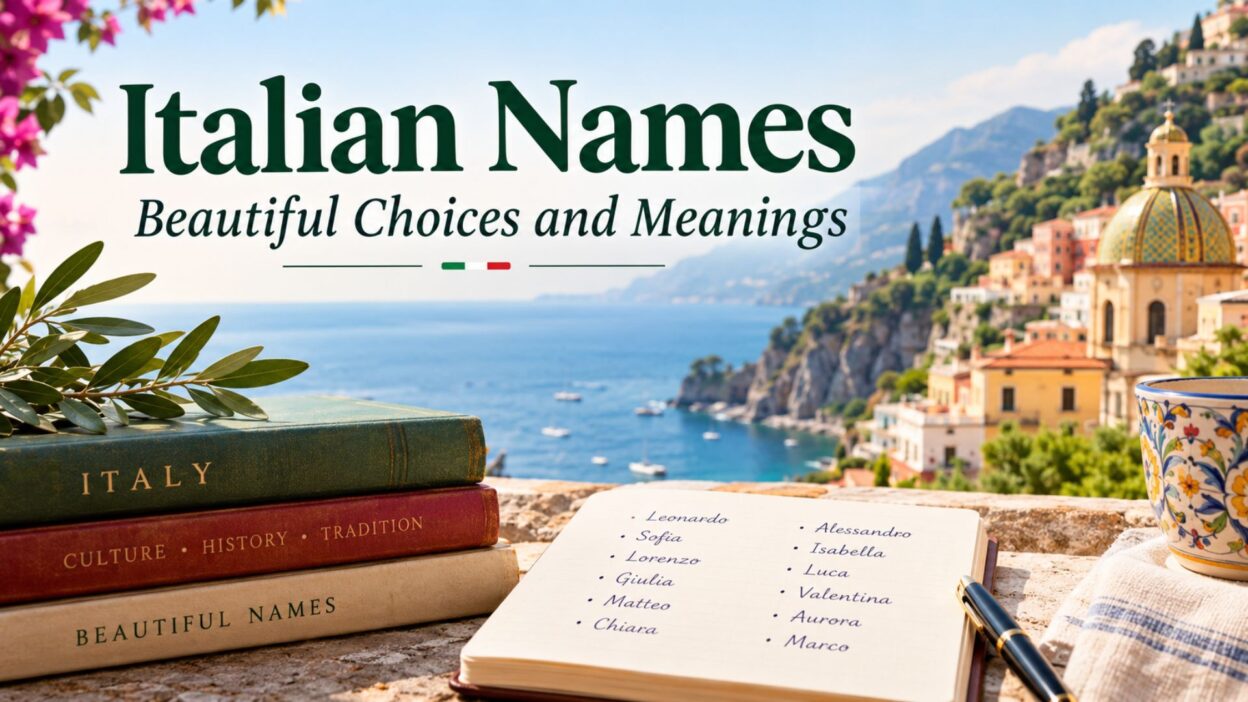
Italian names have a musical, elegant quality that makes them appealing around the world. Many have roots in ancient Rome, Christianity, literature, and the cultures that influenced Italy over centuries. As a result, Italian naming traditions offer a rich variety of classic, romantic, strong, and modern choices.
In this guide, you will discover beautiful Italian names with their commonly accepted meanings and origins. The collection includes traditionally feminine and traditionally masculine names, as well as short, rare, elegant, and internationally familiar options. You will also find practical advice to help you choose a name that sounds natural and suits your purpose.
Top Italian Names to Consider
If you want a quick starting point, these choices combine beauty, history, and lasting appeal.
- Leonardo — A strong Italian name associated with the idea of a brave lion.
- Sofia — A graceful choice derived from the Greek word for “wisdom.”
- Lorenzo — A classic name connected with the ancient Roman name Laurentius.
- Giulia — The Italian form of Julia, with deep roots in Roman history.
- Matteo — An Italian form of Matthew, traditionally meaning “gift of God.”
- Chiara — A bright and elegant name meaning “clear” or “bright.”
- Alessandro — The Italian form of Alexander, meaning “defender of men.”
- Isabella — A timeless choice connected with Elizabeth.
- Luca — A short and smooth name with ancient roots.
- Valentina — A beautiful name connected with strength and health.
Traditionally Feminine Italian Names
Many traditionally feminine Italian names sound graceful, warm, and expressive. In addition, several have long histories that connect them with Latin, Greek, Hebrew, or Germanic traditions.
Classic Choices
These names suit anyone who appreciates traditional options that have remained recognizable for generations.
- Adriana — The feminine form of Adrian, traditionally connected with the ancient city of Hadria.
- Alessandra — An Italian form of Alexandra, meaning “defender of men.”
- Beatrice — Traditionally interpreted as “she who brings happiness” or “blessed.”
- Caterina — The Italian form of Katherine, commonly associated with “pure.”
- Elena — An elegant name related to Helen and often connected with light or brightness.
- Francesca — The feminine form of Francesco, historically linked with the Franks or France.
- Giovanna — The Italian feminine form of Giovanni, meaning “God is gracious.”
- Lucia — A luminous choice connected with the Latin word for light.
- Maria — A deeply traditional name with a long and complex history.
- Vittoria — The Italian name associated with victory.
Modern Italian Choices
For a fresher style, these names feel fashionable while still maintaining a strong Italian identity.
- Allegra — From the Italian word associated with a cheerful and lively mood.
- Aria — An Italian musical term connected with melody and song.
- Aurora — Linked with the Roman goddess of dawn.
- Bianca — The Italian word for “white.”
- Emilia — A polished name with ancient Roman roots.
- Gemma — The Italian word for a precious stone or gem.
- Gianna — A shorter form connected with Giovanna and Giovanni.
- Luna — The Italian word for “moon.”
- Stella — The Italian word for “star.”
- Viola — Associated with the violet flower and the musical instrument.
Rare Italian Names
If you want something less familiar, these choices offer distinctive sounds and meaningful cultural connections.
- Amaranta — Connected with the amaranth flower and the idea of unfading beauty.
- Ambra — The Italian form of Amber.
- Benedetta — A name meaning “blessed.”
- Carlotta — An Italian form related to Charlotte and Charles.
- Fiora — Connected with the Italian word fiore, meaning “flower.”
- Ilaria — Derived from the Latin hilaris, associated with cheerfulness.
- Matilde — The Italian form of Matilda, connected with strength.
- Ondina — A name associated with water and waves in European tradition.
- Rosetta — A diminutive form connected with Rosa, meaning “little rose.”
- Silvana — Connected with forests and woodland through Latin roots.
Traditionally Masculine Italian Names
Italian masculine names can sound powerful, artistic, traditional, or effortlessly stylish. Moreover, many have strong connections with Roman history and Christian traditions.
Traditional Choices
These names have remained important in Italian naming traditions for many generations.
- Antonio — An ancient Roman family name with an uncertain deeper origin.
- Carlo — The Italian form of Charles, traditionally associated with a free person.
- Francesco — The Italian form of Francis, historically linked with “Frenchman” or “free.”
- Giovanni — The Italian form of John, meaning “God is gracious.”
- Giuseppe — The Italian form of Joseph, traditionally meaning “God will add.”
- Marco — An Italian form of Marcus, connected with the Roman god Mars.
- Paolo — The Italian form of Paul, meaning “small” or “humble.”
- Pietro — The Italian form of Peter, meaning “rock.”
- Riccardo — The Italian form of Richard, associated with brave or powerful rule.
- Stefano — The Italian form of Stephen, meaning “crown” or “garland.”
Modern Italian Choices
These names combine traditional roots with a style that feels suitable for modern life.
- Andrea — Traditionally masculine in Italy, although usage differs in some other countries.
- Edoardo — The Italian form of Edward, associated with guarding wealth.
- Enzo — A compact and energetic Italian name often used independently.
- Gabriele — The Italian form of Gabriel, meaning “God is my strength.”
- Leonardo — A classic name that combines strength with artistic and historical associations.
- Lorenzo — A sophisticated choice connected with Laurentius and the laurel tradition.
- Mattia — An Italian form related to Matthew and Matthias.
- Matteo — A familiar Italian form of Matthew, meaning “gift of God.”
- Tommaso — The Italian form of Thomas, meaning “twin.”
- Valerio — A masculine name related to strength and health.
Short Italian Names
Short names are often easy to remember and pronounce. Therefore, they can work especially well when you prefer a simple and flexible choice.
- Elia — The Italian form of Elijah, meaning “my God is Yahweh.”
- Leo — A short name associated with the Latin word for “lion.”
- Luca — A smooth and widely recognized Italian favorite.
- Mario — A traditional Italian name with ancient Roman connections.
- Nino — A familiar short form used in Italian naming traditions.
- Rocco — A strong name with a long history in Italy.
- Tito — A concise name with ancient Roman roots.
- Ugo — The Italian form of Hugh, associated with mind or intellect.
- Vito — A traditional name connected with life.
- Amedeo — A historic Italian choice meaning “loved by God.”
Italian Names With Beautiful Meanings
A meaningful name can add another layer to your decision. However, ancient names sometimes have complex histories, so interpretations can vary slightly between sources.
Names Connected With Light
These choices create associations with brightness, clarity, and the beginning of a new day.
- Alba — “Dawn.”
- Chiara — “Bright” or “clear.”
- Luciana — A name connected with light.
- Luciano — A name associated with light.
- Lucio — Derived from the Latin root connected with brightness.
Names Inspired by Nature
Nature-inspired Italian names can feel gentle and expressive. At the same time, they often remain easy to understand and remember.
- Aurora — Connected with dawn.
- Fiora — “Flower.”
- Luna — “Moon.”
- Stella — “Star.”
- Viola — Connected with the violet flower.
Names Associated With Strength
For a bolder style, these names carry meanings related to protection, health, power, or victory.
- Alessandro — Traditionally interpreted as “defender of men.”
- Massimo — Derived from the Latin word for “greatest.”
- Valentina — Connected with health, strength, and vigor.
- Valentino — A name with similar roots.
- Vittoria — “Victory.”
Elegant Italian Names
Some Italian names immediately create a refined, artistic, or romantic impression. Consequently, they can work particularly well for anyone searching for something sophisticated.
- Camilla — A graceful name with ancient Roman roots.
- Dante — A famous literary name historically connected with Durante.
- Eleonora — An elegant choice with a long European history.
- Filippo — The Italian form of Philip, meaning “lover of horses.”
- Giulietta — A charming diminutive form of Giulia.
- Oriana — A name with debated origins, sometimes associated with gold or sunrise.
- Raffaele — The Italian form of Raphael, meaning “God has healed.”
- Serafina — Connected with the seraphim in religious tradition.
- Veronica — A classic name with Greek and Latin associations.
- Violetta — A delicate name connected with the violet flower.
Italian Names That Work Internationally
Some names remain distinctly Italian while also feeling familiar in English-speaking countries. As a result, they can be practical choices for people who expect the name to be used across different cultures.
- Amelia — A familiar European name with a soft sound.
- Bella — Associated with the Italian word for “beautiful.”
- Emilio — A stylish Italian form with ancient Roman roots.
- Isabella — A classic choice recognized in many countries.
- Mia — A short name used in several naming traditions.
- Sofia — A widely recognized name derived from the Greek word for wisdom.
- Vera — Used across Europe and familiar in Italian naming traditions.
- Luca — Short, memorable, and easy for many people to pronounce.
- Marco — A traditional choice that travels well internationally.
- Stella — Simple, elegant, and immediately recognizable.
Traditional Italian Naming Customs
Italian naming traditions reflect centuries of history, religion, and family connections. For example, many traditional names come from saints, ancient Roman figures, or earlier generations within a family.
Christian traditions have also influenced Italian names. Francesco, Giovanni, Giuseppe, and Caterina carry religious associations alongside their linguistic histories.
Regional traditions can make naming even more interesting. Different parts of Italy have developed their own preferences, pronunciations, and naming customs over time.
Another important point involves gender usage. Andrea, for instance, is traditionally masculine in Italy, even though English-speaking countries often use it differently.
How to Choose the Right Italian Name
A beautiful name should also work comfortably in everyday life. Before making a final decision, consider pronunciation, cultural context, and long-term usability.
Check the Pronunciation
Italian spelling often follows consistent pronunciation patterns. However, English speakers may pronounce some names differently.
For instance, Chiara, Giulia, and Gabriele may sound different when pronounced in Italian. Therefore, say the name aloud several times before making your choice.
Consider the Cultural Context
A name can have different associations in different countries. Andrea provides a useful example because traditional usage changes across cultures.
Likewise, some names used in Italy originally come from other languages. Understanding that history can help you choose more accurately.
Think About Everyday Use
Consider how the name will sound in formal situations and casual conversations. Also, think about whether people around you can pronounce it comfortably.
Short choices such as Leo and Luca may feel simple and flexible. On the other hand, longer names such as Alessandro and Eleonora can offer more nickname possibilities.
Look Beyond the Meaning
Meaning can be important, but it should not be the only deciding factor. Pronunciation, cultural fit, sound, and personal preference matter just as much.
Ultimately, the best choice is one that feels natural and meaningful for the person, character, or purpose you have in mind.
Frequently Asked Questions
What are some popular Italian names?
Well-known Italian names include Leonardo, Sofia, Lorenzo, Giulia, Matteo, Chiara, Alessandro, Francesco, Aurora, and Luca.
What makes a name Italian?
Many Italian names have Latin, Greek, Hebrew, or Germanic origins. However, their Italian forms, pronunciation, and long cultural use make them part of Italian naming traditions.
Is Andrea traditionally masculine or feminine in Italy?
In Italy, Andrea is traditionally a masculine name. In contrast, English-speaking countries often use Andrea as a traditionally feminine name.
What are some beautiful traditionally feminine Italian names?
Popular choices include Chiara, Giulia, Lucia, Bianca, Aurora, Valentina, Beatrice, Stella, Gemma, and Vittoria.
What are some strong traditionally masculine Italian names?
Leonardo, Alessandro, Rocco, Riccardo, Massimo, Lorenzo, Pietro, Francesco, and Valerio all offer strong sounds or meanings.
What Italian names are easy to pronounce in English?
Luca, Leo, Mia, Sofia, Isabella, Marco, Stella, Matteo, Luna, and Bella are generally familiar to many English speakers.
Do Italian names always come from the Italian language?
No. Italian naming traditions include names that originally came from Latin, Greek, Hebrew, Germanic languages, and other linguistic sources.
Conclusion
Italian names offer a beautiful combination of history, culture, meaning, and memorable sound. From timeless choices such as Francesco and Lucia to modern favorites such as Luca and Aurora, there is a wide range of styles to explore.
Consider pronunciation, cultural context, meaning, and everyday usability before making your final choice. Then, choose the name that feels most natural and meaningful for your purpose. A well-chosen Italian name can carry character, tradition, and lasting appeal.