
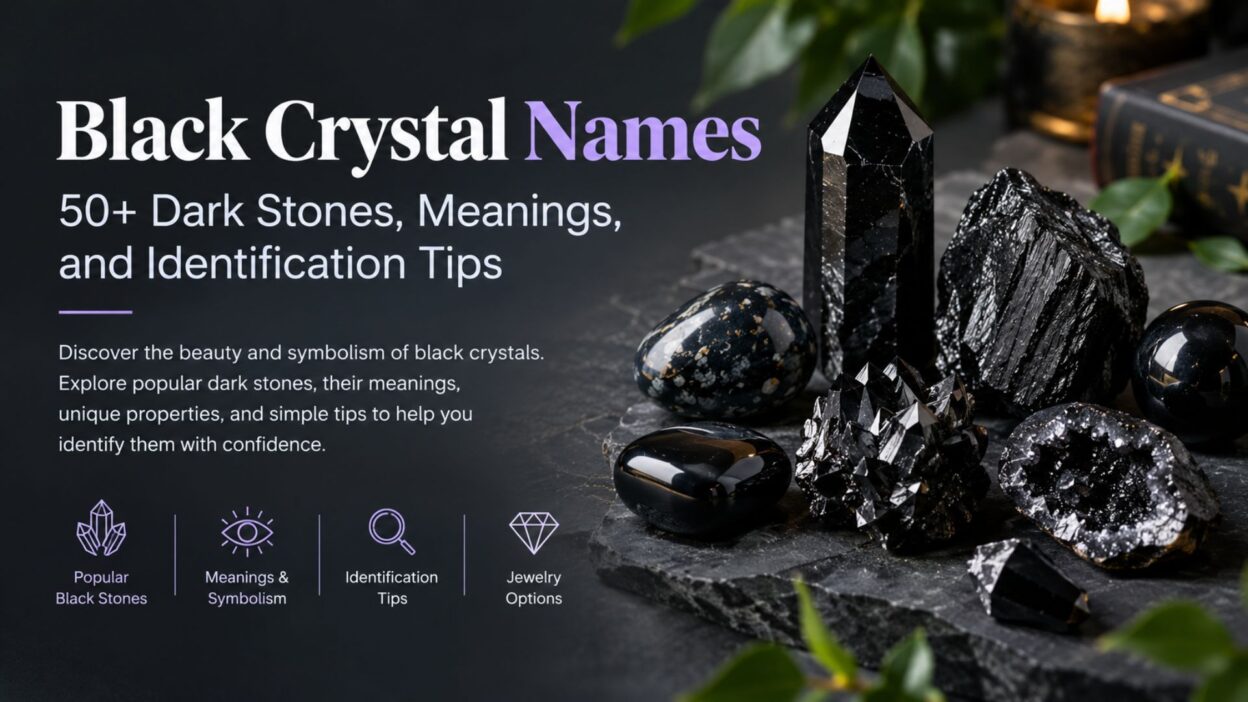
Black crystal names can lead you to a wide range of dark stones, minerals, volcanic glass, and organic gem materials. Although many of them share a deep black color, each stone can look and behave very differently. Obsidian has a smooth, glass-like surface, while black tourmaline often has long ridges. Hematite can look metallic, and jet comes from fossilized wood rather than a mineral crystal.
This guide brings together popular and lesser-known black crystal names in one place. You will find stones grouped by appearance, traditional meaning, jewelry use, and collecting interest. You will also learn how to compare similar stones without relying on color alone. If you want a black stone for a collection, piece of jewelry, character, or personal symbolism, these ideas can help you narrow down your choices.
Popular Black Crystal Names
Some dark stones appear again and again in jewelry stores, mineral collections, and crystal shops. They are a useful starting point because each one has a noticeably different look.
Black Obsidian
Black obsidian is natural volcanic glass formed when lava cools quickly. Its surface is usually smooth and shiny, giving it a sleek appearance.
The stone often has a deep black color, although some pieces may show brown, gray, or other subtle tones. Its glassy look makes it popular for polished jewelry, carvings, and decorative pieces.
Black Tourmaline
Black tourmaline, also known as schorl, is one of the most recognizable dark minerals. Raw crystals often have long grooves running along their length.
Its rough texture gives it a more natural appearance than polished obsidian or onyx. Crystal traditions often connect black tourmaline with grounding and protection.
Black Onyx
Black onyx belongs to the chalcedony family. It is commonly polished into smooth beads, cabochons, rings, bracelets, and pendants.
Many pieces sold as black onyx have an even dark color. However, some commercial material may be treated or dyed, so appearance alone does not always reveal how the color was produced.
Hematite
Hematite is an iron oxide mineral that can appear dark gray, black, or metallic. Its heavy feel and shiny surface make it easy to notice among many other dark stones.
One useful clue is its reddish-brown streak. The stone itself may look black, but the streak can help separate hematite from other materials.
Jet
Jet is an organic gem material made from fossilized wood. Unlike many mineral gemstones, it is relatively light and soft.
The stone has a long history in jewelry. Whitby Jet, in particular, became well known for mourning jewelry during the Victorian period.
Shungite
Shungite is a dark carbon-rich material that is usually black or deep gray. Some pieces have a dull surface, while polished specimens can look much shinier.
Modern crystal practices often give shungite meanings related to grounding and protection. These are traditional beliefs rather than proven medical effects.
Black Spinel
Black spinel is a dark gemstone with a smooth and refined appearance. It can look almost completely black when polished.
Its good durability also makes it suitable for jewelry. For people who want a dark gemstone with a clean, elegant finish, black spinel is a popular option.
Black Jade
Black jade can range from dark gray to nearly black. Some specimens may show subtle green or gray tones when viewed under bright light.
Its smooth surface and rich color make it especially attractive when polished.
Black Kyanite
Black kyanite is easy to recognize because it often forms long, blade-like crystals. Some specimens create fan-shaped or layered patterns.
Collectors often choose it for its unusual crystal structure rather than its color alone.
Black Jasper
Black jasper is an opaque, dark variety of jasper. Depending on the specimen, it may be completely black or contain small areas of gray, brown, or other earthy colors.
Its simple appearance works well for people who prefer natural-looking stones without bright flashes.
Black Crystals With Unique Patterns
Not every black stone has a plain surface. Some have bands, pale markings, or flashes of color that become visible when the stone moves under light.
Snowflake Obsidian
Snowflake obsidian contains pale inclusions that create patterns resembling small snowflakes. The light markings stand out against the dark volcanic glass.
This contrast makes the stone easy to recognize and gives it a softer look than plain black obsidian.
Black Opal
Black opal has a dark body color that can create a striking background for flashes of blue, green, red, orange, or other colors.
Its appeal comes from this play of color. Two pieces can look very different even when both are sold under the same name.
Black Labradorite
Black labradorite can appear dark and quiet until light reaches it at the right angle. Blue, green, gold, or other flashes may then appear across the surface.
That changing effect is known as labradorescence. It makes the stone popular with people who enjoy unusual and mysterious-looking gems.
Black Moonstone
Black moonstone usually ranges from dark gray to black. Some pieces have a soft sheen that seems to move across the surface.
Its moon-like appearance makes it a common choice for celestial, mystical, and fantasy-inspired collections.
Black Agate
Black agate is a dark form of agate. Some specimens are mostly black, while others show bands or slightly translucent edges.
The natural patterns can give each piece a different look, even when the main color remains dark.
More Black Crystal Names for Collectors
Collectors may also come across dark minerals and rocks that are less familiar to casual crystal buyers. Some are common in mineral collections but are not usually sold as everyday jewelry stones.
- Magnetite — A naturally black iron oxide mineral with magnetic properties.
- Ilmenite — A dark iron-titanium oxide mineral that can have a metallic appearance.
- Galena — A lead sulfide mineral known for its bright metallic luster and gray-black color.
- Graphite — A soft form of natural carbon with a dark gray to black appearance.
- Ferberite — A dark tungsten mineral that commonly appears black or nearly black.
- Arfvedsonite — A dark amphibole mineral that may show black or blue-black tones.
- Augite — A dark pyroxene mineral commonly found in igneous rocks.
- Biotite — A dark mica mineral that forms thin sheets.
- Cassiterite — A tin oxide mineral that may form dark brown or black crystals.
- Melanite — A black variety of andradite garnet.
- Hypersthene — A dark pyroxene that may range from brownish-gray to black.
- Basalt — A dark volcanic rock made from several minerals rather than one crystal species.
- Lava Stone — A common jewelry name for porous volcanic rock used in beads and decorative items.
- Black Fossil Coral — Dark fossil material that can retain patterns linked to its original organic structure.
- Indigo Gabbro — A dark rock commonly sold in the crystal trade under this name.
Not all of these are technically crystals or gemstones. Some are minerals, some are rocks, and others are organic materials or trade names. That difference is important when you want an accurate identification.
Black Crystal Names and Their Meanings
People often search for black crystal names because they want to know what a stone represents as well as what it is.
A useful distinction comes first. Geological features such as chemical composition, hardness, and crystal structure can be studied scientifically. Meanings such as protection, grounding, and emotional balance come from cultural or spiritual traditions.
Protection and Boundaries
Black tourmaline, obsidian, onyx, and several other dark stones are often linked with protection in modern crystal practices.
These names can suit a collection built around ideas such as:
- Protection
- Personal boundaries
- Strength
- Resilience
- Feeling grounded
These symbolic meanings should not be treated as medical claims or proven effects.
Grounding and Stability
Dark stones are also commonly connected with grounding and stability. Their earthy colors and solid appearance may contribute to this symbolism.
Popular choices include:
- Black Tourmaline — Often associated with grounding and protection.
- Hematite — Commonly linked with stability and strength.
- Black Onyx — Often connected with self-control and steadiness.
- Obsidian — Frequently associated with grounding and reflection.
- Black Jasper — Fits earthy and stable themes.
- Shungite — Commonly included in modern grounding practices.
Mystery and Transformation
Some black crystals have appearances that change with the light. As a result, they work especially well with themes of mystery, transformation, and hidden beauty.
Good examples include:
- Obsidian
- Black Opal
- Black Labradorite
- Black Moonstone
- Snowflake Obsidian
Their visual qualities can make them especially appealing for fantasy characters, creative projects, or themed collections.
Black Crystal Names for Jewelry
A dark stone can create a very different jewelry style depending on its finish and durability.
Elegant Jewelry
Black onyx and black spinel have smooth, polished surfaces that work well with simple and formal designs. Their dark color can also pair easily with silver, gold, or other metals.
Natural-Looking Jewelry
Black tourmaline offers a rougher crystal texture. Obsidian can provide a glossy volcanic look, while lava stone gives jewelry a porous and earthy appearance.
Statement Pieces
Black opal and black labradorite can stand out because of their flashes of color. Black diamond offers another direction with a more luxurious gemstone appearance.
Historical Character
Jet has a different appeal because it is organic material rather than a mineral. Its connection with Victorian mourning jewelry gives it a strong historical identity.
When choosing a stone for daily jewelry, consider more than color. Hardness, toughness, setting style, and the type of jewelry all affect how well a material handles regular wear.
Black Crystal Names by Personality
Sometimes the easiest way to choose a stone is to match its appearance with the mood you want.
Bold and Powerful
These stones have strong visual character and work well for dramatic styles.
- Black Diamond — A luxurious choice with a bold appearance.
- Black Spinel — Sleek and polished without looking overly bright.
- Hematite — Metallic and substantial.
- Black Tourmaline — Rough, natural, and distinctive.
Mysterious and Magical
These stones suit darker fantasy themes and unusual visual styles.
- Obsidian — Glassy and dark with a volcanic origin.
- Black Opal — A dark background with colorful flashes.
- Black Labradorite — Quiet at first, then bright under the right light.
- Black Moonstone — Soft and celestial in appearance.
Earthy and Natural
Choose these options when you prefer organic textures and simple colors.
- Jet — Organic and connected to fossilized wood.
- Black Jasper — Earthy and understated.
- Lava Stone — Rough and porous with a volcanic look.
- Black Agate — Natural-looking and sometimes softly banded.
Clean and Minimal
For a simple style, polished stones tend to work especially well.
- Black Onyx — Smooth and classic.
- Black Spinel — Refined and dark.
- Obsidian — Glossy and simple.
- Hematite — Minimal with a metallic finish.
How to Identify a Black Crystal
Identifying a dark stone can be difficult because color alone does not tell you much. Several unrelated materials can look almost identical after polishing.
Check the Surface
Start by looking at the stone’s luster.
A glass-like shine may suggest obsidian. Metallic reflections can point toward hematite or another metallic mineral. Black tourmaline often has visible lengthwise grooves.
Look for Patterns
Patterns can offer useful clues.
Snowflake obsidian has pale inclusions. Black labradorite may show flashes of color. Agate can display bands, while black tourmaline often shows a long, ridged structure.
Compare the Weight
Weight can also help when comparing pieces of similar size.
Hematite feels quite dense. Jet, by comparison, is unusually light because it is fossilized organic material.
Consider the Hardness
Hardness is another useful property, especially for jewelry. However, testing hardness by scratching a valuable stone can damage it.
For valuable pieces, professional testing is safer than home experiments.
Examine Fracture and Structure
Obsidian is volcanic glass and commonly shows curved, shell-like fractures. Crystalline minerals such as tourmaline have a different internal structure.
Do not break a specimen just to identify it. A visual examination is a safer first step.
Get Professional Identification
If a stone is valuable or its identity matters, take it to a qualified gemologist or mineral specialist. Professional identification can use tools that provide much more reliable results than color alone.
Mineral, Gemstone, Rock, or Trade Name?
The phrase “black crystal” can describe materials that are scientifically quite different.
Mineral: A naturally occurring substance with a specific chemical composition and organized structure.
Gemstone: A natural or sometimes treated material valued for jewelry or decoration.
Rock: A natural mixture of one or more minerals.
Volcanic glass: Material formed when lava cools rapidly, as with obsidian.
Organic gem material: Material formed from once-living matter, such as jet.
Trade name: A commercial label that may describe a look or variety rather than one exact mineral species.
This explains why a list of black crystal names can include obsidian, hematite, tourmaline, jet, basalt, and other materials even though they are not all technically crystals.
How to Choose the Right Black Crystal
Start by deciding why you want the stone.
If appearance matters most, compare shine, patterns, transparency, and surface texture. A glossy obsidian will create a very different effect from rough black tourmaline.
For jewelry, durability deserves attention. A stone that looks beautiful may not be ideal for a ring that receives frequent impacts.
If symbolism matters, choose a stone whose traditional associations match the theme you prefer. Protection, grounding, strength, mystery, and transformation are common themes connected with dark stones.
Collectors can also think about variety. Instead of buying several stones that look almost identical, choose specimens with different structures and finishes.
Most importantly, avoid identifying a stone only by its color. Black is a visual category, not a mineral classification.
Black Crystal Names for a Starter Collection
A small collection can include several stones that show very different forms of black material.
- Obsidian — Adds a smooth volcanic glass to the collection.
- Black Tourmaline — Shows a distinctive ridged crystal structure.
- Black Onyx — Provides a polished and classic appearance.
- Hematite — Brings a heavy, metallic-looking mineral into the group.
- Jet — Adds an organic gem material with historical interest.
- Black Spinel — Offers a dark gemstone with a refined finish.
- Snowflake Obsidian — Introduces pale patterns against a black background.
- Black Labradorite — Adds colorful flashes that appear under changing light.
Together, these choices show how much variety exists within the broad category of black stones.
Frequently Asked Questions
What are the most popular black crystal names?
Popular names include black tourmaline, black obsidian, black onyx, hematite, jet, shungite, black spinel, black jade, black jasper, and black kyanite. The most familiar choices can vary between jewelry buyers, crystal enthusiasts, and mineral collectors.
What is the most common black crystal?
There is no single answer because different markets use the word “common” in different ways. Obsidian, black tourmaline, and black onyx are among the best-known dark stones in the crystal and jewelry trade.
Is black obsidian a crystal?
Black obsidian is natural volcanic glass rather than a crystalline mineral. It is commonly called a crystal in crystal shops and spiritual communities, but its scientific structure is different from minerals such as quartz or tourmaline.
What is the difference between black tourmaline and obsidian?
Black tourmaline is a crystalline mineral and often has long grooves along its surface. Obsidian is volcanic glass with a smooth, glass-like appearance. Their structure, composition, and physical properties are different.
Is black onyx the same as black obsidian?
No. Black onyx is a form of chalcedony, while black obsidian is volcanic glass. Both can have a smooth black appearance after polishing, but they are completely different materials.
What does a black crystal symbolize?
Modern crystal traditions commonly connect black stones with protection, grounding, stability, boundaries, and strength. These are symbolic or spiritual interpretations rather than scientifically proven effects.
Which black crystal is good for jewelry?
The right choice depends on the type of jewelry and how often you plan to wear it. Black spinel and black sapphire are durable options, while onyx and obsidian offer different visual styles. Jet is softer and needs more careful handling.
How can I tell which black crystal I have?
Look at the stone’s luster, texture, patterns, weight, and structure. A glassy surface may suggest obsidian, ridges can point toward black tourmaline, and a metallic look may suggest hematite. For valuable specimens, professional identification is the safest choice.
Conclusion
Black crystal names include far more than one type of dark stone. Obsidian offers a glassy volcanic look, black tourmaline has a distinctive ridged structure, hematite brings metallic character, and jet adds an organic history. Other choices, such as black opal, labradorite, spinel, and snowflake obsidian, provide flashes, patterns, or polished elegance.
Whether you are choosing a stone for jewelry, collecting, decoration, symbolise, or creative inspiration, look beyond the color. Consider the material, appearance, durability, and traditional meaning. With those details in mind, finding the right black crystal becomes much easier.