
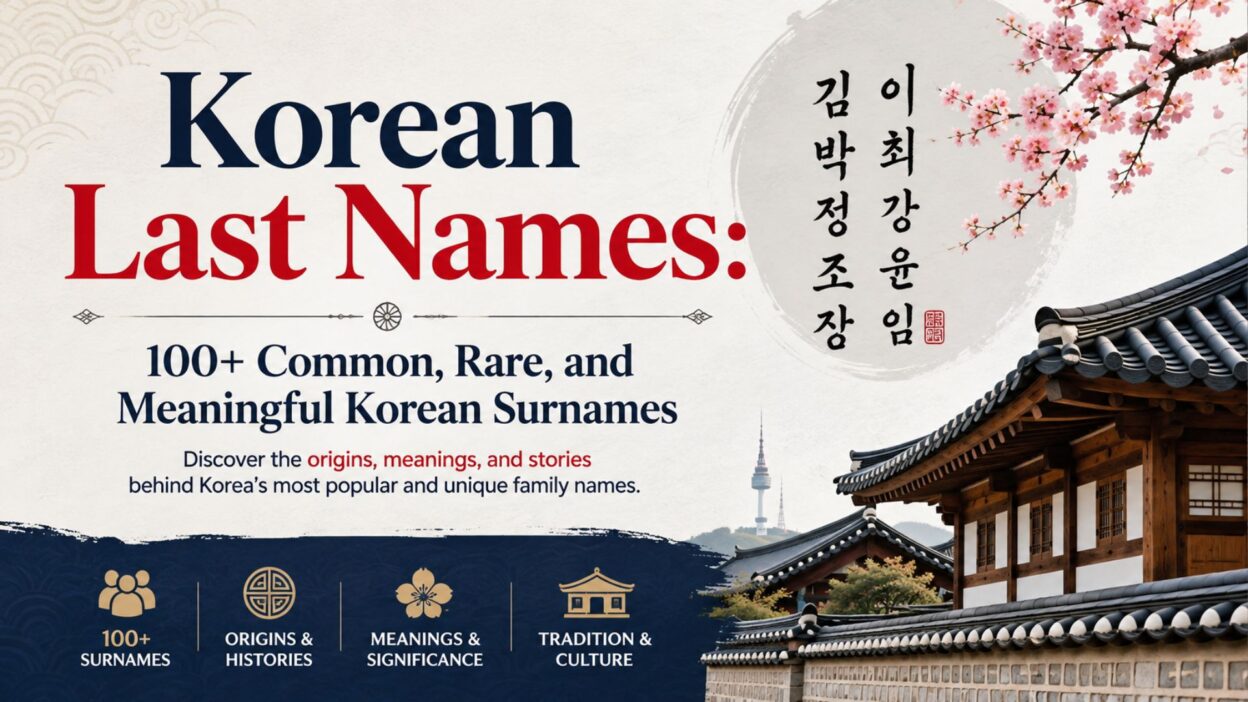
Korean last names carry a fascinating mix of history, language, family identity, and tradition. Unlike many Western surnames, Korean family names are usually short, often one syllable, and they come before the given name. Names such as Kim, Lee, Park, Choi, and Jung are especially familiar because a relatively small group of surnames is shared by a large portion of South Korea’s population.
However, there is much more to Korean surnames than the most recognizable choices. Many have different Hanja characters, alternative romanizations, historical associations, or distinctive meanings. Korea also has two-syllable surnames such as Namgung, Hwangbo, Jegal, Sagong, and Sunwoo, which stand out from the more typical one-syllable family names.
Whether you are researching Korean family names, creating a character, exploring Korean culture, or simply looking for a distinctive surname, this guide covers common, rare, traditional, and meaningful Korean last names.
The Most Common Korean Last Names
A small number of Korean surnames dominate the population. According to the 2015 South Korean census, Kim, Lee, and Park together accounted for 44.6% of the population, while the ten largest surname groups accounted for 65.8%.
Here are the ten most common Korean last names from that census:
- Kim (김) — Associated with 金, meaning “gold” or “metal.”
- Lee (이) — Commonly associated with 李, meaning “plum tree.”
- Park (박) — Associated with 朴, traditionally connected with a gourd and also the idea of being simple or unadorned.
- Jung (정) — A surname with several Hanja forms; 鄭 can refer to the ancient state of Zheng and carries associations such as proper or solemn.
- Choi (최) — From 崔, associated with being high, lofty, or towering.
- Cho (조) — Commonly associated with 趙, the name of an ancient Chinese state.
- Kang (강) — Can be associated with 姜, meaning ginger, while other Hanja forms can carry meanings such as peace or strength.
- Jang (장) — Often associated with 張, meaning to stretch or referring historically to drawing a bow.
- Yoon (윤) — Associated with 尹, connected with governing or administering.
- Lim (임) — Often associated with 林, meaning “forest” or “woods.”
These spellings can vary in English. For example, Lee may also appear as Yi or Rhee, while Jung can appear as Jeong or Chung. Romanization differences do not necessarily indicate different Korean surnames.
100+ Korean Last Names With Meanings
Korean surnames often derive their meaning from Hanja, the Chinese characters historically used to write Korean names. As a result, the same Korean sound can sometimes represent different family lines and meanings. The list below draws on surnames recorded in the 2015 South Korean census.
Common Korean Surnames
These are some of the Korean family names you are most likely to encounter. They work well for realistic Korean characters, cultural research, or anyone interested in the country’s best-known surnames.
- Kim (김) — Gold or metal.
- Lee (이) — Plum tree.
- Park (박) — Gourd; also associated with simplicity.
- Jung (정) — Proper, solemn, or connected with the ancient state of Zheng.
- Choi (최) — High, lofty, or towering.
- Cho (조) — Associated with the ancient state of Zhao.
- Kang (강) — Ginger; other forms can suggest peace or strength.
- Jang (장) — To stretch or draw a bow.
- Yoon (윤) — To govern or administer.
- Lim (임) — Forest or woods.
- Shin (신) — To state or report; other Hanja forms have different meanings.
- Yoo (유) — Willow tree in one common Hanja form.
- Han (한) — Associated with Korea and the ancient Han name.
- Oh (오) — Associated with the ancient state of Wu.
- Seo (서) — Often associated with gentleness, calmness, or slowness.
- Jeon (전) — Whole or complete; another Hanja form means field.
- Kwon (권) — Authority, power, or rights.
- Hwang (황) — Yellow; 黃 also has historical imperial associations.
- Ahn (안) — Peace, safety, or tranquility.
- Song (송) — Associated with the Song dynasty or pine tree, depending on Hanja.
- Hong (홍) — Vast, great water, or flood.
- Yang (양) — Bridge or beam; another form can refer to poplar or willow.
- Ko (고) — High, tall, or elevated.
- Moon (문) — Writing, literature, or culture.
- Son (손) — Grandchild or descendant.
- Bae (배) — Associated with a traditional flowing robe or skirt in one Hanja form.
- Baek (백) — White or pure.
- Heo (허) — To permit or allow.
- Noh (노) — Associated with several Hanja forms, including a traditional rice bowl or hut.
- Nam (남) — South.
- Shim (심) — Deep or to sink.
- Ha (하) — River.
- Joo (주) — Vermilion red; other forms relate to the Zhou dynasty or lordship.
- Koo (구) — Tool, preparation, or completeness.
- Kwak (곽) — Outer wall of a city.
- Sung (성) — To accomplish or complete.
- Woo (우) — Associated with Yu the Great in one traditional Hanja form.
- Cha (차) — Cart, vehicle, or chariot.
- Jin (진) — Has several Hanja forms with meanings connected to display, antiquity, or ancient states.
- Min (민) — Can relate to compassion or the common people.
- Ryu (류) — Willow tree in a common Hanja form.
- Na (나) — Net or silk gauze in common Hanja forms.
- Ji (지) — Pond or pool.
- Uhm (엄) — Strict, stern, or dignified.
- Byun (변) — Has several Hanja forms with meanings including law or change.
- Chae (채) — Associated with the ancient state of Cai and other Hanja meanings.
- Won (원) — Origin, source, or first.
- Bang (방) — Direction, square, or method.
- Cheon (천) — Thousand, heaven, or river, depending on Hanja.
- Kong (공) — Associated with Confucius in one form; other forms mean hole or public.
More Korean Surnames to Explore
The next group includes established Korean surnames that are less common than Kim or Lee but still have substantial representation in census records.
- Hyun (현) — Dark, profound, or mysterious.
- Yeo (여) — Associated with several Hanja forms, including the surname of Lü.
- Ham (함) — All or entirely; the Hanja can also relate to salty.
- Yeom (염) — Honest or incorruptible.
- Seok (석) — Stone or rock.
- Chu (추) — Autumn.
- Do (도) — Capital city, pottery, or “the Way,” depending on Hanja.
- So (소) — To revive; another Hanja form refers to the perilla plant.
- Seol (설) — Associated with wormwood or mugwort in one Hanja form.
- Sun (선) — To proclaim or announce.
- Ma (마) — Horse.
- Gil (길) — Lucky, auspicious, or fortunate.
- Yeon (연) — To extend or prolong.
- Wi (위) — Associated with the ancient state of Wei or with being towering.
- Pyo (표) — Surface, table, or expression.
- Myung (명) — Bright, brilliant, or clear.
- Ki (기) — Strange, extraordinary, or wonderful.
- Ban (반) — Associated with rice-washing water or the Pan clan.
- Ra (라) — Net or silk gauze; commonly associated with the North Korean form of Na.
- Wang (왕) — King.
- Keum (금) — Stringed musical instrument or gold, depending on Hanja.
- Ok (옥) — Jade.
- Yook (육) — Land or continent.
- In (인) — Seal, stamp, or printing.
- Maeng (맹) — Eldest or first-born; also associated with Mencius.
- Je (제) — All or various; another Hanja form suggests uniformity.
- Mo (모) — To seek or plan.
- Tak (탁) — Outstanding or eminent.
- Kook (국) — To nurture; another form refers to the chrysanthemum.
- Eo (어) — Fish.
- Kyung (경) — Celebration, congratulation, or scenery.
- Eun (은) — Silver in one Hanja form; other forms have historical meanings.
- Pyun (편) — A slice or fragment.
- Yong (용) — Dragon.
- Ye (예) — Small or sharp; another Hanja form refers to ritual.
- Bong (봉) — To offer respectfully or phoenix.
- Sa (사) — History or chronicling.
- Boo (부) — Man or husband; other Hanja forms can relate to wealth.
- Ga (가) — Merchant, trade, or price.
- Bok (복) — Divination or foretelling.
- Tae (태) — Great or supreme.
- Mok (목) — Harmonious or friendly.
- Hyung (형) — Associated with the ancient state of Xing.
- Kye (계) — Cassia or cinnamon laurel.
- Pi (피) — Skin, hide, or leather.
- Doo (두) — Pear tree; another Hanja form means to shut.
- Gam (감) — Sweet.
- Dong (동) — To direct or supervise; another Hanja form means east.
Rare Korean Last Names
If you want a surname that feels less familiar, Korea has many options beyond its famous family names. The 2015 census identified 191 surname spellings with at least five holders. Many names had far fewer bearers, including dozens with fewer than 1,000 people.
Rare surnames can be especially interesting for fictional characters because they create distinction without requiring an invented Korean-sounding name.
- On (온) — Warm or gentle.
- Si (시) — To bestow or carry out.
- Beom (범) — Model, pattern, or example.
- Seung (승) — To inherit or rise.
- Jwa (좌) — Left.
- Paeng (팽) — Associated with the Peng clan.
- Gan (간) — Simple, plain, or a letter.
- Sang (상) — To esteem, value, or maintain.
- Gal (갈) — Kudzu vine or arrowroot.
- Gyeon (견) — To distinguish; another form relates to pottery.
- Dan (단) — Section or segment.
- Soon (순) — Associated with grass or obedience.
- Dang (당) — Associated with the Tang dynasty.
- Chang (창) — Prosperous or flourishing.
- Ong (옹) — Harmonious.
- Hwa (화) — To transform or change.
- Bing (빙) — Ice.
- Jong (종) — Bell; another form means ancestor or clan.
- Dae (대) — Great or big.
- Pung (풍) — Associated with the Feng clan.
- Gung (궁) — Bow or palace.
- Yeop (엽) — Leaf.
- Ah (아) — Hill; another Hanja form can mean to flatter.
- Pyung (평) — Level, flat, or peaceful.
- Nae (내) — Thus or how.
- Pan (판) — To judge or decide.
- Mae (매) — Plum blossom.
- Gwok (궉) — A rare surname with a distinctive native Korean surname character.
- Nang (낭) — Wave.
- Pil (필) — To assist or finish.
- Muk (묵) — Ink.
- Geun (근) — Axe or a traditional unit of weight.
- Jeom (점) — To occupy or divine.
- Hae (해) — Sea or ocean.
- Tan (탄) — To pluck a string; another Hanja form relates to a projectile.
- Man (만) — Ten thousand or myriad.
- Un (운) — Cloud.
- Gok (곡) — Bend, curve, or valley.
- Ya (야) — Night.
- Ja (자) — Kind, loving, or compassionate.
- Hu (후) — Marquis or nobleman.
- Po (포) — To wrap or contain.
- Su (수) — Water; another form refers to the Sui dynasty.
- Sam (삼) — Forest or cedar.
- Hak (학) — Associated with a traditional place-name Hanja.
- Yo (요) — Associated with the Yao clan and can carry a graceful association.
- Chong (총) — Thicket or gathering.
- Gyo (교) — Bridge or tall tree.
- Ae (애) — Mugwort.
- Yeong (영) — Glory or honor; another Hanja form means shadow.
- Myo (묘) — Seedling or sprout.
- Gwan (관) — Mountain pass, gate, or management.
- Deung (등) — Associated with the ancient state of Deng or the idea of ascending.
Two-Syllable Korean Last Names
Most Korean surnames contain one syllable, so two-syllable family names immediately stand out. Census-based sources identify a small group of these surnames, including Namgung, Hwangbo, Jegal, Sagong, and Sunwoo.
These surnames can be particularly useful when you need a distinctive character name while still using a documented Korean family name.
- Namgung (남궁) — Literally associated with “south palace.”
- Hwangbo (황보) — Associated with an imperial protector.
- Jegal (제갈) — A two-syllable surname with the same written form associated with the historical Chinese surname Zhuge.
- Sagong (사공) — Connected with an ancient official title, traditionally translated as minister of works.
- Sunwoo (선우) — A two-syllable surname with historical Xianyu origins.
- Seomun (서문) — Associated with “west gate.”
- Dokgo (독고) — A distinctive two-syllable surname with the Hanja 獨孤.
- Dongbang (동방) — Eastern direction or “the east.”
- Eogeum (어금) — A very rare two-syllable surname written 魚金, literally combining “fish” and “gold.”
- Mangjeol (망절) — An exceptionally rare surname recorded in the census.
Korean Last Names With Nature-Inspired Meanings
Some Korean family names have Hanja meanings connected to trees, plants, water, animals, weather, or the landscape. These can be appealing when you want a surname with a natural image.
- Lee (이) — Plum tree.
- Yoo (유) — Willow tree.
- Ryu (류) — Willow tree.
- Lim (임) — Forest or woods.
- Ha (하) — River.
- Seok (석) — Stone or rock.
- Chu (추) — Autumn.
- Ma (마) — Horse.
- Ok (옥) — Jade.
- Eo (어) — Fish.
- Yong (용) — Dragon.
- Yeop (엽) — Leaf.
- Un (운) — Cloud.
- Hae (해) — Sea or ocean.
- Mae (매) — Plum blossom.
- Sam (삼) — Forest or cedar.
- Nang (낭) — Wave.
- Gok (곡) — Valley.
- Gung (궁) — Bow or palace.
- Kye (계) — Cassia or cinnamon laurel.
The meaning of a surname should always be considered alongside its Hanja. A Korean sound can have multiple written forms, so a simple English translation does not necessarily describe every family line with that surname.
Strong Korean Last Names
If you are naming a fictional character and want the surname to suggest authority, dignity, nature, or strength, several Korean family names have Hanja associations that create that impression.
- Kwon (권) — Authority, power, or rights.
- Choi (최) — High, lofty, or towering.
- Kang (강) — Can represent strength, depending on the Hanja.
- Jang (장) — Connected with drawing a bow.
- Yoon (윤) — To govern or administer.
- Hwang (황) — Yellow, with 黃 historically carrying imperial associations.
- Wang (왕) — King.
- Tak (탁) — Outstanding or eminent.
- Tae (태) — Great or supreme.
- Yong (용) — Dragon.
- Mu (무) — Martial or military.
- San (산) — Mountain.
- Gwan (관) — Mountain pass or gate.
These meanings can inspire a character concept, but they should not be treated as fixed personality traits. A surname’s literal Hanja meaning does not determine the personality or history of the person who carries it.
Korean Last Names With Elegant Meanings
Some surnames have softer associations that may suit literary characters, historical fiction, or names where you want a refined impression.
- Ahn (안) — Peace, safety, or tranquility.
- Seo (서) — Gentle or calm in one common interpretation.
- Moon (문) — Literature, writing, or culture.
- Baek (백) — White or pure.
- On (온) — Warm or gentle.
- Ja (자) — Kind, loving, or compassionate.
- Yeong (영) — Glory or honor.
- Myung (명) — Bright, brilliant, or clear.
- Ok (옥) — Jade.
- Mae (매) — Plum blossom.
- Gil (길) — Lucky or auspicious.
- Bong (봉) — Respectful offering or phoenix, depending on Hanja.
How Korean Last Names Work
Korean naming conventions differ from those used in many English-speaking countries. Traditionally, a Korean full name places the family name before the given name. For example, in “Kim Yu-na,” Kim is the surname and Yu-na is the given name. English-language contexts may reverse the order, which explains why both “Kim Yu-na” and “Yuna Kim” can appear.
Korean surnames are also closely connected to bon-gwan, or an ancestral seat. The bon-gwan identifies the geographic origin of a clan. Consequently, two people who share the surname Kim are not automatically members of the same family line. Different Kim clans have different ancestral seats and genealogical histories.
Another important point concerns marriage. Korean women traditionally keep their birth surname after marriage rather than automatically adopting their husband’s surname. Children have traditionally taken their father’s surname, although South Korean law allows parents to agree to use the mother’s surname in certain circumstances.
Why Are Korean Last Names So Similar?
The concentration of Korean surnames has deep historical roots. Surnames originally functioned largely as markers of royal and aristocratic status. Over time, surname use expanded, while many families adopted established and prestigious family names. The late nineteenth and early twentieth centuries brought major changes in social status and civil registration, further expanding surname use among ordinary households.
That history helps explain why Kim, Lee, and Park became so widespread. The pattern is unusual compared with countries where thousands of surnames are distributed more evenly across the population.
It is also why the surname alone does not tell you everything about Korean ancestry. Bon-gwan and genealogy provide additional family-line information, especially when a common surname is involved.
Korean Surname Spellings and Romanization
You may encounter several English spellings for the same Korean surname. Korean names were romanized in different ways over time, and older systems remain visible in family names used internationally.
For example:
- Lee may also appear as Yi or Rhee.
- Kim may appear as Gim.
- Park may appear as Bak or Pak.
- Choi may appear as Choe.
- Jung may appear as Jeong or Chung.
- Kang may appear as Gang.
- Jang may appear as Chang.
- Yoon may appear as Yun.
- Lim may appear as Im.
- Ryu and Yoo can reflect different romanizations and surname forms associated with 류/유.
Romanization alone can therefore make two family names look more different—or more similar—than they actually are. The Hangul and Hanja provide much better information when you need to distinguish specific Korean surname lineages.
Korean or Chinese Last Name?
Korean surnames often share Chinese characters with Chinese surnames because Hanja developed from Chinese characters. However, sharing a character does not mean that two families have the same ancestry.
For example, 李 can appear as Lee in Korean and Li in Chinese. Likewise, 金 is Kim in Korean but can have other pronunciations in Chinese contexts. The written character may be shared while the language, pronunciation, and family history differ.
When researching a surname for a character or genealogy project, therefore, do not rely only on an English spelling. Check the Korean Hangul and the relevant Hanja whenever possible.
How to Choose a Korean Last Name for a Character
A realistic Korean surname should fit the purpose of the character rather than simply sounding attractive. Start with the character’s background, setting, and naming style.
Consider these points:
- Choose a documented surname. If authenticity matters, select a surname that appears in Korean census or genealogical records rather than inventing a random Korean-sounding word.
- Check the Hangul. The Korean spelling helps confirm that you are using the intended surname.
- Consider romanization. Decide whether your character should use a modern English-friendly spelling such as Kim or Choi, or another established romanization.
- Look at Hanja carefully. A surname can have multiple Hanja forms, so the meaning may change.
- Think about realism. A common surname such as Kim immediately feels familiar, while a rare surname can make a character more distinctive.
- Use two-syllable surnames intentionally. Namgung, Hwangbo, Jegal, Sagong, and Sunwoo create a noticeably different rhythm from one-syllable surnames.
- Say the complete name aloud. The surname should flow naturally with the chosen given name.
- Avoid stereotypes. A surname’s literal meaning should not become the entire personality of a character.
For example, Kwon could work well for a character associated with authority, while Ahn can create a softer impression because of its association with peace. Still, the character’s actual personality should come from the story rather than from the surname alone.
Frequently Asked Questions
What is the most common Korean last name?
Kim (김) is the most common Korean surname. The 2015 South Korean census recorded about 10.69 million people with the Kim surname, representing approximately 21.5% of the population. Lee and Park followed it as the second- and third-most common surnames.
What are the top 5 Korean last names?
The five largest surname groups by Hangul spelling in the 2015 census were Kim, Lee, Park, Jung, and Choi. Jung’s position can vary in lists that count only one particular Hanja form rather than grouping all 정 lineages together.
Do Korean last names come first?
Yes. In traditional Korean name order, the surname comes before the given name. For example, in “Kim Yu-na,” Kim is the family name. However, Korean names may be written in Western order in English-language settings.
Do Korean women change their last names after marriage?
Generally, no. Korean women traditionally keep their birth surname after marriage. Children have traditionally used the father’s surname, although Korean law permits parents to agree to use the mother’s surname in applicable circumstances.
Why are Kim, Lee, and Park so common in Korea?
Korea historically had a relatively small pool of prestigious surnames. Surnames initially marked royal and aristocratic families, and their use expanded as social structures changed. During later surname registration, many households adopted established family names, helping surnames such as Kim, Lee, and Park become exceptionally widespread.
What does a Korean surname mean?
Its meaning generally comes from the Hanja associated with that particular surname. For instance, Kim can be associated with 金, meaning gold or metal, while Lee is commonly associated with 李, meaning plum tree. However, one Korean surname sound can correspond to multiple Hanja characters, so meanings can differ between family lines.
What are some rare Korean last names?
Examples include Gwok, Nang, Pil, Muk, Geun, Hae, Un, Ya, Ja, Sam, Yo, Gyo, Ae, Yeong, and San. Korea also has unusual two-syllable surnames such as Namgung, Hwangbo, Jegal, and Sagong.
Are all people with the same Korean surname related?
No. A surname by itself does not establish that two people belong to the same family line. Korean surnames are divided into clans identified through bon-gwan, or ancestral seats. Two people named Kim, for example, can belong to different Kim clans.
Conclusion
Korean last names offer far more variety and history than the familiar list of Kim, Lee, and Park might suggest. While a small group dominates the population, hundreds of surname forms and numerous clan traditions create a much richer naming landscape. Common choices such as Kim, Choi, Kang, and Jung work well when authenticity and familiarity matter, while names such as Namgung, Hwangbo, Jegal, and Sagong provide a more distinctive option.
If meaning matters, remember that Korean surname meanings usually come from Hanja rather than from the sound of the Korean name itself. For the most accurate choice, consider the Hangul, Hanja, romanization, and family history together. That approach will help you choose a Korean last name that feels natural, meaningful, and culturally informed.