Serbian last names look hard to decode at first, yet they follow a clear logic. Most describe a family line, and one ending, -ić, appears on a large share of them. Once you know that pattern, a surname like Petrović or Nikolić becomes a small piece of family history.
This guide covers the most common Serbian surnames in the country today, along with their meanings and the traditions behind them. You will also find surnames grouped by origin, names that break the -ić pattern, and a short pronunciation guide. Writers will find tips for building realistic full names for characters. Along the way, the article flags which facts are well documented and which are only estimates.
How Serbian Last Names Work
Serbian surnames began as patronymics, labels built from a father’s given name. Over time, families passed those labels down. Serbia standardized fixed surnames in 1851, and the 1854 census recorded the population under them for the first time. wikipedia
The ending -ić works as a diminutive that came to mean “descendant of.” So Petrović means the little son of Petar. Some estimates say about two thirds of Serbian surnames end in -ić, although that figure lacks a firm source. chisechise
Other endings exist too. The possessive suffixes -ov, -ev, and -in also appear, and they often combine with -ić to give forms like -ović. A few more patterns are worth knowing: chise
- Surnames don’t change by gender. Sons and daughters carry the same form, so a woman can be Jelena Jovanović. Some minority communities in Serbia follow their own language’s rules instead. serbiaincoming
- Official lists put the surname first. Sorted lists and legal documents often use the “Eastern” order, such as MILOVANOVIĆ Janko. Everyday use puts the given name first. chise
- Some surnames come from mothers. Petrić, for instance, points to a mother named Petra, often a widow. Names like Miljanić can come from either a male or female given name, so their source is sometimes unclear. chise
- Surnames decline by grammatical case. In Serbian sentences, the ending of a surname shifts depending on its role.
The Most Common Serbian Last Names
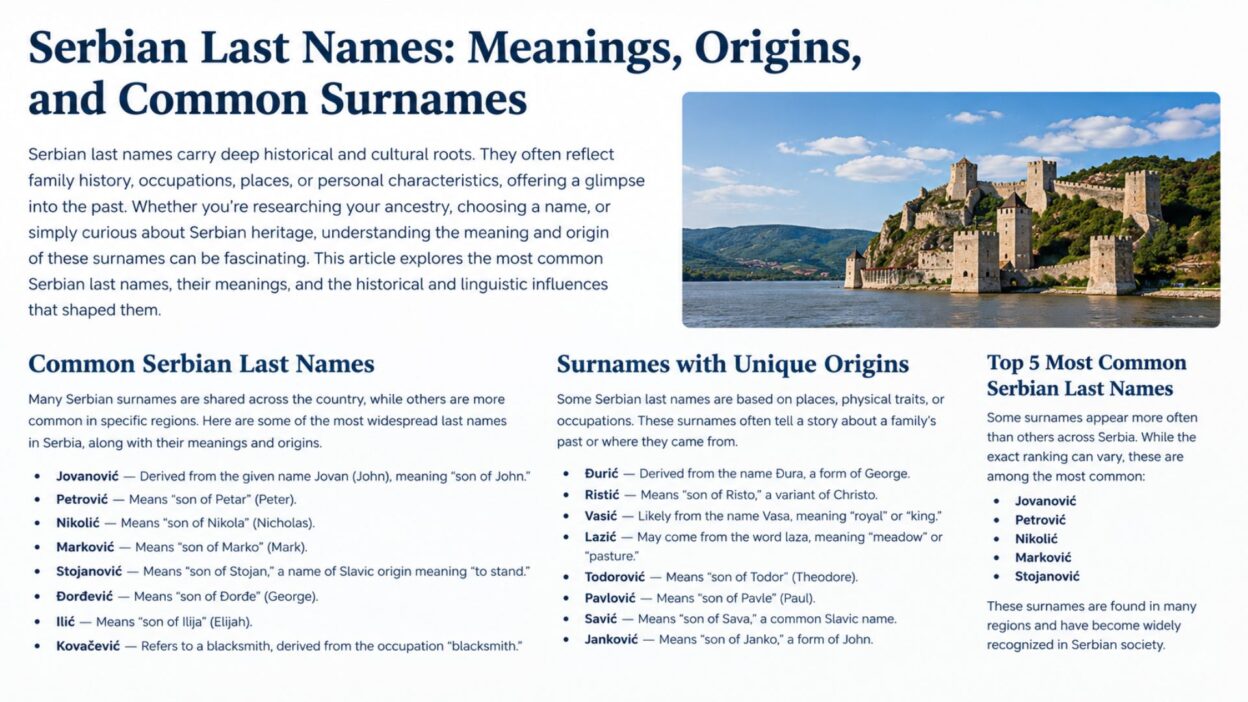
Serbia’s Statistical Office published its list of the ten most frequent surnames after the 2022 census. The list below follows that ranking, from most to least common. stat
- Jovanović — “Son of Jovan” (John). About 130,000 citizens carry it. stat
- Petrović — “Son of Petar” (Peter). Nearly 100,000 people share it. stat
- Nikolić — “Son of Nikola” (Nicholas). Around 90,000 people have it. stat
- Marković — “Son of Marko” (Mark).
- Đorđević — “Son of Đorđe” (George). It takes -ević rather than -ović, as many names ending in a soft consonant do.
- Stojanović — “Son of Stojan,” a Slavic given name.
- Ilić — “Son of Ilija” (Elijah), a short and tidy form.
- Stanković — “Son of Stanko,” a short form of names built on the same root.
- Pavlović — “Son of Pavle” (Paul).
- Popović — From pop, meaning “priest,” so it reads as “the priest’s son.”
Milošević held a spot in the top ten in the 2011 census. Meanwhile, the most common full-name combination is Dragan Jovanović, shared by over 2,200 people. wikipediastat
Serbian Surnames From Saints’ and Biblical Names
Christianity brought a wave of Greek, Hebrew, and Latin names into Serbian life. Parents often chose them for patron saints, and the surnames followed.
- Ivanović — From Ivan, another form of John.
- Stefanović — From Stefan, a Greek name often explained as “crown.”
- Mihajlović — From Mihajlo (Michael), meaning “who is like God.”
- Gavrilović — From Gavrilo (Gabriel).
- Dimitrijević — From Dimitrije (Demetrius).
- Todorović — From Todor (Theodore).
- Lukić — From the given name Luka, the Serbian form of Luke. britishsurnames
- Savić — From Sava, a name with Late Greek roots. Serbs also associate it with Saint Sava, the first archbishop of the Serbian church. geneanet
- Ristić — From Risto, a form of Hristo (Christ).
Surnames From Old Slavic Names
Before Christian names dominated, Serbs used Slavic names built from meaningful word parts. Many surnames preserve that older layer.
- Milošević — From Miloš, tied to milo, “dear” or “gracious.”
- Milovanović — From Milovan, built on the same milo root.
- Bogdanović — From Bogdan, “given by God.”
- Vukadinović — From Vukadin, a name built on vuk, “wolf.”
- Živković — From Živko, linked to živ, “alive.”
Protective Names Behind Serbian Surnames
Some parents chose odd-sounding names to protect a child. Serbian tradition calls these apotropaic names, and Vuk, Nenad, and Prodan are classic examples. Their surnames still circulate widely. wikipedia
- Vuković — From Vuk, “wolf,” a name meant to lend strength and ward off harm.
- Nenadović — From Nenad, “unexpected,” often given to a child who arrived unplanned.
- Prodanović — From Prodan, “sold.” Tradition says the name tricked evil forces into thinking the child was no longer the parents’ treasure.
Occupational, Animal, and Trait-Based Surnames
Not every surname starts with a father’s name. Some began as job titles, nicknames, or Ottoman-era loanwords.
- Kovačević — From kovač, “blacksmith,” so it means “the blacksmith’s son.” familyeducation
- Terzić — From terzija, a tailor, a word Serbian borrowed from Turkish.
- Kujundžić — From kujundžija, a goldsmith or silversmith, also of Turkish origin.
- Sokolović — From soko, “falcon,” likely a nickname for a quick or sharp-eyed ancestor.
- Zečević — From zec, “hare,” often traced to a nickname.
- Mladenović — From Mladen, built on mlad, “young.”
Place-Based and Historic Family Names
Some surnames point to a region, a clan, or a ruling house. Montenegrin and Herzegovinian naming, for example, includes surnames drawn from places like the Piva region and Bijelo Polje. myheritage
- Pivljanin — Someone from the Piva region.
- Bjelopoljac — Someone from Bijelo Polje.
- Vasojević — Linked to the Vasojevići clan lands.
- Nemanjić — The medieval dynasty descended from Stefan Nemanja.
- Lazarević — The house of Prince Lazar, remembered for the Battle of Kosovo in 1389.
- Obrenović — The 19th-century ruling dynasty, named for Obren.
- Karađorđević — The royal house tracing back to Karađorđe, “Black George,” leader of the First Serbian Uprising.
Serbian Last Names That Don’t End in -ić
Plenty of Serbian surnames skip the famous ending. They tend to look more distinctive.
- Tesla — Nikola Tesla’s surname is rare and doesn’t use the -ić ending. In Serbian, tesla also means “adze,” a woodworking tool. myheritage
- Pupin — Carried by the physicist Mihajlo Pupin. The -in ending is a possessive form.
- Strugar — An occupational surname, linked to woodworking. rodoslovlje
Serbian Surnames Known Around the World
Famous bearers keep these surnames in the spotlight.
- Đoković — Tennis champion Novak Đoković. His surname follows the traditional Serbian structure. myheritage
- Andrić — Ivo Andrić, the Nobel Prize-winning author.
- Milanković — Milutin Milanković, the scientist known for his work on climate cycles.
Many Serbs abroad adapt their spelling. Serbian immigrants to English-speaking countries usually write the ending as -ich. Likewise, an Americanized Petrović often appears as Petrovich. rodoslovlje
How to Pronounce and Spell Serbian Surnames
The ending -ić sounds close to “itch,” with a soft “tch.” The special letters cause most of the trouble, so this quick guide helps.
LetterApproximate soundČA hard “ch,” as in “church”ĆA softer, lighter “ch”ĐA soft “dj,” like the “j” in “jeans”Š“sh,” as in “shop”Ž“zh,” as in “measure”
Spelling varies outside Serbia, which also uses Cyrillic alongside Latin script. For example, Đorđević often becomes Djordjevic in English, with the diacritics dropped. Both versions refer to the same name.
How to Build a Realistic Serbian Surname
Writers, game designers, and genealogy hobbyists often need a believable surname. Because the system is so regular, you can build one in a few steps.
- Pick a given name for the imagined father or ancestor, such as Ratko.
- Add -ić, -ović, or -ević. Names ending in a vowel often drop it or take a linking sound, so Ratko becomes Ratković.
- Try consonant-ending names with -ović, as in Vojin becoming Vojinović. Names ending in a soft consonant often prefer -ević.
- Say the result aloud, then check it against real surnames. Branko → Branković, for example, already exists as a historic family name.
- Keep the same form for female characters.
The rules have exceptions, so treat them as a guide rather than a law.
Match the First Name to the Era
A believable full name also needs a first name that fits the character’s age. The census data helps here:
- Dragan topped the charts for boys born from 1951 to 1962, and Dejan led from 1971 to 1979. stat
- Nikola dominated from 1992 to 2007. stat
- Milica led for girls born from 1995 to 2011. stat
Full Name Ideas for Characters
These pairings combine period-appropriate first names with surnames not used earlier in this article.
- Luka Mitrović — Luka ranks among the most popular boys’ names in recent decades, and Mitrović comes from Mitar. stat
- Dunja Simić — A modern girl’s name paired with a short surname from Sima.
- Lazar Tomić — A strong, traditional pairing suited to a thoughtful lead.
- Milica Vasić — A classic girl’s name from the 1990s and 2000s with a surname from Vasa.
- Stefan Kostić — A familiar, easy-to-read name for a mainstream character.
- Jelena Radivojević — Jelena is the most common female name in Serbia overall, and Radivojević adds a longer, formal feel. stat
- Anđela Rakić — A compact, modern pairing.
- Aleksa Cvetković — A surname from Cvetko, tied to cvet, “flower.”
Frequently Asked Questions
What is the most common Serbian last name?
Jovanović. The Statistical Office reports about 130,000 citizens with that surname, followed by Petrović and Nikolić. stat
Why do so many Serbian last names end in -ić?
The ending started as a diminutive used to build patronymics, meaning “son of.” Over generations, those labels became fixed family names. The same pattern appears in neighboring countries, including Bosnia, where the suffix also signals a patronymic origin. myheritage
Do Serbian women change their last names?
The surname form stays the same for women, so no gender-based ending exists. After marriage, a woman most often takes her husband’s surname, though she can keep her own or use both. Wikipedia
Does an -ić surname prove someone is Serbian?
No. Croatians, Bosnians, and Montenegrins also use the ending. Petrović, for example, appears in both Serbia and Croatia. A surname gives a hint at best. rodoslovlje
Do people with the same Serbian surname share ancestors?
Usually not. Common surnames like Jovanović and Petrović arose independently in many families. Shared names therefore rarely prove a family link. rodoslovlje
How do you write Serbian surnames in English?
Most people drop the diacritics. Đ becomes Dj, and ć or č becomes c. Many diaspora families also write -ić as -ich. Either spelling is fine, but consistency matters on legal documents.
Are Serbian surnames written the same in Cyrillic and Latin?
They have two parallel spellings. Јовановић and Jovanović are the same name, and Serbia uses both scripts daily.
Conclusion
Serbian last names reward a closer look. Most began as simple “son of” labels, and their endings reveal how Serbian families named themselves for centuries. The common ones, from Jovanović to Popović, show the dominant pattern. Names built on saints, protective charms, trades, and clans add useful variety.
If you are researching a family name, remember that a shared surname rarely proves shared ancestry. If you are writing a character, pair a surname with a first name that fits the era, then say it aloud. That quick check usually tells you whether the name feels right.